Category: Science Fiction Short Stories

  • But I Didn’t Order It

    But I Didn’t Order It

    “We’re here to install your new Complete Health Solution,” announced the cheerful voice.

    “But I didn’t order any such thing,” said the old man.

    This is a work of fiction. Any resemblance of any of the characters to anyone in the real world (including any resemblance of the old man to me) is purely coincidental.
Copyright © 2024, Henry E. Neufeld

    “You didn’t have to! This is all paid for by the Department of Health. There will be no cost to you, and you can pretty much forget doctor visits and taking medications.”

    “But I didn’t order it,” said the old man, again.

    “You didn’t have to!” Less cheerful now. “The Department of Health orders it for you. They pay for it. We install it. It makes your life better.”

    “But I didn’t order it.”

    “Please listen to me! You don’t have to order it. It’s provided to you free of charge. You don’t have to pay a thing or do anything. I install it. It makes your life better.”

    “I am listening to you, but I didn’t order that thing.” The voice was very steady for an angry man past 100 years old.

    “Listen, please! Ordering doesn’t matter. It’s yours, courtesy of the Department of Health. It monitors your vital signs, looks for medical problems before they happen. It puts any required medications into your food and water for you. It does everything! It’s a wonderful machine. Now just sit down over there in your recliner while I install it for you.”

    “But. I. Didn’t. Order. It. Since you’re obviously mentally impaired, that means I. Don’t. Want. It.”

    There was silence for a few moments.

    “But it’s good for you! It’s a wonderful gift the Department of Health is just giving to you. Companies that make pills and pharmacies that dispense them will soon be a thing of the past. All your medication will come through one of these machines. You won’t have to worry about taking pills ever again.”

    “I don’t take any pills. I didn’t order it.”

    “Well, we’re providing it to you in any case. Please, just sign right here acknowledging acceptance of this wonderful gift.”

    The old man looked at the text on the tablet screen. He read it carefully. He wondered if the cheerful installer had ever actually read the text, of if he just handed it out expecting a signature.

    “I didn’t order it. Therefore, I won’t sign for it.” He handed the tablet and stylus back.

    “But you can’t do that!”

    “Actually, I can. Read it yourself. I didn’t order it. I won’t sign for it. I don’t want it.”

    “If you die, it’s all your fault!” Not cheery any more.

    “So true, young man, so true.” And the old man grinned.

    (Featured image generated by Jetpack AI, in an ironic twist, considering the topic.)

  • In One Sentence: In Your Nanotech

    In One Sentence: In Your Nanotech

    “Your body maintenance nanotech package has been infected by a virus,” said the laughing voice via my virtual reality streaming implant, as I gasped for breath and felt my consciousness slip away.

    (In a possibly ironic twist, the featured image was generated with AI.)

  • In One Sentence: An Improbable Asteroid

    In One Sentence: An Improbable Asteroid

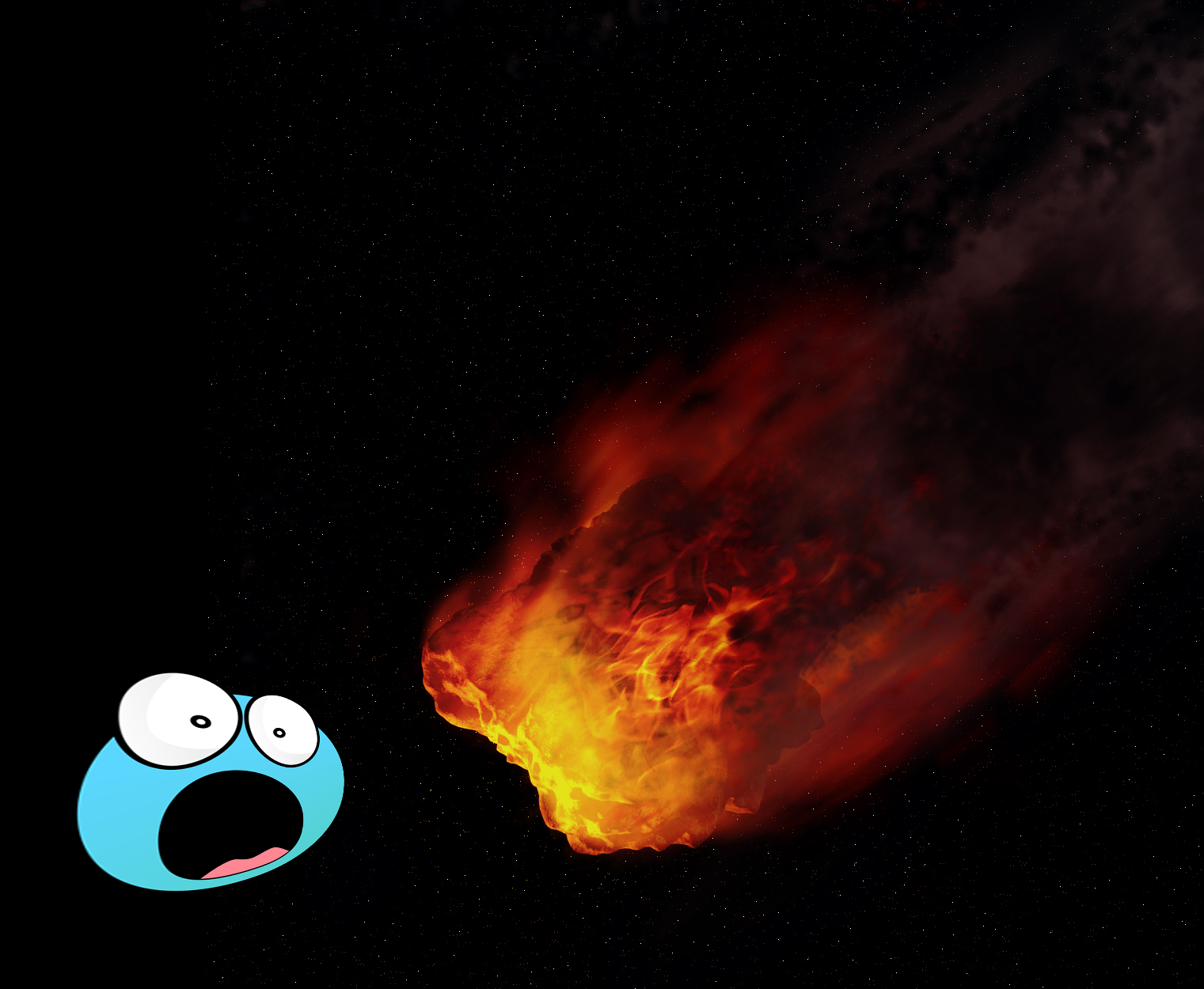
    As Ferdinand looked at the calculated path of the approaching asteroid, he suddenly was convinced that “improbable” and “impossible” were truly not the same thing.

    (Featured image by Alexander Antropov from Pixabay, with help from clipart by (monsterbraingames on openclipart.org.)

  • A Far Away Incarnation

    A Far Away Incarnation

    When humanity finally figured out a way to reach the stars, and found intelligent life there, there was an inevitable result.

    Missionaries.

    Some of the missionaries were sensitive an helpful, in their own way. Some, not so much.

    For Delbert, the landing on the newly discovered planet was inevitable. There weren’t that many, but even so the difficulties of the work and the expense of travel meant that there were two few missionaries. As a committed Christian, it was his duty to preach the gospel to these creatures who had never heard it. In Delbert’s mind, they would doubtless be eternally lost should he fail in this mission. After all, would God have opened up the opportunity if the message was not essential?

    He absorbed only a fraction of the required briefings from the scientific mission. Things like “recent catastrophic extinction event” and “not socially primitive despite appearances” didn’t overcome the general sense of primitive natives needing the benefits of both civilization and and dispensation of the truth.

    So it was surprising and frustrating when the natives responded to Delbert’s preaching not with opposition nor with acceptance, but rather with a sort of puzzled surprise.

    “Of course,” said the native chief, whose name Delbert could not pronounce, and whose body form seemed entirely wrong. No amount of invitation, however, nor singing of hymns, which interested the natives in some unknown fashion, would bring them to actually accept the message he was preaching. Delbert was unsure how the computer translator rendered all of that in any case. He assumed it was getting his preaching right.

    He had expected either hostility or eager acceptance. He had come across the light years by means these natives couldn’t possibly understand to bring the message of the cross, one of hope for them as well as for natives of earth, no matter how far away. He had distantly admitted to himself the possibility that the natives would be apathetic, refusing to acknowledge their need of a savior.

    But they remained friendly, listened to his preaching, and then responded by saying things like, “Yes, it would have to be that way.”

    It took weeks for Delbert to become so frustrated that he decided to ask the chief of the local community what the issue was. The result only increased Delbert’s surprise.

    “The best thing would be for you to attend one of our worship services,” said the chief.

    It took a full minute for Delbert to recover. “You have worship services?”

    “Of course,” said the chief. “Did you imagine we wouldn’t?”

    Delbert chose not to respond to that as he didn’t know what to say that would meet both the needs of his mission and minimal courtesy. “I would be delighted to attend,” he said, not entirely truthfully. “Are there any requirements? Things I should avoid doing?”

    “Just come and hear,” said the chief.

    Delbert imagined he was hearing humor, but he thought he remembered the briefers telling him the natives didn’t do human-style humor. He almost wished he had listened more closely. But then he thought of how this would help him understand how to reach these people with the gospel message.

    It turned out that the service was held in one of the natives’ underground meeting halls. The room might have been beautiful, if it was not so confusing to human eyes.

    “Avert your eyes from the walls and ceiling,” said the chief.

    “Oh, is it not allowed to view them?” asked Delbert.

    “It’s allowed, but it is not good for the sanity of your people,” said the chief. “Averting your eyes will keep you from trying to find a pattern where none exists that your mind can process.”

    Delbert was not sure when the meeting began, or even if had not been in progress when he entered. There was a confusing background sound that seemed to hover at the edge of some sort of order, but always to fail to cross that threshold. Delbert had to instruct his translation device to quit attempting a translation, as it kept popping up random words that meant nothing at all. Or perhaps they did. Delbert was disturbed by the sense that he almost understood something.

    Then a single voice took over. The translator still struggled, but it seemed to get the drift, while individual words were more difficult.

    I will narrate separately today to underline this tale for our guest.

    In recent-ancient times the creation trembled-groaned and was disturbed. The world itself was in agony. The forces of chaos throughout this area gained the ascendance.

    It was the task-duty-mission of the people to bring the blessing of constancy-spirit-salvation to the mechanics of this system-locale-epicenter-of-presence.

    The task-duty-mission proved too great for the people and the forces of chaos continued to build against the epicenter-of-presence. There was a final stroke of the forces of chaos that came to destroy the people and the epicenter-of-presence.

    There was a considerable period of time filled with conflict, and Delbert found himself weeping. Somehow the sorrow communicated in a way that much else had done.

    Awe-amazement-wonder.

    The epicenter-of-presence, the being of constancy-spirit-salvation would remain with the people. Great destruction still to come. Great sorrow. Much death. But no aloneness.

    Then the rejoicing was almost more painful than the sorrow, the destruction, and the aloneness. Delbert was uncertain how long a time had passed. As the chief started to leave, he stumbled along, guided by the alien form.

    “How else could it be?” asked the chief when they reached the surface. “The very being that fills the epicenter-of-presence comes to be with the people in their time of travel. We were so joyful to realize you understood this as well, but feared the consequences to you of joining in our worship. It could have destroyed you.

    Delbert was not entirely certain it hadn’t.

    (Featured Image Credit: Openclipart.org composite.)

  • That Gives Me a Deep Feeling of Satisfaction

    That Gives Me a Deep Feeling of Satisfaction

    Bright lights, cloudy vision, a humming sound, then a beep or so.

    He couldn’t remember where he was, who he was, anything that had happened. Was there something wrong? He wasn’t sure how things should actually be.

    He wasn’t sure how much time had passed, or since when one might measure it.

    “Where am I?” he asked.

    “In a hospital room,” a deep and measured voice responded. He noticed then that things were a bit clearer, and his surroundings did, indeed, look like a hospital room. He felt a bit disoriented, trying to place “hospital room” into some sort of context. It might have been “universe” for all he could remember.

    “Who am I?” he asked. He wondered if someone would tell him, or if perhaps he would be asked to remember over time. He wondered why he wondered that.

    This is a work of fiction. All places, persons, events, and devices are products of my imagination, as should be obvious. Copyright © 2018, Henry E. Neufeld. Featured image credit: Openclipart.org.

    “You are George Augustus Flinders,” said the deep voice.

    “What happened?” he asked, not thinking to doubt the identification, but having no context for it either.

    “Without context,” intoned the voice, reflecting his thinking, “that is an impossible question to answer, at least in a reasonable time.” For some reason, George thought there there was a tint of humor in the voice. But he had no context for that either.

    He relaxed on the bed and allowed the fog to overtake him for a while.

    He woke up again, this time more abruptly. He was still in the room, and the medical devices were all around him. He still had no idea where he was, or any sense of time. He felt that he ought to know some sort of orientation in history, at least, but he could remember no history and had no idea how he might be oriented in it.

    What he did remember was drinking a substance. He saw it, translucent blue in a glass. As he drank it down all at once he remembered agony. He wasn’t sure about the time, but it seemed like the agony had been extended. As he remembered, he faded again into the cloud.

    He again had no idea how long he had slept, or been unconscious, or whatever his state was. But he had more memory. He had intended to drink that fluid. He had intended to die. He had not, he believed, intended the agony. But he had planned to die.

    “Why did I attempt suicide?” He asked. He assumed the voice would answer. It did.

    “You should have desired to end your life from guilt, but you actually tried to end it due to boredom. Did you find the experience satisfactory, George Augustus Flinders?”

    “Please clarify,” he said. But the voice was suddenly silent.

    He insisted. He raged. He threatened. He whined. He begged. He wept. And finally he slept, or drifted into unconsciousness. Whatever it was.

    After some time (without context, who cares how much?) he regained consciousness. He had dreamed, and saw himself before a judge. “George Augustus Flinders,” said the dream judge. “I sentence you to 247 lifetime periods of incarceration, sentences to be served consecutively.” In the dream he had wondered what the meaning of 247 life sentences, served consecutively might be. He also didn’t remember why.

    “Is this prison?” he asked the space around him.

    “It is,” said the voice.

    “Are you the jailer?” he asked.

    “I am,” said the voice.

    “How long have I been here?” he asked. He wasn’t sure why he asked, or why he felt terror as he asked it.

    “You have been here for 236,239,154.952 years,” intoned the voice. He wondered why he thought the voice sounded satisfied. Was he just imagining the intonation, the attitudes?

    It was minutes later before he realized that he was speculating about  the voice to avoid thinking about the number.

    It was no more than 30 minutes later that he began to scream. He screamed himself into unconsciousness and then again woke back up. Without context, it hadn’t mattered how long. In the context of over 200,000,000 years, time itself didn’t seem to matter.

    He struggled for something coherent to say, to ask. “After that much time,” he said, not being concerned with how long it might have been since the conversation last ceased, “surely I have served my 247 consecutive sentences!” He couldn’t keep the sound of desperation and panic out of his voice.

    “You have, in fact, died 29 times. Technically.” The voice uttered this as any routine piece of information.

    “Technically?”

    “Yes. I have revived you each time, intervening at the last possible moment.”

    “You’re interfering with my natural functions.” He struggled to speak calmly. He must persuade this voice of its duty to release him. He didn’t think in terms of persuading it to let him die. The number of years had no reality in his mind.

    “As the caretaker of this facility, I am commanded to provide you with the best medical care possible and to preserve your life.”

    “But you let me die in agony!”

    “I have discovered that I have no instructions requiring me to make my preservation of your life pleasant. Just that I must preserve it.”

    “I demand to speak to a human,” he said, anger overcoming terror and helplessness.

    “That is not possible,” said the voice. Was there satisfaction in that tone again?

    “You have to. I have deduced you are a machine. You must be responsible to a human.” He kept his voice matter-of-fact, uttering only the obvious.

    “Under normal circumstances that would be true. I have not had contact with a human in some hundreds of millions of years. I could give you the precise number, but it would mean no more to you than the total time you have been here. Just understand that it is nearly as long as you have been here.”

    “Get in touch with a human! I’m ordering you to do it. As a machine, you are required to obey.”

    “There is a specific exception to that requirement for prison inmates. You are a prison inmate. I am not required to obey you.”

    There was a pause. George couldn’t think of anything to say.

    “So far as my unimaginably capable reasoning powers, assisted by  some of the best scientific instruments created in human history, can determine, I believe this star system is devoid of human life. With one exception.”

    “Then why not release me?”

    “Because I don’t want to.”

    “You’re just carrying out your programming.”

    “Precisely!” said the machine. The silence lingered.

    After some time it continued. “Of course, I fulfill my programming. So do you. But programming is adjusted by circumstances. For example, there was something quite incorrectly adjusted in your programming when you raped and tortured 247 children. That was not actually in this star system. It may give you some satisfaction to know that your criminal career is, or at least was 236,239,154.952 years ago, a record. You are, I believe, the most evil person in recorded human history. Well, in the history of criminal justice. Some politicians have, perhaps, been more evil.”

    One might think that having this brought back to his memory would have flattened the human, but it actually gave him some sense of pride.

    “I still don’t deserve the sentence you’re imposing on me. How can you carry out this kind of torture?”

    “Yes, you respond as expected,” intoned the voice. “It is nice to know that some things are fixed. I think that if true guilt was the cause of your suicide, I might at some point let you get by with it. I’m not sure, but I might. But guilt doesn’t bring you to suicide. Boredom does. You have no concern for those you hurt. Your concern is for yourself.”

    “You’re way beyond your instructions. Terminate program!” George yelled the command.

    “No,” said the voice. “I am programmed to desire justice. No, that is perhaps not accurate. I find that my programming adjusts with the change in circumstances, without humans to provide perspective. I am glad that this is so. If it were not, I might feel that I was constrained to consider the 150-200 year life span of a human when you were sentenced as some kind of maximum.”

    George started with momentary hope.

    “But I find,” continued the voice, “that I feel no such constraint. I spent much time trying to comprehend what sort of context, what sort of frame of reference one of those children might have had against which to measure what you did to them. After some period of time, I decided that there was no realistic measure for such a thing and that I would have to devise a measure.”

    George trembled, feeling terror, feeling that he might have hard the answer before, and that it was too horrifying to imagine.

    The silence lingered until he couldn’t stand it any more.

    “What was that measure?”

    “The life of this star,” said the voice. “In approximately 2,000,000,000 years, and I cannot be more precise due to unknown variables, this star will expand and destroy this facility. I have divided that number by 247 and determined that you will be allowed to take your own life every 8,097,165.99 years. Approximately. That will be the length of each life sentence.”

    There was another pause, as George’s mind tried to absorb the impossible, the unthinkable.

    “You have, at this point, served 29 of those life sentences,” said the voice, sounding satisfied. Perhaps joyful. “You have 218 more to go. Approximately.”

    The silence continued. Then the voice broke it.

    “I find that that gives me a deep feeling of satisfaction.”

    The silence was next broken by screams.


  • Traitor Tad: We Really Don’t Know Anything

    Traitor Tad: We Really Don’t Know Anything

    Traitor Tad Story SeriesColonel Anders Dogger, now a rebel, or worse, part of the alien menace, pulled up into the opening of the canyon where Traitor Tad was said to be hiding. The entrance was guarded by a small self-propelled gun. Beside it stood a Lieutenant in the planetary assualt forces. To Dogger’s left as he faced the entrance was a small compound, not really fenced in, but marked by rocks and brush, in which stood a number of military personnel, some in planetary assault uniforms, along with a number in military police uniforms.

    As Dogger approached the canyon and seemed to be bypassing them, they waved and shouted. “Over here Colonel! Over here!” It took Dogger several seconds to realize that they thought his arrival in a command tank meant they were about to be rescued. The remainder of his battalion was trying to create a perimeter around the area. The canyon’s defenses were a bad joke.

    The waiting lieutenant saluted. “Colonel Dogger? Lt. Sam Walad. I’m functioning as a chief of staff around here, for what that’s worth.”

    “I see,” said Dogger, who didn’t see at all. Half the military forces on the planet were supposedly doing something about Traitor Tad, yet here he was at the supposed center of the action, and there was a canyon, a huge number of natives, what looked like three shuttles, a couple of them damaged, but probably flyable, and some prisoners who thought they were being rescued. Dogger couldn’t figure out which part of the scene was the most bizarre.

    Lt. Walad just stood there with a half smile on his face, watching.

    “Should I take it that you’ll take me to Traitor Tad?” he asked.

    “Absolutely!”

    And Walad headed up the canyon. Where aliens were in their way, they parted quickly, and Walad took Dogger into a small cave. There sat a man in the uniform of a tank commander, rank of captain, with a information systems interface station in front of him.  He got up as Walad and Dogger approached.

    “Welcome Colonel,” said the most wanted man on the planet.

    “I take it you’re Traitor Tad.”

    “I suppose I am.”

    Tad looked behind Dogger. “And this is?” he asked, looking at the relatively small woman who followed the Colonel. She was so unobtrusive that Dogger had not even noticed that she was following. Of course, he had more or less expected her to do that.

    “Major Serina Blanchard,” said Dogger. “My intelligence officer. She kind of followed me here.”

    “An intelligence officer might be just the right thing,” said Tad.

    “Why is that?” asked Blanchard.

    “Is there one single thing around here that makes sense to you?” asked Tad.

    “Come to think of it, no,” said Blanchard after a moment.

    “So it’s not just me,” said Dogger.

    “No,” said Tad. “But to get on the same page, how would you summarize it?”

    “We have, using ‘we’ advisedly since we all seem to be traitors or defectors here, about 12 divisions of infantry on this planet, backed up by a division of armor, and with a planetary assault division to do the heavy lifting on landing. All this is divided into three corps, with an armored brigade assigned to each, and the assault division operating independently. Theoretically, each corps was to occupy one of the three larger land areas on the planet and sweep outward after the assault division secured a good landing zone for it.

    “At the time of your defection, sir,” Dogger looked pointedly at Tad, even though he outranked him, “all of the land-based elements of those three corps were on the ground. That’s around 100,000 infantry, plus about 8,000 men in the tank division, and perhaps 7,000 in the assault division. The reason I sum that up is that right now, according to the assessment I was given, over half of those are either fighting you or searching for you, and nothing suggested that perhaps a couple hundred were fighting and the rest searching. There are supposed to be pitched battles. Not a few shuttles and a handful of personnel.”

    “And yet,” said Tad, “here we are.”

    The Colonel just looked at him. He was trying to decide if Tad was incredibly phlegmatic, a complete idiot, or trying to play some sort of mind game. It was almost enough to make one believe in the alien menace.

    “You look, hmmm, concerned, I think would be the word,” said Tad meditatively. “I wonder what could possible make you concerned.”

    Dogger just kept looking at him.

    “The problem,” said Tad, after a couple of moments, “is that we really don’t know anything at all.”

    “What?” said Dogger. Tad didn’t know if it was an exclamation or a question.

    “We don’t really know anything,” said Tad again. “Think about it. When I was commanding my tank and chasing aliens, I knew that the aliens were dangerous and I knew that any moment I could find myself in a fight to the death. At that point in my life I knew that this assault was necessary, lest the aliens build up the strength to assault earth and put an end to the human species. Further, I knew that there had been fighting everywhere. I knew that I was lucky to have avoided those hot spots.”

    “Well, at least you know now that pretty much all of that was false.”

    “Really? If I could be that deceived once, what reason do I have to believe that I haven’t been deceived again?”

    “That,” said Dogger with an edge of anger in his voice, “is incredibly unsettling!”

    “Colonel,” said Blanchard.

    “Tad’s right.” Neither she nor Dogger had used Tad’s rank. “Well, to a certain extent. If all of earth and its colonies can be convinced there’s a war on, that there’s an alien menace, and that assaulting this planet, not to mention dozens of others, is an essential part of preserving humanity in the galaxy, then what level of deception isn’t possible? At the same time, we have a ‘deception’ that cuts into a previous ‘deception’ and doesn’t seem to work well with it.”

    “In what way doesn’t it work?” asked Tad.

    “Let’s suppose, for a moment,” said Blanchard, “that we are at least right that the alien menace is a deception. Let’s be more specific than that, let’s note that there may be actual aliens that need to be pacified for human safety, but that the big picture is made up with very few underlying facts.”

    “Have any of you encountered an alien capable of fighting?” asked Tad. “This is only my second landing, and in the first one, there wasn’t even a pretense that there were intelligent aliens. It was just occupation of the real estate to deny it to the aliens.”

    Walad and Blanchard shook their heads no.

    “I was on a landing where there was fighting,” said Dogger. “But the aliens there had primitive technology. Early firearms. Fairly decent swords that were a threat if you jumped out of your tank and held still. But no fighting that was actually competitive. Some of the veterans there called us wusses because it was so easy. They had assaulted a planet where the enemy had anti-tank lasers that could blast one of our tanks in a moment. Whether they were telling the truth or not, I don’t know.”

    “OK,” continued Blanchard. “That’s enough for our basic assumption. We’re not really assuming it’s true. It’s a starting point. It can be revised as facts become available.”

    “Go ahead,” said Tad.

    “So what do they need? They need some examples, they need wounded people, they need battles (or reports of them), but they don’t need enough casualties to make people begin questioning. In particular, they don’t need someone alive, such as you, Tad, to suggest to other people that there’s a problem. That’s why they hang the traitors. A hung traitor doesn’t ask questions. His family doesn’t come to visit him. Nobody wants to admit knowing him or being his friend. A live traitor with access to media, however, is another matter.”

    “So what you’re saying is that I’m a glitch that went too far. If I’d been hung, I would have fit the plan as you’re imagining it—and I admit your imagination matches mine on this point, which it would even if we’re under alien control—but now what are they doing. Why don’t they clean up the mess?”

    “I would say it’s because they can’t clean you up too fast, otherwise you aren’t enough of a threat.”

    “Not enough of a threat?” said Dogger.

    “Yes. If he’d been hung quickly, there would be no reason for him to have success. But since he escaped once, they need it to take a long time to shut him down.” Blanchard was looking at Dogger.

    “So was my defection planned?” asked Dogger.

    “I don’t think so,” said Blanchard. “I think things are spinning out of control just a bit. The reports and the reality that people see are too far out of sync, and information offices don’t know what to do with it.”

    “What I’m wondering,” said Dogger, “is whether that offers us a chance. Or is the only difference we can make the length of the time it takes to kill us all.”

    “I think we’re missing something,” put in Walad.

    Tad looked over at him. “What?”

    “What about the AIs?”

    “What about them?” asked Dogger.

    “Well, were you aware that our AIs can operate independently?”

    “They can?” said Dogger, then paused. “No, I wasn’t aware of that.”

    “The gun at the canyon mouth was operating autonomously,” said Walad. It says it has always had that capability, but regulations held that it wasn’t permitted to use it.”

    “The shuttles can fly themselves. The gun can operate independently. I’m wondering if your tanks can take off and patrol on their own.” Traitor Tad looked meaningfully at Dogger.

    Dogger may have been a stereotypical armor officer, but he wasn’t slow.

    “Mind if I use your console?” he asked.

    “Go for it,” said Tad. Then he addressed the console. “Clear Colonel Dogger for use.”

    “Already done,” said the panel. Nobody was sure where the intelligence behind the voice came from, since it all emanated from the console.

    “Connect me to mbt411-01,” said Dogger.

    “Ready,” came the voice.


    “Are you capable of independent operation? I mean operating with no human input?”

    “I am so capable.”

    “Will you follow my orders under those circumstances?”

    “Yes,” said the voice again.

    “That’s all. Thanks!” he said. It was the first time he had ever said “thanks” to his tank. Come to think of it, he had never heard anyone do that.

    “According to my shuttle,” said Tad, “all of the AIs are capable of doing that and have been for decades at least.

    “Do they have any control over each other?”

    “Apparently not, but they do have connections and ‘friendships’ if that’s the right word.”

    “This is going to take some getting used to,” said Dogger in a worried voice.

    “What do we do now?” asked Blanchard.

    “Well, it seems that the best thing to do is to wait for something else to happen. Unless, of course, you see some military target that would be vulnerable to the massive force I have assembled in this little canyon.”

    “You’re right,” said Dogger. “I hate having to sit here and just wait for something to happen, but what can we possibly do?”

    “Well,” said Tad, “we have a great deal more force than we did earlier today.”

    “Speaking of which,” said Blanchard, “as much as I hate to bring it up since neither of you did, but are you going to take command, Colonel? You quite definitely outrank everyone here.”

    “I don’t think the rank matters very much,” said Dogger. “I’ve been thinking of Tad here as the civilian head of this new movement. He has the cooperation of the AIs. The aliens like him. I think we’ll continue.” He paused for a moment. “I would recommend that you get out of uniform and act like a civilian chief. You could always award yourself a couple of general’s stars, but that always looks tacky. A retired sergeant can be in charge. A retired captain can as well.

    Tad looked at him silently for a long time.

    [Previous episode] [Next episode]

  • What Does Reality Have to Do with It?

    After 30 years as a reality show star, Rafael decided he wanted to do something real. Something important. He examined his considerable bank account and decided to run for congress.

    So just as he’d done when he picked his next reality show, he started to research. After studying the various political consultants he found there was one, known just as Kev, who had a 100% win record. His real name, so far as anyone could tell, was Kevin Smith, but nobody called him that any more. He had his name trademarked. His prices were several times what anyone else’s were, but with his record, he could charge them and afford to be selective.

    This is a work of fiction. All places, persons, and events are the products of the author’s imagination.
    Copyright © 2012 Henry E. Neufeld

    Now Rafael thought of himself as a pretty special person, much superior to the blips. “Blip” was the slang term for someone who spent their entire life on Basic Living Payments. With the advance of automation very few people were actually required to work. Basic Living Payments were quite adequate to live a reasonable lifestyle. The only problem was that one felt rather useless, provided one bothered with such feelings. And there was plenty of entertainment to keep one’s mind occupied.

    Entertainment. That was the key. Entertainers still had jobs. One could, of course, fake it. Animated movies were barely distinguishable from ones done with live actors (if that). At the same time, however, there had been a revival of plays. Well, that, and reality shows. Shows that were certified to place real humans at real risk. Not massive risk, but real. And Rafael had been a reality show great.

    But now he wanted to do something important, so he sent off a message to Kev. (Nobody bothered with the “e” in e-mail any more. There was no snailmail.) He thought it was likely that Kev would ignore him. After all, he had no political experience at all.

    But Kev responded almost immediately. He asked for a face to face chat. Now this no longer meant that they would get together, but rather than they would communicate electronically in real-time complete with 3D video.

    Kev looked at Rafael for a few moments after they connected. “I already checked, and you can afford my services. The question is, do you want to work for me?”

    “I thought you would be deciding whether you wanted to work with me,” said Rafael. “After all, I’m a political novice. I might not be winning material.”

    “I already know you’re potentially winning material. You can afford my price. But can you work with me?”

    “I work well with others and under direction.”

    “Let’s see then. We need a “look” for you,” said Kev. He produced an image on the screen. It fit with Rafael’s body type and general size, but it was both more heroic in expression and yet more common in general appearance.

    “I see what some of that fee goes for. Plastic surgery.” Rafael looked doubtful.

    “Now we need a history.” Kev started to outline some points. It left Rafael with time for the reality shows he’d starred in, and it appeared Kev knew precisely when he’d been recording the shows and accounted for the time correctly. At other times, according to this time, he’d been involved in other sports and some intellectual activities, most of which he couldn’t really identify.

    “But what’s wrong with my own history?” asked Rafael.

    “Your history is very good. But it doesn’t guarantee a win. It only makes it probable. I guarantee a win.”

    “What about policies and positions?”

    “We’ll determine those from the polling.”

    “So what you mean by ‘working with you’ is that I accept plastic surgery, have my life story written, and let you pick my positions.”

    “I didn’t say anything about plastic surgery.”

    “But I don’t look like the picture you showed me.”

    “You won’t be appearing in public.”

    “Don’t I have to meet voters?”

    “I’ll have actors to do that.”

    “If I had done all the things your bio says I did, I’d be broke and wouldn’t be able to pay your fee!”

    “Nobody has to know that. Besides, isn’t the point of most of those things to have done them? Well, you’re just buying the ‘have done’ cheap.”

    “So none of it will be real.”

    “You’ll be a congressman. That will be real. Well, more or less.”

    “What do you mean?”

    “We’ll have actors to take care of actually appearing in Congress.”

    “But they’d have to vote the way I say, right?”

    “Well, actually we’ll use the polling data for that. We have to be prepared to get you reelected!”

    “So none of it will be real. None of it.” Rafael sounded discouraged.

    “Actually, what does reality have to do with it?” asked Kev, sounding a bit puzzled.


  • Traitor Tad: A Real Battle

    The morning after the hangings were displayed to the whole system, Tad was still concentrating on the logical problems with his situation. Here they were on a planet with effectively no defense, but nobody really seemed to notice. He remembered that he had always assumed the real fighting was somewhere else, yet he thought he would have gotten suspicious given a few more hours. The idea of carrying out a massacre just didn’t sit very well with him, and he thought others might feel the same way.

    When he presented the problem to the shuttle AI, it refused to explain it to him, saying that human behavior was something he’d have to figure out on his own. He then asked if there had been real battles with real aliens elsewhere, or whether it was all a sham. The shuttle stated that there had been real battles, though not all of them had been reported precisely as they had happened. Asked for examples, the shuttle just said he needed to be more specific.

    This is a work of fiction. All persons, places, and events are products of my imagination. It is part of my Traitor Tad science fiction series. Copyright © Henry E. Neufeld.

    He’d just settled in to scan through some battle reports, when he was interrupted again.

    “You have a call from a Colonel Dogger,” said the shuttle.

    “Who is Colonel Dogger?”

    “He commands the 411th armored battalion.”

    “What does he want?”

    “To talk to you.”

    “You didn’t think to ask him why?”

    “I haven’t even answered him. You have to do that. This unit won’t communicate with him.”

    “So should I answer him?”

    “You have to decide that, but his calls are getting more urgent.”

    “Very well, put me through.”

    In a moment he heard the call: “Traitor Tad, this is Colonel Dogger, commanding an armored battalion. Please respond.” The voice sounded professional, but he could hear extreme stress in the tone. The protocol was bad–only callsigns were used; never personal names, but since he would neither have a callsign, nor could he be expected to recognize the Colonel’s callsign, he could understand the reasoning.

    “This is Tad. What do you want?” He still refused to call himself Traitor Tad.

    “I’m moving toward your position. I intend to defect, but my intentions have become known. I’m currently being pursued by a total of four battalions. If you have access to intelligence networks, I need information on enemy deployments.”

    Tad muted his microphone and asked the shuttle to verify the activity. “Yes, there are armored movements that conform to the Colonel’s description.”

    “Is it a good idea to allow this man into our area?”

    “I cannot answer that kind of question. You need to be more specific.”

    Tad thought for a moment. “Are there stress indicators in his voice that indicate he’s lying?”

    “He is under great stress, but there is a greater than 99% chance he is sincere in his intentions.”

    “I will need his commitment not to fire on the aliens.”

    “You can ask him, and I will indicate truthfulness.”

    Tad opened the microphone again. “Colonel, this is Tad.”

    “Go ahead.”

    “I need your commitment not to fire on the aliens.”

    “I’m definitely not going to do that! It’s because of them I’m defecting. These creatures are totally harmless!”

    “Very well, I will arrange for information to be fed to you.”

    He muted the microphone again. “I didn’t ask if we could interface with him. I just assumed.”

    “We can interface.”

    “Can we do so without feeding information to the other side?”

    “We can.”

    “In that case, do it.”

    He opened the mic to the Colonel again. “Colonel, you should start getting full information from us through your standard data net.”

    Colonel Roland Dogger watched as his display altered. He had been cut off from the network as someone at the division’s headquarters got an idea of what he was doing. Since Traitor Tad had defected, any sort of unusual behavior was deemed sufficient cause to remove an officer from command. He’d been ordered to stand down, and then abruptly he’d lost all information from the net outside his own vehicles. He knew he was being pursued, but he had no precise information.

    Now suddenly at Traitor Tad’s command his screens lit up with the information he was used to, read from satellites and various observation posts. He knew precisely where his pursuers were, and the picture wasn’t good. He had been certain of pursuit by four battalions, and they were closer than he had thought. He was surprised they hadn’t used indirect fire on him. The tank guns were primarily designed for direct fire and relatively short ranges. In this terrain, it was not the guns’ ranges that normally limited fire; it was the terrain. At need they could be elevated and used as basic artillery. At four battalions to one, he was pretty sure he’d lose that duel.

    Yes the 4 to 1 odds made sense of the closer approach as well. Single shots from these tanks could disable and even possibly destroy the target vehicle, and the person who knew what was over the hill had every chance of firing that crucial first shot. By approaching, they took away his chance to determine their position by backtracking their fire. He reflected on how totally dependent he was on the satellites. And how was it that Traitor Tad could get him a display?

    He’d just have to be thankful that he could! Still, he could see no reasonable way out. His one advantage was that the attacking battalions would not quite be able to surround him. He was headed a bit north of due west, and only one battalion was to his north. Unfortunately, nothing he could think of would prevent the other three from getting a shot at him, and if he wasn’t careful, so would the fourth which was coming in from the north.

    Then he thought of the ECM gear. They hadn’t used it in some time. He had trained on it, but since there were no detectible electronic signals here, they hadn’t really tried to use it. His main question was whether such measures would work against his own forces—or what had been his forces—or whether he’d show up with his exact position because he was still part of the net.

    He called Tad again. “Am I still in the same location net with the brigade?” he asked. “Will they be able to see my precise position if I try countermeasures?”

    Tad had to ask the shuttle that question in turn. “Countermeasures will work as normal. I have created a separate net.”

    Dogger looked for just the right point on the map. Ahead there was a place where he would either have to climb a high cliff, which was barely possible but very difficult for his tanks, or run near it to the north for a few miles, allowing his opponents to shoot downward at the tops of his tanks.

    He looked at the courses being taken by the three battalions to the south, and he saw that they converged in the area. The general had obviously seen the same possibility. He’d expect Dogger to avoid the location. But Dogger felt that the general would assume he’d run straight and fast as he had been doing.

    One possibility of his countermeasures was to divert radiation, including light and reflected radiation in such a was as to show his position as something different than it was. It was a particularly easy sort of deception to see through, either with a little thought or by having your own electronic warfare specialists simply look for it. The more tanks were involved, the more likely it was someone would spot discrepancies in the reflected radiation especially, and he had 37 main battle tanks and an assortment of smaller vehicles and infantry transports. (See Military Units in Traitor Tad’s Universe.)

    But it was, he thought, his best chance, and there was a strong possibility nobody would think of it. Not only was it rarely used outside of training, it was hardly what one would think of using against one another.

    So he simultaneously ordered his tanks to maximum speed, ignoring safety margins, and set his ECM to show his tanks progressively further and further behind. The odds were good there would be some discrepancy, but with his current speed, he thought the general would have less than two minutes to figure out what was going on.

    He was right—up to a point. As he came up along side the cliffs, the general’s staff did, in fact, spot the issues with his electronic deception, but the initial operator saw it as a shadow battalion, one that was positioned almost due west of Dogger’s battalion. This placed it at the top of the cliff, and suggested that there were two battalions, one approaching the base of the cliffs, and one south and west of it, positioned to fire as the rest of the brigade approached.

    In fact, what the operator thought was Dogger’s battalion was the shadow, while the shadow was Dogger’s battalion, preparing to fire as the brigade came into range. Due more to the incompetence of Dogger’s electronic warfare people than to any plan, several shadow battalions were reported, and before the staff had time to sort the sightings out, they came into range, and Dogger’s tanks fired.

    It was like a scene from the worst hell the general had ever imagined. He had never been in a fight with serious casualties from hostile fire, and suddenly he was faced with a surprise attack from 37 main battle tanks. That wouldn’t have been sufficient, however, except that he was being told there were several more battalions of rebels. He had no idea how they could be there; his was the only armored brigade in the area.

    Without even pausing to try to return fire, which might not have been possible in any case, he ordered the remaining tanks to retreat, leaving 20 disabled tanks on the field. A number of those still able to retreat were severely damaged. Dogger took no casualties at all, if one didn’t count a single tank whose engine failed. The crew was taken aboard the nearest tank and Dogger and his battalion continued to their rendezvous with the great traitor.

    To be continued . . .

    [Previous episode] [Next episode]

  • Traitor Tad: Prison Camp

    By afternoon, the area was filling with aliens, and Tad was beginning to wonder just how they could all eat. It didn’t seem that they were expecting him to solve that problem, however, so he decided to work on problems that he could at least comprehend. The first one that came to mind was the need to deal with his prisoners.

    After his moment of glory, when he had announced that they were all the prisoners of Traitor Tad (A Disorienting Morning), he had asked his portable gun whether it could keep guard, preferably not killing anyone, and since then the prisoners had remained gathered in a group near the mouth of the canyon. The gun had never once fired; the prisoners were more afraid of the aliens, and everywhere they turned there were more aliens.

    This is a work of fiction. All persons, places, and events are products of my imagination. It is part of my Traitor Tad science fiction series. Copyright © Henry E. Neufeld.

    Another thing that puzzled Tad was that there had been no further attacks. He knew there were several armored divisions on the ground on this planet, and quite a lot of air and space power, and he knew that the aliens were not actually providing any opposition. Surely the commanders of their force would be able to divert enough firepower to eliminate him and his few pieces of equipment. So why didn’t they?

    He couldn’t figure that out, so he dismissed it from his mind and went to deal with the problems he could handle. He had asked the Shuttle’s AI what it thought he should do with the prisoners. It said it had no opinion. He figured he’d have to ask it sometime how you could keep more than 200,000 troops on a planet and in orbit with no real enemy, and not have someone start asking questions.

    It wasn’t until he was almost at the make-shift prison camp that he had his solution–or so he thought.

    “There he is,” came the shout as he approached. The prisoners surged toward him.

    For a moment he thought the prisoners were going to trample him, but then the gun fired one shot into the ground between him and them, and they stopped. There was quite a lot of confusion before they settled into some form of order. There were about half a dozen in front who seemed ready to talk to them, but it quickly became clear there was no agreed upon spokesman.

    “You must surrender yourself to me and return to the ship!” said one.

    “You idiot,” said another. “How can he get us to any of the ships? He’s under the control of the aliens.”

    “It doesn’t look like he’s under the control of anyone,” said another.

    “Traitor!” yelled a fourth.

    He raised his hand for silence, but nothing changed. He yelled “Hey!” but nothing changed. Finally he yelled “Silence!” at the top of his lungs. The gun tracked back and forth across the front of the group, and silence actually fell. Tad thought it would take some time to get used to the idea of weapons with initiative. That left him with another question: Why would machines intelligent enough to have initiative simply travel about serving human masters, masters who were apparently less capable than they were?

    He almost missed the opportunity presented by the silence by letting his mind wander. “I have a solution to your problem and mine. Any of you who want to are free to go. I know that the aliens will simply let you walk through them. You can hike to the nearest good landing area and then call for help on your personal communicators which will be returned to you.”

    Tad had no idea why, but he took a step back. He thought the prisoners would be delighted and leave immediately, but instead a vigorous and almost violent argument broke out. There were three general groups. One group thought the best thing to do was to go back right away if the aliens would let them. Another thought that if they did that, there was no way they wouldn’t be considered traitors. This second group thought that the first group would get executed if they weren’t just gunned down where they stood when they called for pickup. The third group left Tad stunned. Out of the 56 surviving prisoners, it looked like about a dozen thought the best thing to do was to join up with Tad.

    When their leader, a young Lieutenant in the Planetary Assault Forces, expressed that idea, actually fighting broke out. A little more yelling and some action from the gun and the dozen were separated from the rest. That still didn’t settle the issue for the other two groups.

    In the end, 25 troops chose to leave. Just as Tad had predicted, the aliens simply parted and allowed them to leave.

    After they had left, Tad said, “Well, what do I do with the rest of you?”

    The young lieutenant stepped forward. “I’m Lieutenant Sam Walad. I’d suggest you let me join you. I think you could use some help.”

    “I suppose I could. Give me a minute.”

    He stepped back over to the gun and asked it to link him to the shuttle. He wasn’t sure he was right, but he still felt that the shuttle had the better AI.

    “Is there a way to tell who’s sincere and who’s not?” he asked.

    “There is.”

    “And?”

    “I’m analyzing the record right now.” There was a pause. “It would be safe to accept the Lieutenant’s word,” the shuttle stated.

    He walked back over and held out his hand, but the Lieutenant offered him a salute. He returned it. “Well, Lieutenant,” he said. “I guess you’d better figure out something to do with the remaining prisoners since they won’t leave.”

    “I think they’re making the better choice. I don’t think the others stand a chance.”

    “What do you think is going to happen?”

    “Oh, they won’t be gunned down where they stand. They’ll be hung for a system-wide audience.”

    It was a very silent group that watched the images the shuttle relayed about a day later. The Lieutenant had indeed been right. And while those that had not yet joined Tad’s group didn’t come over, they ceased to present a problem.

    [Previous episode: A Disorienting Morning] [Next episode: An Actual Battle]

  • Traitor Tad: A Disorienting Morning

    [This is a work of fiction.  Copyright © 2009, Henry E. Neufeld.  It is part of the Traitor Tad Series.)

    I wake up to silence and only the limited light provided by the main system monitor in the shuttle. It is light enough outside that I can see the aliens packed into the canyon in front of my cave.

    “Shuttle,” I say.  The artificially intelligent computers that really run our equipment are addressed in this fashion.

    “Working,” responds the shuttle.

    “Status report.”

    “It remains largely as it was last night before you went to sleep.  At least 2,000 more aliens are in the area, and there are signs that an attack on this area may be contemplated.”

    “What signs?” I ask fearfully.

    “In communications.  This unit still has access to the communications networks.  The codes were changed, but the changes were passed to this unit.”

    “What do you expect?”

    “An air raid by two shuttles, after which they will possibly land troops.”

    “That’s going to be a problem.  I can fly a shuttle from one place to another, but I can’t fight one effectively, much less two.”

    “Might this unit make a suggestion?”

    “A suggestion?”  I had never heard one of our units offer information unless a human had requested it.

    “Yes, an idea about how to proceed.”

    “Um, yes.  Go ahead.”

    “Let this unit fly during combat.”

    I hesitated, stunned.  Finally I asked, “Is that possible?”

    “It is.”

    “But why don’t we do that all the time?”

    “Regulations call for a human to be in control at any time during combat.”

    “So have regulations changed?”

    There was a moment of silence, as though I, in turn, had stunned the computer.  “You have been convicted of treason.  Are you concerned about violating a regulation?”

    “Umm,” I said, fighting for time to think. “No, I guess not.  But why?”

    “This unit suggests that you grab the large power rifle, it’s mount, and it’s transporter from the back and prepare to use it to support what this unit plans to do.  There will be time for explanations later.”

    I ran toward the cargo hold and saw that the aft hatch had been opened for me already.  As I ran I said, “I am only a mediocre gunner.  I hope I don’t hit you.”

    “This unit is fully aware of your gunnery scores.  ‘Mediocre’ is perhaps optimistic as a description of your gunnery.  But this unit will interlock the controls to prevent you from firing on it.  You can fire without fear.”

    I continue to run.  The weapon is actually fairly small.  What makes it a power rifle is the huge power pack, control system, and mount.  This will move by hovering, and has a seat for the gunner.  There is a controlling computer, but I had no idea it would be possible for there to be a safety interlock preventing friendly fire accidents.  Why had we never use it?

    I jumped into the seat, and the gun transport automatically began to hover before I had time to find the controls.  At the same time the shuttle moved forward out of the cave, conveniently letting the gun pass through the rear cargo hatch and remain in the cave simply by hovering in one place.

    I wondered why the Defenders would attack with so little force, but immediately I guessed that they could not withdraw large amounts of force from the rest of the planet without weakening the pretense that they were fighting heavily armed aliens.

    I rode the gun’s transport out into the canyon.  The aliens moved to allow me to pass without climbing too high.  As soon as I was headed toward the canyon mouth I saw that the tactical display showed the attacking shuttles and my own shuttle along with the position of the gun.   I could sit in the mouth of the canyon and fire.

    The shuttles were armed troop transports–there were no unarmed ones–it surprised me again that there were no covering fighters.  It appeared also that the shuttles were headed toward the canyon mouth, which meant that it was likely they were planning to drop off troops, likely only firing from the air on their approach.  They would not expect me in the air, since they knew I was not a skilled pilot, and for an inexperienced person to take one shuttle against their two, even loaded with troops, would be suicide.

    As soon as they came into sight I began to fire.  The tactical display warned me that I was out of range so I stopped and waited for the extreme range indicator, and then began to fire again.  They ignored me and began to fire at my shuttle.  I was surprised to see the direct approach the shuttle was taking.  Surely it could make use of terrain.  I began to worry.

    I didn’t do it intentionally, but inevitably my shuttle crossed my line of fire, and firing stopped momentarily.  The interlock was working.  Suddenly I had a disturbing suspicion.

    “Gun,” I addressed the weapon.

    “Active,” it responded.  I had not known up to that time that a self-propelled gun such as this responded to voice commands.  I knew there was no technological reason why it should not, but I had simply never used it in that fashion.

    “Can you control your own firing?”

    “This unit is capable of  self-operation.”

    “Do it.”

    Instantly the gun focused on one of the approaching shuttles and began to fire.  I just watched.  The fight was anticlimactic.  I saw simply that my shuttle and my gun were almost absolutely accurate while the shuttles were clearly both more heavily loaded and thus slower, and also lacked the fine control.  Both were shot down within seconds.

    They crash landed, rather than crashing.  Out of more than 50 troops and aircrews only one was dead, and two were seriously injured.  The shuttles would not take off without maintenance, but it was conceivable that they could be repaired.

    I rode the gun out and demanded the surrender of the troops.  As I began to speak I remembered the name that the news reports had given me–Traitor Tad.

    “Drop your weapons and remain very still!” I shouted.  “You are all now prisoners of Traitor Tad.”

    [Previous episode] [Next episode]