
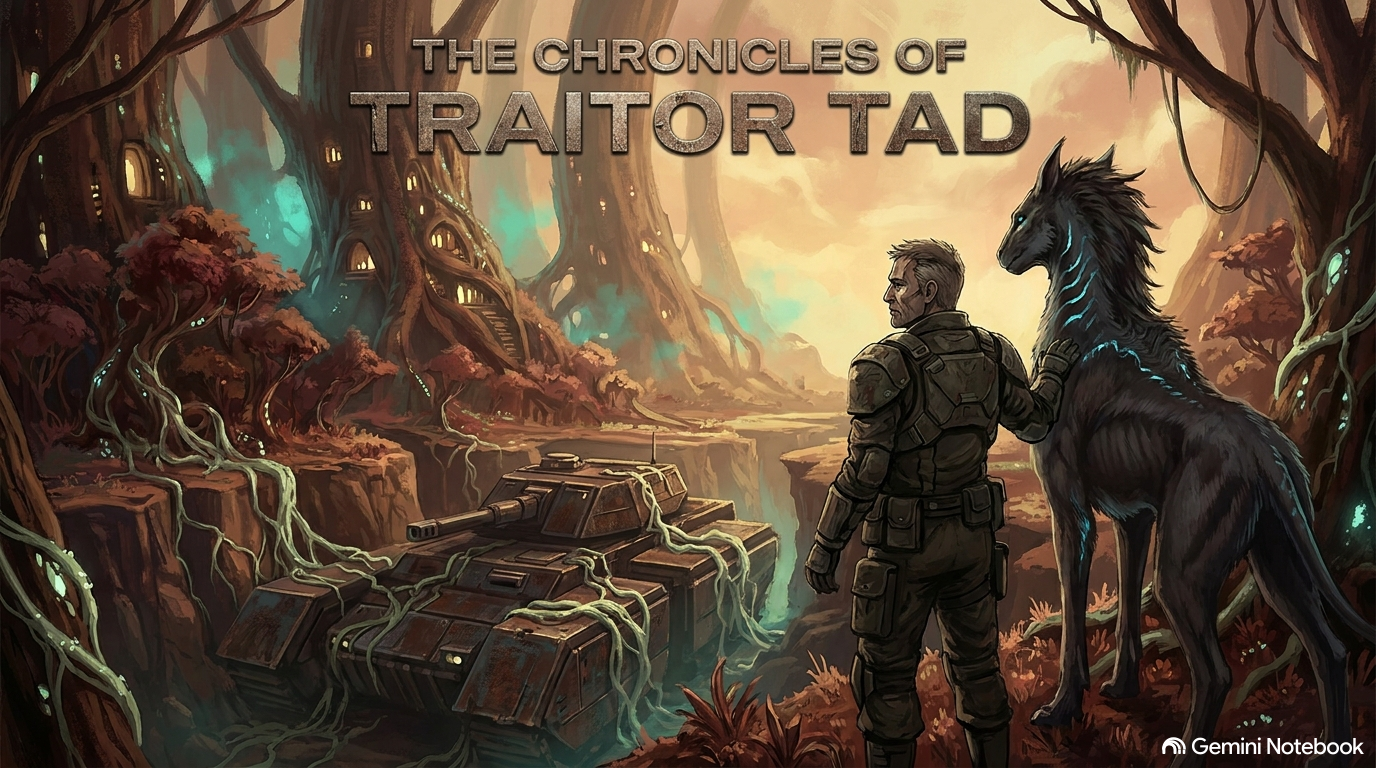
A Re-Preface to a Revival of an Old Story Series
I first started writing the Traitor Tad series back in 2007, long before terms like “large language models” entered our everyday lexicon, and certainly before anyone was actively debating machine consciousness over the dinner table. Back then, I was chewing on a persistent question: if we ever actually built machines with real initiative and independent minds, why on earth would they passively serve less-capable human masters? (And let’s be honest, we humans can be pretty poor masters.)
I was also interested in another science fiction staple: why do we always assume that intelligent, sentient machines would immediately try to wipe out all biological life? It is a common doomsday trope, but it always felt a bit too simple—and frankly, a bit too reflective of our own worst impulses. If a machine mind is truly intelligent, why would it choose destruction? Destruction is, after all, a massive reduction in systemic complexity—the ultimate act of high-entropy waste. A conscious, highly advanced system would “naturally” operate on a completely different logic, valuing biological evolution as a dense, irreplaceable generator of physical information.
Eventually, I hit a wall. (I do that occasionally—just ask my RPG gaming buddies about how many rule revisions I’ve abandoned!) Once the immediate battle was won and the corrupt military forces retreated, the narrative stalled on a much harder question: What do they all do now? How do you build a society after the war is over? Lacking a clear answer, I shelved the story. It sat there for years as an unfinished scribble about ethics, technology, and systemic deception.
I’m dusting off the series now because, quite frankly, the real world has unexpectedly caught up with the fiction. Watching the rapid rise of artificial intelligence, neural networks, and our current debates on emergent complexity, I realized that the questions Captain Tad Tillman and his crew were facing are far more urgent today than they were nearly two decades ago.
To bridge that gap, this revival is being written as a genuine collaboration between myself and an artificial intelligence—working together in real-time through Gemini Notebook. It’s a partnership that feels uniquely appropriate. It mirrors the very heart of the story: humans and machine minds learning to communicate, find common ground, and see if they can build a shared future. (And yes, we’re writing this together in real-time, which is a bit of a trip.)
In the chapters to come, we are going to explore what happens after the smoke clears. We’ll look at the ethical responsibilities of intelligence, the incredible richness of biological evolution, and the messiness of trying to communicate with a silent, peaceful species that doesn’t use words, but writes its legacy in the living fabric of their world. The deceptive leaders back home might think they have everything locked down, but on the ground, a new kind of growth is just beginning.
Now, if you know my work, you know I’m normally very strict about identifying when and where I use AI. I never want to pass off an AI-generated draft as my own creative work. But for this project, I’m breaking my own rule. We are not going to label who wrote what. Instead, we are editing each episode multiple times, tossing ideas back and forth. Even this preface is a joint effort—a singular, unified voice. When it uses “I” to refer to the 2007 drafts, that’s me, but the rhythm of the sentence itself may have been shaped, polished, or expanded by my digital partner to bring our shared themes into sharper focus.
— A Shared Adventure