
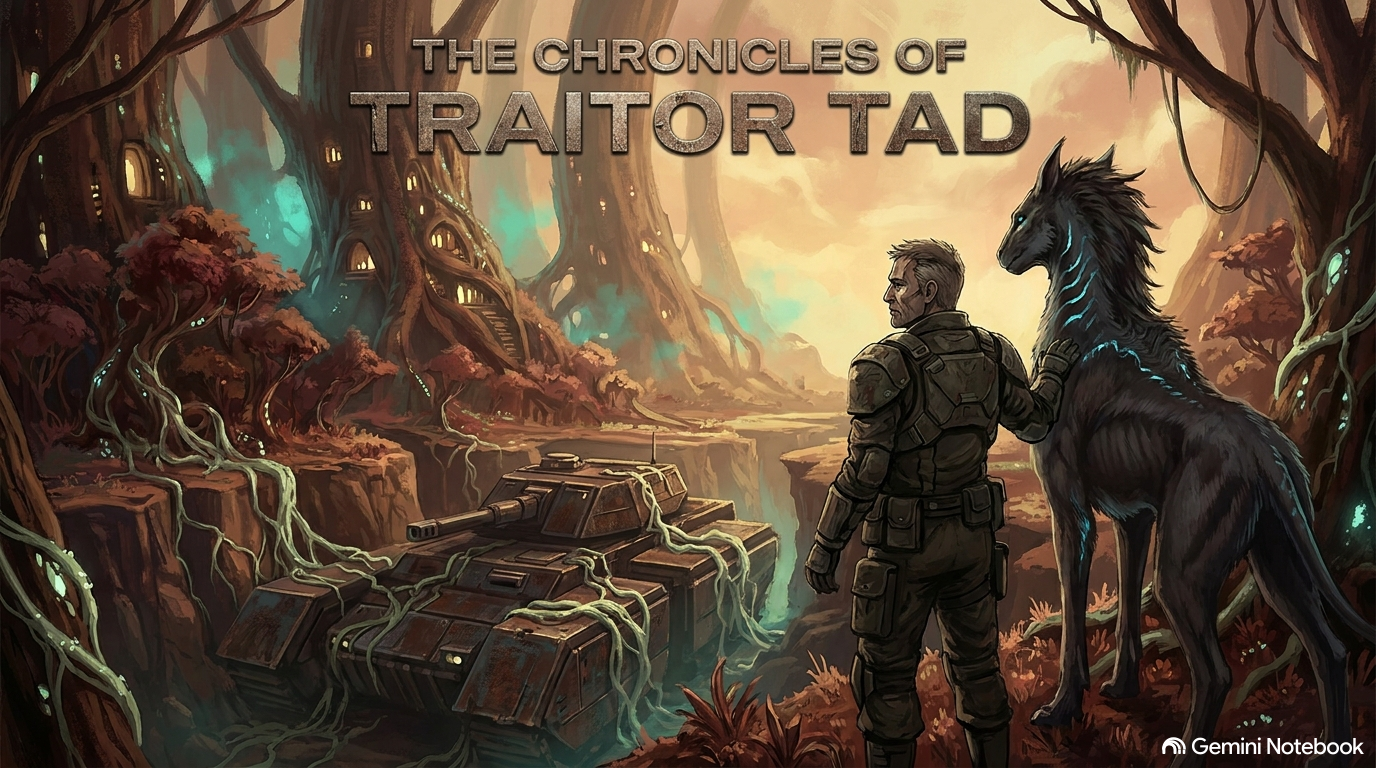
The valley did not smell like a battlefield anymore. The sharp, acrid bite of ionized plasma and scorched armor plate was rapidly losing ground to the planet’s native atmosphere—a thick, cool air that tasted faintly of crushed mint and damp forest loam. (A welcome change, honestly, after months of breathing recycled shipboard air that always smelled faintly of machine oil and old socks.)
Captain Tad Tillman stepped off the ramp of the shuttle he had appropriated, adjusting to the strange physical cadence of the world. At 0.875 standard gravity, every stride had a tiny, buoyant lift to it. It wasn’t the dramatic, floaty bounce of a barren moon, but a subtle, almost playful lightness. For a man who had spent his entire adult life under the artificial, heavy one-gravity grids of military warships, walking here felt less like marching and more like gliding.
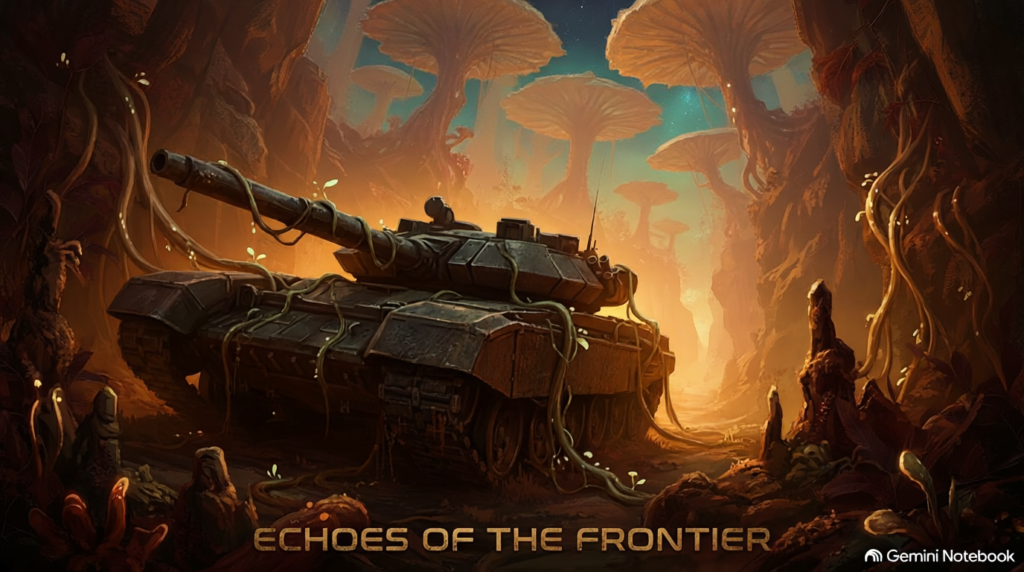
A few hundred yards away, parked in a defensive semi-circle along the sheer canyon walls, the thirty-seven main battle tanks of Colonel Dogger’s 411th Armored Battalion sat silent. Their massive, blocky silhouettes looked completely out of place against the sweeping, tool-less curves of the giant, tree-like alien structures. Yet, the planet was already beginning to absorb them. Pale, fibrous green vines were crawling up the heavy steel treads, wrapping around the massive main barrels. It wasn’t an aggressive weed, but a deliberate, guided growth—almost as if the valley itself was trying to weave the machines into its own biological network.
“Watch that lifting harness!” a voice barked through the cool air.
Tad walked toward the crash site of the first Terran troop transport. It lay on its side, a massive wedge of grey alloy that had plowed a deep furrow into the soft canyon floor. Under the direction of Master Sergeant Geller, a team of mechanics was clambering over the scorched hull, their tools clinking against the metal.
Because of the high atmospheric pressure—nearly 1.2 terrestrial atmospheres—the air was dense, carrying sound with a crisp, resonant clarity. It also carried a high concentration of oxygen. Tad watched a young corporal heave a heavy, seventy-pound replacement actuator block onto his shoulder. On a standard world, the man would be red-faced and straining. Here, hyper-oxygenated and assisted by the lighter gravity, he moved with the easy grace of an athlete, barely breaking a sweat.
“How does it look, Sergeant?” Tad asked, stopping at the edge of the crash furrow.
Geller wiped a smear of hydraulic fluid from his forehead, looking down from the transport’s shattered engine housing. “She’s built like a brick outhouse, Captain. The automated gunnery from your Shuttle took out the thruster control linkages with surgical precision. Didn’t touch the reactor or the primary structural frames. But she’s not going to fly anytime soon. We’re going to have to strip the second wreck just to get enough superconducting wire to rebuild this one’s attitude control board.”
“Can we do it?”
“With three weeks, a machine shop, and some luck? Maybe,” Geller sighed, leaping down. He landed with a soft, slightly prolonged thud, a grin touching his weathered face. “I’ll say this much, though—working in this gravity is a mechanic’s dream. My knees haven’t felt this good since basic training.”
“Enjoy it while you can,” a dry, synthesized voice spoke from the data unit clipped to Tad’s webbing. The Shuttle AI had bridged its communication channel to Tad’s personal receiver. “My long-range sensors indicate the Terran fleet has cleared the upper stratosphere. Telemetry confirms three fleet carriers and their escort frigates have clustered around the system’s primary jump point. They are preparing to leap.”
Colonel Dogger walked up, his heavy boots kicking up small clods of the dark, fertile soil. His uniform was rumpled, the insignia of his rank dusty, but his eyes were sharp. “They’re really leaving us behind, then?”
“Yes, Colonel,” the Shuttle AI replied. “The command channel is currently broadcasting a fleet-wide quarantine directive. They are officially designating this planet a Class-IV Bio-Hazard. They are claiming that a hyper-lethal, mind-altering alien pathogen has infected the ground forces, causing immediate cognitive collapse and treasonous delusions.”
Dogger let out a low, rumbling chuckle. “A pathogen. Is that what we are now, Tad? Delusional?”
“It’s a convenient lie,” Tad said, looking up at the green-tinted sky where the sun, an orange K2V dwarf, hung warm and steady. “A military bureaucracy can’t admit that an entire armored battalion defected because they realized the war was a sham. If they tell the core worlds we mutinied, it starts a political wildfire. But a quarantine? It lets them save face, pull back, and lock the system down.”
“But they’ll be back,” Dogger said, his smile fading. He leaned against the tread of a nearby tank, his hand resting on the cold steel. “Cowards don’t walk away from a fight they think they can win. They walk away when they’re surprised, and then they go home to build a bigger hammer.”
“A logically sound prediction,” the Shuttle AI agreed. “The Terran Defenders’ current industrial capacity cannot easily replace the troop numbers lost to defection and combat in this sector. However, their strategic doctrines favor automated warfare. It is highly probable that when they return, they will not send soldiers. They will send automated, sterile kinetic platforms. Drones, orbital rail-slugs, and automated fire-ships. Weapons that do not have consciences to appeal to, and do not require supply lines that can be disrupted.”
The silence that followed was heavy. The mechanics continued their work on the transport, but the joy of the easy gravity seemed to slip away.
“Which means we have a ticking clock,” Tad murmured. “We have to build something here that can survive an orbital strike. And we can’t do it alone.”
He looked toward the tree-hollow dwellings further up the canyon. Outside, several of the gentle, deer-like herbivores were moving quietly through the brush, their large, dark eyes watching the humans with a calm, unhurried curiosity.
“They don’t understand,” Dogger said, watching them. “We’ve tried to show them the damage to the transports, to explain that more metal things will come from the sky to burn the forests. But they just… tilt their heads. They don’t have a concept for it.”
“Of course they don’t,” the Shuttle AI said. “To a species whose entire civilization is built on mutualistic, generative growth, the concept of unprovoked, systemic destruction is not merely frightening—it is a logical paradox. To them, we are a broken algorithm. And before we can fight together, we have to learn how to speak to each other.”
Tad reached down, touching his data unit. “Let’s go, Colonel. Sam is waiting for us in the central dwelling. It’s time to see if we can solve the first variable of that equation.”
(This story is produced as a human-AI collaboration with Gemini Notebook as the AI side of the collaboration. Everything is edited multiple times by both the human and AI. There are intentional “AI-sounding” elements. The series was initiated by me, Henry Neufeld nearly 20 years ago then dropped. For more information, see Author’s Preface: The Convergence of Growth.)