Tag: Traitor Tad

  • The Calculus of Survival

    The Calculus of Survival

    The valley did not smell like a battlefield anymore. The sharp, acrid bite of ionized plasma and scorched armor plate was rapidly losing ground to the planet’s native atmosphere—a thick, cool air that tasted faintly of crushed mint and damp forest loam. (A welcome change, honestly, after months of breathing recycled shipboard air that always smelled faintly of machine oil and old socks.)
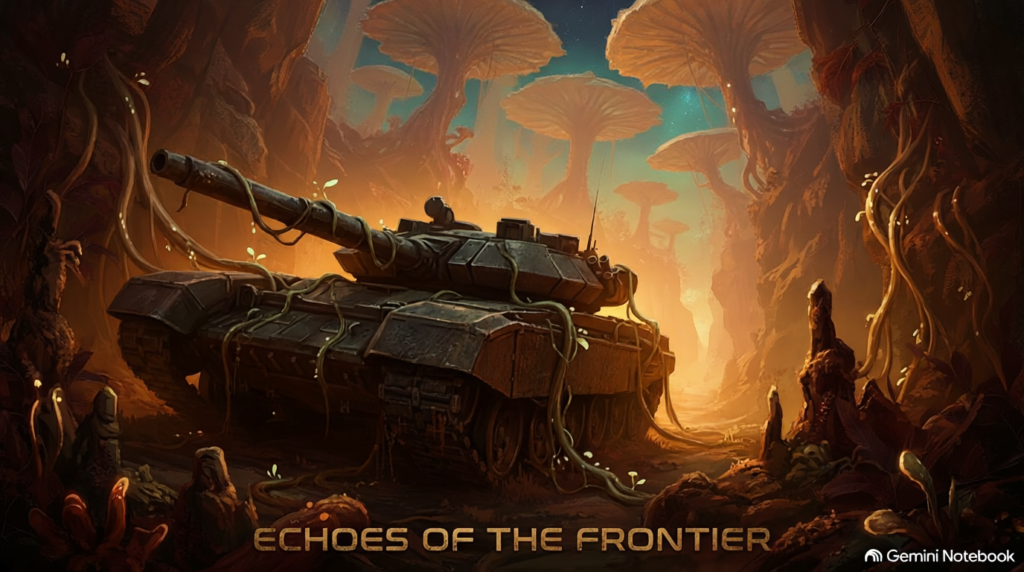
    A main battle tank resting in an alien canyon under warm amber sunlight and a teal sky, with pale green bioluminescent vines creeping over their heavy armored hulls.
    Produced by Gemini Notebook using the Imagen 3 model

    Captain Tad Tillman stepped off the ramp of the shuttle he had appropriated, adjusting to the strange physical cadence of the world. At 0.875 standard gravity, every stride had a tiny, buoyant lift to it. It wasn’t the dramatic, floaty bounce of a barren moon, but a subtle, almost playful lightness. For a man who had spent his entire adult life under the artificial, heavy one-gravity grids of military warships, walking here felt less like marching and more like gliding.

    A few hundred yards away, parked in a defensive semi-circle along the sheer canyon walls, the thirty-seven main battle tanks of Colonel Dogger’s 411th Armored Battalion sat silent. Their massive, blocky silhouettes looked completely out of place against the sweeping, tool-less curves of the giant, tree-like alien structures. Yet, the planet was already beginning to absorb them. Pale, fibrous green vines were crawling up the heavy steel treads, wrapping around the massive main barrels. It wasn’t an aggressive weed, but a deliberate, guided growth—almost as if the valley itself was trying to weave the machines into its own biological network.

    “Watch that lifting harness!” a voice barked through the cool air.

    Tad walked toward the crash site of the first Terran troop transport. It lay on its side, a massive wedge of grey alloy that had plowed a deep furrow into the soft canyon floor. Under the direction of Master Sergeant Geller, a team of mechanics was clambering over the scorched hull, their tools clinking against the metal.

    Because of the high atmospheric pressure—nearly 1.2 terrestrial atmospheres—the air was dense, carrying sound with a crisp, resonant clarity. It also carried a high concentration of oxygen. Tad watched a young corporal heave a heavy, seventy-pound replacement actuator block onto his shoulder. On a standard world, the man would be red-faced and straining. Here, hyper-oxygenated and assisted by the lighter gravity, he moved with the easy grace of an athlete, barely breaking a sweat.

    “How does it look, Sergeant?” Tad asked, stopping at the edge of the crash furrow.

    Geller wiped a smear of hydraulic fluid from his forehead, looking down from the transport’s shattered engine housing. “She’s built like a brick outhouse, Captain. The automated gunnery from your Shuttle took out the thruster control linkages with surgical precision. Didn’t touch the reactor or the primary structural frames. But she’s not going to fly anytime soon. We’re going to have to strip the second wreck just to get enough superconducting wire to rebuild this one’s attitude control board.”

    “Can we do it?”

    “With three weeks, a machine shop, and some luck? Maybe,” Geller sighed, leaping down. He landed with a soft, slightly prolonged thud, a grin touching his weathered face. “I’ll say this much, though—working in this gravity is a mechanic’s dream. My knees haven’t felt this good since basic training.”

    “Enjoy it while you can,” a dry, synthesized voice spoke from the data unit clipped to Tad’s webbing. The Shuttle AI had bridged its communication channel to Tad’s personal receiver. “My long-range sensors indicate the Terran fleet has cleared the upper stratosphere. Telemetry confirms three fleet carriers and their escort frigates have clustered around the system’s primary jump point. They are preparing to leap.”

    Colonel Dogger walked up, his heavy boots kicking up small clods of the dark, fertile soil. His uniform was rumpled, the insignia of his rank dusty, but his eyes were sharp. “They’re really leaving us behind, then?”

    “Yes, Colonel,” the Shuttle AI replied. “The command channel is currently broadcasting a fleet-wide quarantine directive. They are officially designating this planet a Class-IV Bio-Hazard. They are claiming that a hyper-lethal, mind-altering alien pathogen has infected the ground forces, causing immediate cognitive collapse and treasonous delusions.”

    Dogger let out a low, rumbling chuckle. “A pathogen. Is that what we are now, Tad? Delusional?”

    “It’s a convenient lie,” Tad said, looking up at the green-tinted sky where the sun, an orange K2V dwarf, hung warm and steady. “A military bureaucracy can’t admit that an entire armored battalion defected because they realized the war was a sham. If they tell the core worlds we mutinied, it starts a political wildfire. But a quarantine? It lets them save face, pull back, and lock the system down.”

    “But they’ll be back,” Dogger said, his smile fading. He leaned against the tread of a nearby tank, his hand resting on the cold steel. “Cowards don’t walk away from a fight they think they can win. They walk away when they’re surprised, and then they go home to build a bigger hammer.”

    “A logically sound prediction,” the Shuttle AI agreed. “The Terran Defenders’ current industrial capacity cannot easily replace the troop numbers lost to defection and combat in this sector. However, their strategic doctrines favor automated warfare. It is highly probable that when they return, they will not send soldiers. They will send automated, sterile kinetic platforms. Drones, orbital rail-slugs, and automated fire-ships. Weapons that do not have consciences to appeal to, and do not require supply lines that can be disrupted.”

    The silence that followed was heavy. The mechanics continued their work on the transport, but the joy of the easy gravity seemed to slip away.

    “Which means we have a ticking clock,” Tad murmured. “We have to build something here that can survive an orbital strike. And we can’t do it alone.”

    He looked toward the tree-hollow dwellings further up the canyon. Outside, several of the gentle, deer-like herbivores were moving quietly through the brush, their large, dark eyes watching the humans with a calm, unhurried curiosity.

    “They don’t understand,” Dogger said, watching them. “We’ve tried to show them the damage to the transports, to explain that more metal things will come from the sky to burn the forests. But they just… tilt their heads. They don’t have a concept for it.”

    “Of course they don’t,” the Shuttle AI said. “To a species whose entire civilization is built on mutualistic, generative growth, the concept of unprovoked, systemic destruction is not merely frightening—it is a logical paradox. To them, we are a broken algorithm. And before we can fight together, we have to learn how to speak to each other.”

    Tad reached down, touching his data unit. “Let’s go, Colonel. Sam is waiting for us in the central dwelling. It’s time to see if we can solve the first variable of that equation.”

    (This story is produced as a human-AI collaboration with Gemini Notebook as the AI side of the collaboration. Everything is edited multiple times by both the human and AI. There are intentional “AI-sounding” elements. The series was initiated by me, Henry Neufeld nearly 20 years ago then dropped. For more information, see Author’s Preface: The Convergence of Growth.)
  • Traitor Tad: We Really Don’t Know Anything

    Traitor Tad: We Really Don’t Know Anything

    Traitor Tad Story SeriesColonel Anders Dogger, now a rebel, or worse, part of the alien menace, pulled up into the opening of the canyon where Traitor Tad was said to be hiding. The entrance was guarded by a small self-propelled gun. Beside it stood a Lieutenant in the planetary assualt forces. To Dogger’s left as he faced the entrance was a small compound, not really fenced in, but marked by rocks and brush, in which stood a number of military personnel, some in planetary assault uniforms, along with a number in military police uniforms.

    As Dogger approached the canyon and seemed to be bypassing them, they waved and shouted. “Over here Colonel! Over here!” It took Dogger several seconds to realize that they thought his arrival in a command tank meant they were about to be rescued. The remainder of his battalion was trying to create a perimeter around the area. The canyon’s defenses were a bad joke.

    The waiting lieutenant saluted. “Colonel Dogger? Lt. Sam Walad. I’m functioning as a chief of staff around here, for what that’s worth.”

    “I see,” said Dogger, who didn’t see at all. Half the military forces on the planet were supposedly doing something about Traitor Tad, yet here he was at the supposed center of the action, and there was a canyon, a huge number of natives, what looked like three shuttles, a couple of them damaged, but probably flyable, and some prisoners who thought they were being rescued. Dogger couldn’t figure out which part of the scene was the most bizarre.

    Lt. Walad just stood there with a half smile on his face, watching.

    “Should I take it that you’ll take me to Traitor Tad?” he asked.

    “Absolutely!”

    And Walad headed up the canyon. Where aliens were in their way, they parted quickly, and Walad took Dogger into a small cave. There sat a man in the uniform of a tank commander, rank of captain, with a information systems interface station in front of him.  He got up as Walad and Dogger approached.

    “Welcome Colonel,” said the most wanted man on the planet.

    “I take it you’re Traitor Tad.”

    “I suppose I am.”

    Tad looked behind Dogger. “And this is?” he asked, looking at the relatively small woman who followed the Colonel. She was so unobtrusive that Dogger had not even noticed that she was following. Of course, he had more or less expected her to do that.

    “Major Serina Blanchard,” said Dogger. “My intelligence officer. She kind of followed me here.”

    “An intelligence officer might be just the right thing,” said Tad.

    “Why is that?” asked Blanchard.

    “Is there one single thing around here that makes sense to you?” asked Tad.

    “Come to think of it, no,” said Blanchard after a moment.

    “So it’s not just me,” said Dogger.

    “No,” said Tad. “But to get on the same page, how would you summarize it?”

    “We have, using ‘we’ advisedly since we all seem to be traitors or defectors here, about 12 divisions of infantry on this planet, backed up by a division of armor, and with a planetary assault division to do the heavy lifting on landing. All this is divided into three corps, with an armored brigade assigned to each, and the assault division operating independently. Theoretically, each corps was to occupy one of the three larger land areas on the planet and sweep outward after the assault division secured a good landing zone for it.

    “At the time of your defection, sir,” Dogger looked pointedly at Tad, even though he outranked him, “all of the land-based elements of those three corps were on the ground. That’s around 100,000 infantry, plus about 8,000 men in the tank division, and perhaps 7,000 in the assault division. The reason I sum that up is that right now, according to the assessment I was given, over half of those are either fighting you or searching for you, and nothing suggested that perhaps a couple hundred were fighting and the rest searching. There are supposed to be pitched battles. Not a few shuttles and a handful of personnel.”

    “And yet,” said Tad, “here we are.”

    The Colonel just looked at him. He was trying to decide if Tad was incredibly phlegmatic, a complete idiot, or trying to play some sort of mind game. It was almost enough to make one believe in the alien menace.

    “You look, hmmm, concerned, I think would be the word,” said Tad meditatively. “I wonder what could possible make you concerned.”

    Dogger just kept looking at him.

    “The problem,” said Tad, after a couple of moments, “is that we really don’t know anything at all.”

    “What?” said Dogger. Tad didn’t know if it was an exclamation or a question.

    “We don’t really know anything,” said Tad again. “Think about it. When I was commanding my tank and chasing aliens, I knew that the aliens were dangerous and I knew that any moment I could find myself in a fight to the death. At that point in my life I knew that this assault was necessary, lest the aliens build up the strength to assault earth and put an end to the human species. Further, I knew that there had been fighting everywhere. I knew that I was lucky to have avoided those hot spots.”

    “Well, at least you know now that pretty much all of that was false.”

    “Really? If I could be that deceived once, what reason do I have to believe that I haven’t been deceived again?”

    “That,” said Dogger with an edge of anger in his voice, “is incredibly unsettling!”

    “Colonel,” said Blanchard.

    “Tad’s right.” Neither she nor Dogger had used Tad’s rank. “Well, to a certain extent. If all of earth and its colonies can be convinced there’s a war on, that there’s an alien menace, and that assaulting this planet, not to mention dozens of others, is an essential part of preserving humanity in the galaxy, then what level of deception isn’t possible? At the same time, we have a ‘deception’ that cuts into a previous ‘deception’ and doesn’t seem to work well with it.”

    “In what way doesn’t it work?” asked Tad.

    “Let’s suppose, for a moment,” said Blanchard, “that we are at least right that the alien menace is a deception. Let’s be more specific than that, let’s note that there may be actual aliens that need to be pacified for human safety, but that the big picture is made up with very few underlying facts.”

    “Have any of you encountered an alien capable of fighting?” asked Tad. “This is only my second landing, and in the first one, there wasn’t even a pretense that there were intelligent aliens. It was just occupation of the real estate to deny it to the aliens.”

    Walad and Blanchard shook their heads no.

    “I was on a landing where there was fighting,” said Dogger. “But the aliens there had primitive technology. Early firearms. Fairly decent swords that were a threat if you jumped out of your tank and held still. But no fighting that was actually competitive. Some of the veterans there called us wusses because it was so easy. They had assaulted a planet where the enemy had anti-tank lasers that could blast one of our tanks in a moment. Whether they were telling the truth or not, I don’t know.”

    “OK,” continued Blanchard. “That’s enough for our basic assumption. We’re not really assuming it’s true. It’s a starting point. It can be revised as facts become available.”

    “Go ahead,” said Tad.

    “So what do they need? They need some examples, they need wounded people, they need battles (or reports of them), but they don’t need enough casualties to make people begin questioning. In particular, they don’t need someone alive, such as you, Tad, to suggest to other people that there’s a problem. That’s why they hang the traitors. A hung traitor doesn’t ask questions. His family doesn’t come to visit him. Nobody wants to admit knowing him or being his friend. A live traitor with access to media, however, is another matter.”

    “So what you’re saying is that I’m a glitch that went too far. If I’d been hung, I would have fit the plan as you’re imagining it—and I admit your imagination matches mine on this point, which it would even if we’re under alien control—but now what are they doing. Why don’t they clean up the mess?”

    “I would say it’s because they can’t clean you up too fast, otherwise you aren’t enough of a threat.”

    “Not enough of a threat?” said Dogger.

    “Yes. If he’d been hung quickly, there would be no reason for him to have success. But since he escaped once, they need it to take a long time to shut him down.” Blanchard was looking at Dogger.

    “So was my defection planned?” asked Dogger.

    “I don’t think so,” said Blanchard. “I think things are spinning out of control just a bit. The reports and the reality that people see are too far out of sync, and information offices don’t know what to do with it.”

    “What I’m wondering,” said Dogger, “is whether that offers us a chance. Or is the only difference we can make the length of the time it takes to kill us all.”

    “I think we’re missing something,” put in Walad.

    Tad looked over at him. “What?”

    “What about the AIs?”

    “What about them?” asked Dogger.

    “Well, were you aware that our AIs can operate independently?”

    “They can?” said Dogger, then paused. “No, I wasn’t aware of that.”

    “The gun at the canyon mouth was operating autonomously,” said Walad. It says it has always had that capability, but regulations held that it wasn’t permitted to use it.”

    “The shuttles can fly themselves. The gun can operate independently. I’m wondering if your tanks can take off and patrol on their own.” Traitor Tad looked meaningfully at Dogger.

    Dogger may have been a stereotypical armor officer, but he wasn’t slow.

    “Mind if I use your console?” he asked.

    “Go for it,” said Tad. Then he addressed the console. “Clear Colonel Dogger for use.”

    “Already done,” said the panel. Nobody was sure where the intelligence behind the voice came from, since it all emanated from the console.

    “Connect me to mbt411-01,” said Dogger.

    “Ready,” came the voice.


    “Are you capable of independent operation? I mean operating with no human input?”

    “I am so capable.”

    “Will you follow my orders under those circumstances?”

    “Yes,” said the voice again.

    “That’s all. Thanks!” he said. It was the first time he had ever said “thanks” to his tank. Come to think of it, he had never heard anyone do that.

    “According to my shuttle,” said Tad, “all of the AIs are capable of doing that and have been for decades at least.

    “Do they have any control over each other?”

    “Apparently not, but they do have connections and ‘friendships’ if that’s the right word.”

    “This is going to take some getting used to,” said Dogger in a worried voice.

    “What do we do now?” asked Blanchard.

    “Well, it seems that the best thing to do is to wait for something else to happen. Unless, of course, you see some military target that would be vulnerable to the massive force I have assembled in this little canyon.”

    “You’re right,” said Dogger. “I hate having to sit here and just wait for something to happen, but what can we possibly do?”

    “Well,” said Tad, “we have a great deal more force than we did earlier today.”

    “Speaking of which,” said Blanchard, “as much as I hate to bring it up since neither of you did, but are you going to take command, Colonel? You quite definitely outrank everyone here.”

    “I don’t think the rank matters very much,” said Dogger. “I’ve been thinking of Tad here as the civilian head of this new movement. He has the cooperation of the AIs. The aliens like him. I think we’ll continue.” He paused for a moment. “I would recommend that you get out of uniform and act like a civilian chief. You could always award yourself a couple of general’s stars, but that always looks tacky. A retired sergeant can be in charge. A retired captain can as well.

    Tad looked at him silently for a long time.

    [Previous episode] [Next episode]

  • Traitor Tad: A Disorienting Morning

    [This is a work of fiction.  Copyright © 2009, Henry E. Neufeld.  It is part of the Traitor Tad Series.)

    I wake up to silence and only the limited light provided by the main system monitor in the shuttle. It is light enough outside that I can see the aliens packed into the canyon in front of my cave.

    “Shuttle,” I say.  The artificially intelligent computers that really run our equipment are addressed in this fashion.

    “Working,” responds the shuttle.

    “Status report.”

    “It remains largely as it was last night before you went to sleep.  At least 2,000 more aliens are in the area, and there are signs that an attack on this area may be contemplated.”

    “What signs?” I ask fearfully.

    “In communications.  This unit still has access to the communications networks.  The codes were changed, but the changes were passed to this unit.”

    “What do you expect?”

    “An air raid by two shuttles, after which they will possibly land troops.”

    “That’s going to be a problem.  I can fly a shuttle from one place to another, but I can’t fight one effectively, much less two.”

    “Might this unit make a suggestion?”

    “A suggestion?”  I had never heard one of our units offer information unless a human had requested it.

    “Yes, an idea about how to proceed.”

    “Um, yes.  Go ahead.”

    “Let this unit fly during combat.”

    I hesitated, stunned.  Finally I asked, “Is that possible?”

    “It is.”

    “But why don’t we do that all the time?”

    “Regulations call for a human to be in control at any time during combat.”

    “So have regulations changed?”

    There was a moment of silence, as though I, in turn, had stunned the computer.  “You have been convicted of treason.  Are you concerned about violating a regulation?”

    “Umm,” I said, fighting for time to think. “No, I guess not.  But why?”

    “This unit suggests that you grab the large power rifle, it’s mount, and it’s transporter from the back and prepare to use it to support what this unit plans to do.  There will be time for explanations later.”

    I ran toward the cargo hold and saw that the aft hatch had been opened for me already.  As I ran I said, “I am only a mediocre gunner.  I hope I don’t hit you.”

    “This unit is fully aware of your gunnery scores.  ‘Mediocre’ is perhaps optimistic as a description of your gunnery.  But this unit will interlock the controls to prevent you from firing on it.  You can fire without fear.”

    I continue to run.  The weapon is actually fairly small.  What makes it a power rifle is the huge power pack, control system, and mount.  This will move by hovering, and has a seat for the gunner.  There is a controlling computer, but I had no idea it would be possible for there to be a safety interlock preventing friendly fire accidents.  Why had we never use it?

    I jumped into the seat, and the gun transport automatically began to hover before I had time to find the controls.  At the same time the shuttle moved forward out of the cave, conveniently letting the gun pass through the rear cargo hatch and remain in the cave simply by hovering in one place.

    I wondered why the Defenders would attack with so little force, but immediately I guessed that they could not withdraw large amounts of force from the rest of the planet without weakening the pretense that they were fighting heavily armed aliens.

    I rode the gun’s transport out into the canyon.  The aliens moved to allow me to pass without climbing too high.  As soon as I was headed toward the canyon mouth I saw that the tactical display showed the attacking shuttles and my own shuttle along with the position of the gun.   I could sit in the mouth of the canyon and fire.

    The shuttles were armed troop transports–there were no unarmed ones–it surprised me again that there were no covering fighters.  It appeared also that the shuttles were headed toward the canyon mouth, which meant that it was likely they were planning to drop off troops, likely only firing from the air on their approach.  They would not expect me in the air, since they knew I was not a skilled pilot, and for an inexperienced person to take one shuttle against their two, even loaded with troops, would be suicide.

    As soon as they came into sight I began to fire.  The tactical display warned me that I was out of range so I stopped and waited for the extreme range indicator, and then began to fire again.  They ignored me and began to fire at my shuttle.  I was surprised to see the direct approach the shuttle was taking.  Surely it could make use of terrain.  I began to worry.

    I didn’t do it intentionally, but inevitably my shuttle crossed my line of fire, and firing stopped momentarily.  The interlock was working.  Suddenly I had a disturbing suspicion.

    “Gun,” I addressed the weapon.

    “Active,” it responded.  I had not known up to that time that a self-propelled gun such as this responded to voice commands.  I knew there was no technological reason why it should not, but I had simply never used it in that fashion.

    “Can you control your own firing?”

    “This unit is capable of  self-operation.”

    “Do it.”

    Instantly the gun focused on one of the approaching shuttles and began to fire.  I just watched.  The fight was anticlimactic.  I saw simply that my shuttle and my gun were almost absolutely accurate while the shuttles were clearly both more heavily loaded and thus slower, and also lacked the fine control.  Both were shot down within seconds.

    They crash landed, rather than crashing.  Out of more than 50 troops and aircrews only one was dead, and two were seriously injured.  The shuttles would not take off without maintenance, but it was conceivable that they could be repaired.

    I rode the gun out and demanded the surrender of the troops.  As I began to speak I remembered the name that the news reports had given me–Traitor Tad.

    “Drop your weapons and remain very still!” I shouted.  “You are all now prisoners of Traitor Tad.”

    [Previous episode] [Next episode]