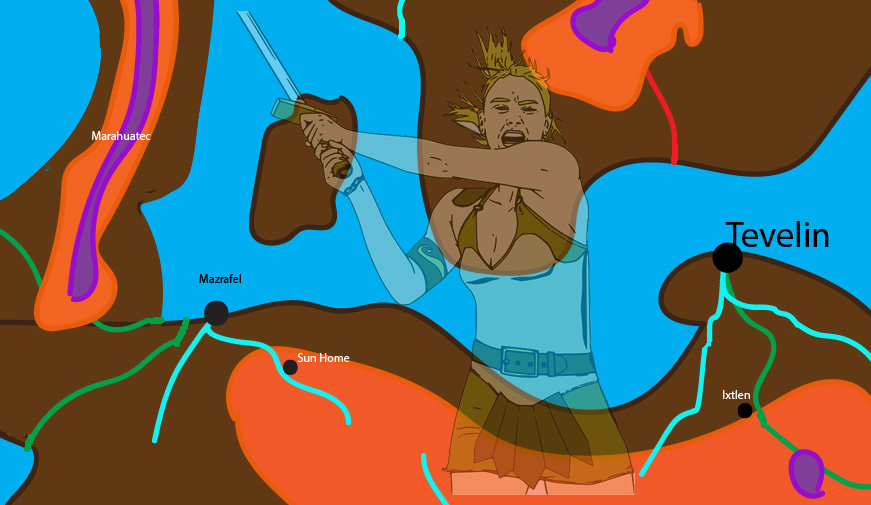
Arrival in the Estuary & The Grand Skyline
The air over the river mouth tasted of salt, decaying vegetation, and distant ocean rain.
Tlisli stood by the starboard rail of Aterin’s riverboat, her hands resting on the polished ironwood top-beam. To her left, stretching away into the humid haze, the mainland shoreline was an unbroken wall of dark green jungle. Sitting squat and solitary at the water’s edge was Fort West—a low star-fort of pale river-stone whose gun ports stared silently out across miles of open, choppy water.
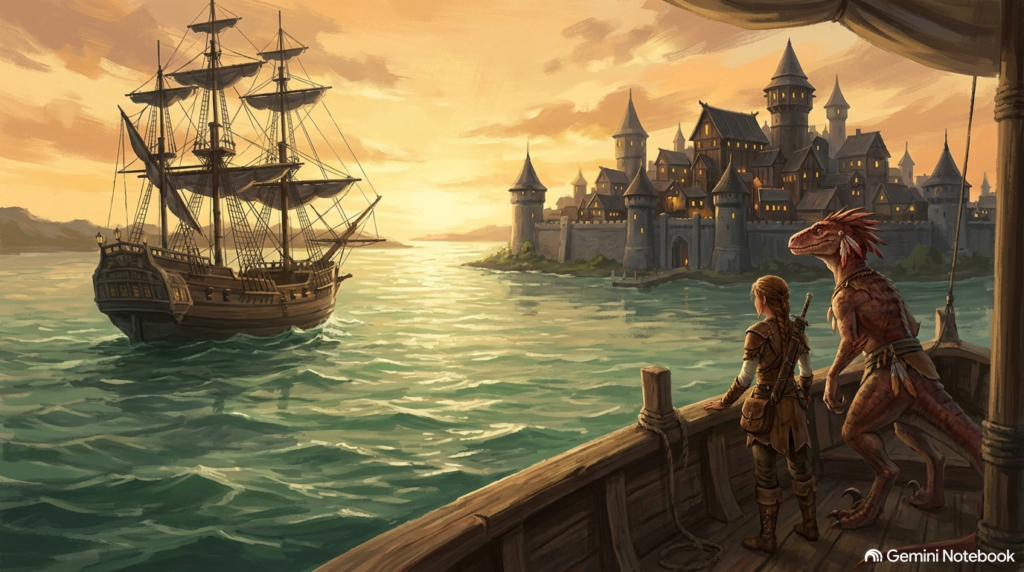
“That’s the last of the crown’s mainland stone,” Aterin said, stepping up beside her with a brass spyglass tucked under his arm. He pointed out across the expanse where the river widened into what looked to Tlisli less like a stream and more like a landlocked sea. “Beyond that shore, Inraline law stops at the tree line. But ahead… ahead is where the crown actually lives.”
Tlisli followed his gaze, taking in the sight.
Rising out of the green estuary waters was a city unlike anything she had imagined. Back in Ixtlen, buildings were squat, adobe-walled compounds designed to keep women indoors and dust out. But Tevelin—sprawling across six massive islands in the mouth of the river—was built of heavy stone and massive timber. Multi-story structures stood shoulder-to-shoulder along the water, their foundations crafted from light-gray river-stone and their upper frames built from thick beams of quarried rockwood that shone like polished bronze in the afternoon sun.
“They built all of that on the water?” Tlisli asked.
“The Inraline don’t hold with the notion that timber is only for huts or that stone belongs only to kings,” Aterin replied with a dry chuckle. “If a building is worth raising, they build it to stand for three centuries. And since they prefer water to mud, they put their metropolis where the tides can wash their front steps.”
All around them, the wide channels were busy. Sleek, rowed water-taxis darted between the islands, while heavy cargo lighters laden with inland logs wallowed in the four-knot current. Native river-galleys with low, swept hulls glided alongside clumsy merchant barges.
Riding at deep-water anchor in the main channel were the true workhorses of the harbor: three-masted ocean-going merchant ships. Their dark hulls rode high in the brackish water, their towering spars and web of rigging crisscrossing against the tropical sky.
“Are those warships?” Tlisli asked, staring at the nearest three-master. Its size dwarfed Aterin’s sturdy riverboat.
“Merchantmen, mostly,” Aterin said. “Three-masters are the real workhorses of our sea lanes. Powerful enough to ride out an ocean storm and hold off a dozen coastal raiders. The Crown Navy keeps a few five-masted leviathans docked back home in Terinor for state parades and fleet engagements, but out here on the frontier, a fine three-master is king.”
Behind them, a raspy, familiar voice cut through the creak of the timber deck.
“A king until the wind drops,” Azzesh remarked, leaning her tall, red-scaled form against the cabin housing. The Red Tlazil flicked her fork-tongued snout toward the ship’s canvas sails, tucked tightly against their yards. “Then your great floating wooden mountain sits in the channel like a fat, stranded turtle while three rowed canoes run circles around it.”
Aterin smiled thinly, though he didn’t contradict her. “True enough in a calm, Azzesh. But until the wind fails, she carries sixty tons of trade and enough longbows to clear a riverbank before you can reach your blowgun.”
Tlisli only half-listened to their usual back-and-forth. Her eyes remained fixed on the stone quays of Merchant’s Basin drawing near. Stepped landings carved from solid granite led up from the water toward crowded thoroughfares filled with people of every shape, color, and species. For a girl who had spent her life inside a walled courtyard in Ixtlen—and her last month fighting to stay alive in the humid silence of the Forbidden Ground—Tevelin was a complete revelation.
An Alley Ambush
The stone quays of Merchant’s Basin felt solid beneath Tlisli’s boots after days on the riverboat, though the ground still seemed to sway slightly from the lingering rhythm of the water.
Aterin had handed her a modest advance on her guard wages before departing for his trading house, suggesting she find a room at The Riverman’s Rest—a clean, respectable hostelry three streets back from the main wharves. Azzesh had slunk off into the lower docks to visit a Tlazil quarter, leaving Tlisli with several hours of rare, unscripted freedom.
She walked slowly up the broad granite steps, taking in her surroundings.
The main avenue was lively. High iron lamps mounted on river-stone pillars flickered to life as dusk settled, casting a warm yellow glow across multi-story buildings of carved rockwood. The street was packed with people—Inraline dockworkers in linen tunics, wealthy merchants in embroidered wool jackets, and tall, thick-scaled Tlazil carrying bundles of raw timber or fish crates.
What struck Tlisli most was the women. They moved unescorted through the crowds, laughing, bargaining at open-air stalls, and operating shops without a male guardian anywhere in sight. In Ixtlen, a woman walking unescorted at dusk would have been dragged home by her family or arrested by civic guards for immodesty. Here, she was simply another citizen going about her evening.
Adjusting the strap of her travel pack, Tlisli turned off the noisy main thoroughfare into a quieter side street lined with grain warehouses and merchant offices. The air smelled of woodsmoke, roasted nuts, and tar.
She had gone about fifty yards down the shadowy lane when three men stepped out from the gap between two stone warehouses.
They moved with the practiced routine of local footpads. The leader—a broad-shouldered man with a scarred jaw and a heavy wooden cudgel—blocked her path ahead. The other two drifted toward her flanks, cutting off her retreat back to the main street. All three wore rough, oil-stained clothes and carried short, notched skinning knives.
“Lost, little girl?” the leader grunted, his eyes dropping to the leather coin-pouch at her belt and the covered blade sheathed over her shoulder. “A pretty thing like you shouldn’t be wandering off the wharves alone. Hand over the purse and the blade, and we might let you walk back to your daddy.”
A month ago in the dark alleys of Fort Confluence, Tlisli’s heart would have hammered against her ribs. She would have panicked, wondering what the law or her father would say.
Now, she simply felt a practical, cold calm.
Azzesh’s harsh lessons in the humid clearings of the Forbidden Ground came back to her naturally: Don’t stare at their eyes—watch their shoulders. Let them commit before you move.
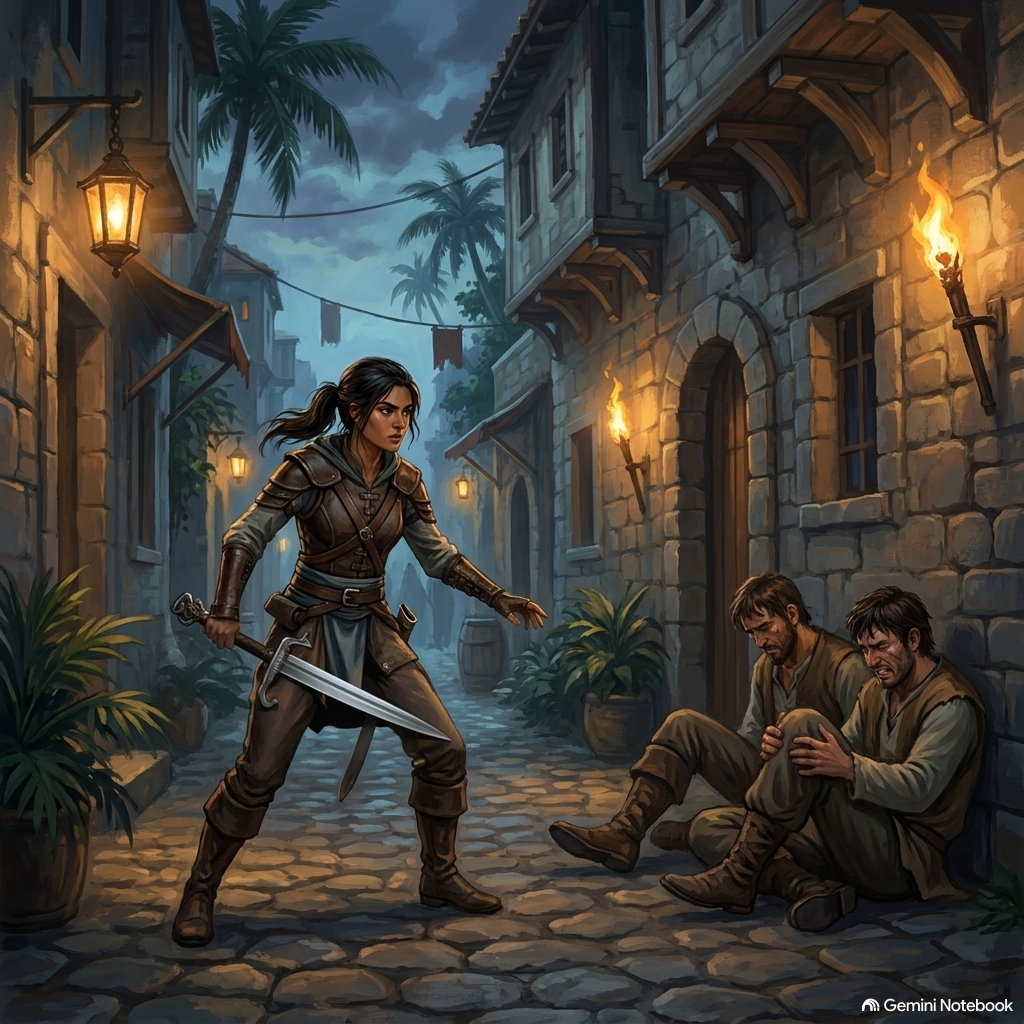
Tlisli didn’t scream or reach for her purse. She slid her shoulder pack to the stone paving, unhooked her leaf-blade, and drew the weapon smoothly from its sheath. The lightweight, silver-hued metal caught the faint glow of a distant street lamp.
“You really ought to go away,” Tlisli said quietly.
The leader gave a short grunt and lunged forward, swinging his cudgel in a heavy downward arc aimed at her shoulder.
Tlisli didn’t bother trying to block the blow head-on. She stepped fluidly to her right, letting the heavy stick crash harmlessly into the empty air where she had been standing a second before. As his own momentum pulled him off-balance, she brought the flat of her blade up in a swift, hard crack against the side of his knee.
The man yelped as his leg buckled, dropping him onto the cobblestones.
Before the second attacker could react, Tlisli pivoted inside his guard. Rather than stabbing, she drove her left elbow straight into his midsection, knocking the wind out of him with a ragged gasp, and set the sharp tip of her blade lightly against the hollow of his throat.
The third footpad—a skinny man who had been circling to her left—froze in mid-stride. He looked from his leader groaning on the ground, to his partner pinned against the river-stone wall, to Tlisli’s steady, unblinking eyes.
“Drop it,” Tlisli said.
The skinny thug dropped his knife so fast it clattered twice against the stones, and he immediately raised both hands over his head.
Tlisli held her position, her breathing steady. Under her boot, the disarmed leader grumbled and clutched his swollen knee, but she didn’t shift her balance. Standing in the quiet lane surrounded by three disarmed muggers, it hit her with a sudden, quiet clarity just how much she had changed.
She wasn’t the frightened girl who had fled Ixtlen in the middle of the night anymore.
Inraline Justice & An Unexpected Invitation
Moments later, heavy bootsteps echoed from the mouth of the alley. A squad of four Inraline town guards came around the corner with lanterns raised and short-swords drawn.
“Hold it right there!” the squad leader called out.
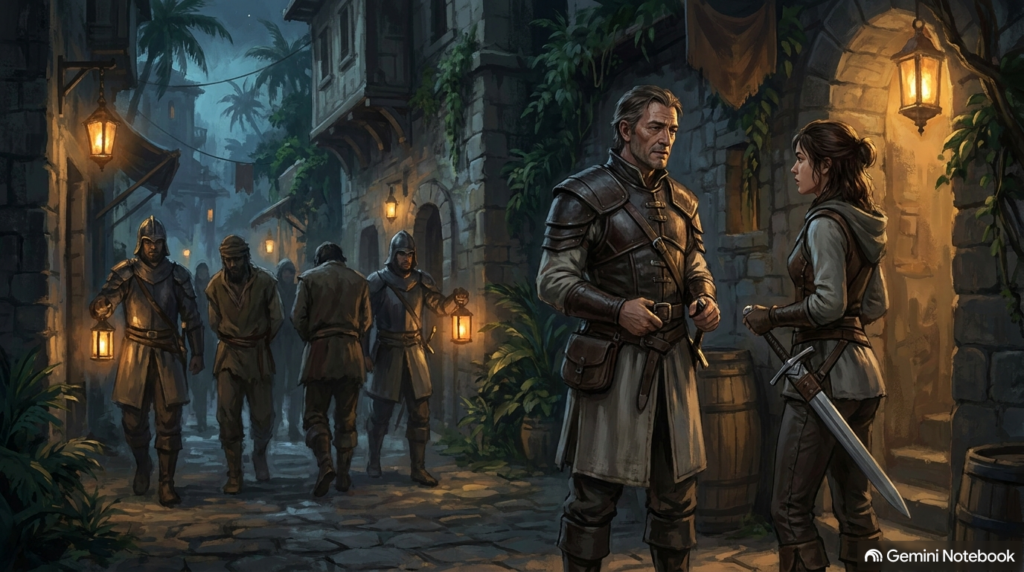
Tlisli held her ground, though an old habit made her stomach tense for a second—reminding her of how quickly authorities back home would throw someone in a cell first and ask questions later.
The guard captain took in the scene with a practiced eye: two footpads groaning on the cobbles, one with his hands in the air, and a young woman in a merchant guard sash holding a leaf-blade.
“You alright, miss?” the captain asked, stepping closer and lowering his sword.
“I’m fine,” Tlisli said. “They tried to take my purse.”
The captain kicked the heavy wooden cudgel away from the leader on the ground and grunted. “Marek and his boys. We’ve been trying to catch these three in the act for two weeks.” He noticed the woven emblem on her shoulder. “Aterin’s trading company?”
“Yes, sir,” Tlisli said, sliding her blade back into its sheath.
“Good work keeping your head,” the captain said, gesturing to his men. “We’ll take them off your hands. You don’t need to come down to the guardhouse tonight, but write your name in my log.”
Tlisli stood on the paving stones as the guards hauled the footpads away, quietly impressed by how straightforward it was. No beatings, no demands for bribes, and no lectures about why a young woman was carrying a sword.
As she picked up her travel pack, a young uniformed runner stepped out from the shadow of a warehouse.
“Guard Tlisli?” the runner asked, checking a slate. “Commander Vane over at Governor’s Isle wants a word with you.”
A Questionable Offer
Getting over to Governor’s Isle meant hiring a rowed water-taxi across the main channel. It took twenty minutes of hard rowing against the tide, the ferryman grumbling about the heavy current the entire way.
The military headquarters on Governor’s Isle was built like a solid block of grey river-stone. Inside, Commander Vane sat behind an ironwood desk piled high with rolled maps and sea charts. He was a middle-aged Inraline officer with tired eyes, short-cropped hair, and a direct, businesslike manner.
“Sit down, Tlisli,” Vane said, waving at a heavy wooden chair across from him. “I spoke with Zerdanin and read the report from Fort Confluence. You seem to have a habit of walking into trouble and coming out in one piece.”
“I try to avoid it, sir,” Tlisli said, sitting on the edge of the chair.
“Doesn’t matter if you avoid it, as long as you survive it,” Vane said, leaning back. “Here’s the situation. The Grand Empire is pushing closer in the interior. Their scouts are moving through the creek villages, and I need eyes out there. But High Command back home in Terinor won’t give me the budget for a proper scouting company.”
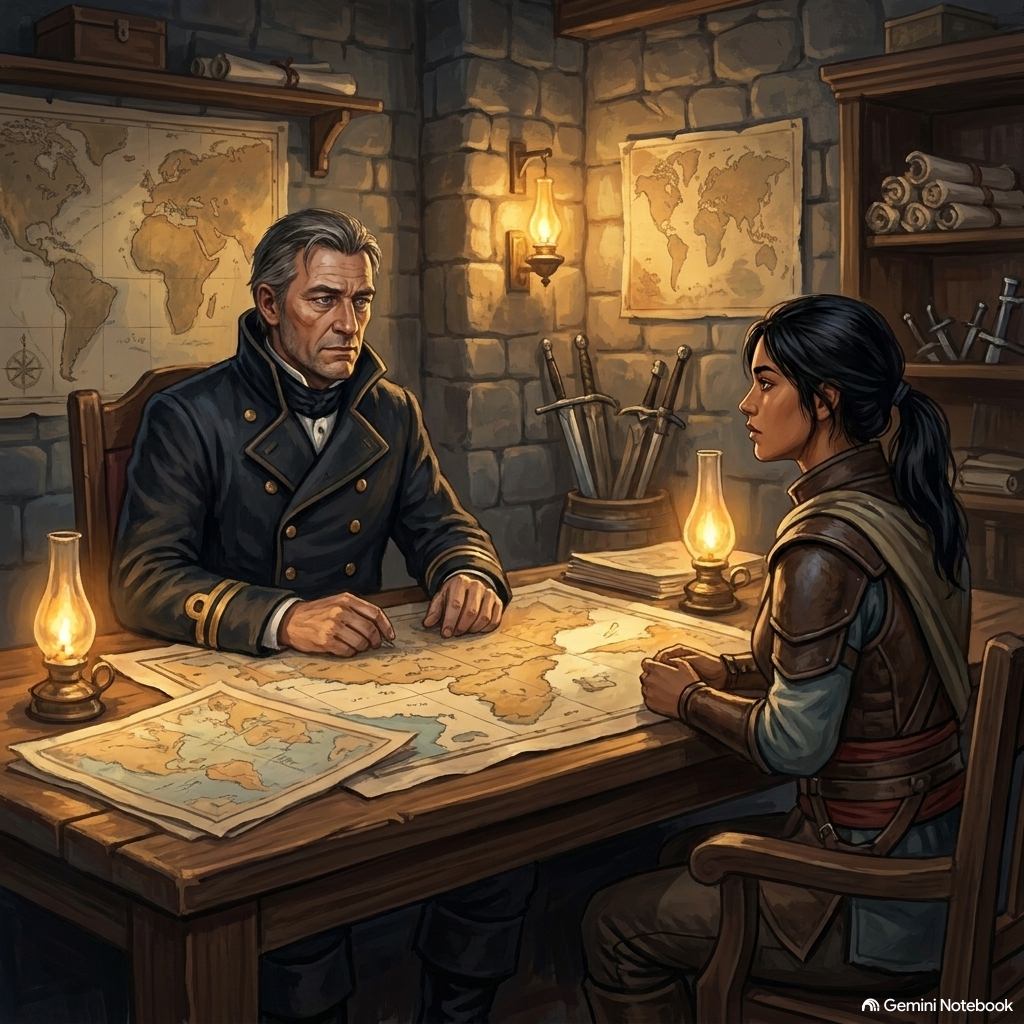
He tapped his finger on a large map of the western coastline.
“I need independent scouts. People who don’t wear Inraline uniforms, who can move through native villages without starting a war, and who know how to handle themselves if things go sideways. Sending a single scout out into hostile territory is… suboptimal. I know that. But it’s what I have the coin for. I can pay you well for every solid report on enemy troop movements.”
Tlisli looked at the detailed map on his desk. “I’m already hired as a guard for Aterin.”
“Talk to him,” Vane said simply. “If he’s willing to share your time, the crown will pay you a good stipend for every report you bring back to Tevelin.”
Aterin Gets Involved
Aterin’s private study on the third floor of his trading house looked out over the lantern-lit wharves of Merchant’s Basin. The room smelled comfortably of old parchment, pipe leaf, and polished ironwood.
Aterin sat behind his desk, swirling amber wine in a glass while Tlisli explained her meeting on Governor’s Isle.
“Commander Vane knows sending a single scout is suboptimal,” Tlisli finished, leaning back in her chair. “He’ll pay for any solid reports I bring back about imperial troop movements, but he isn’t providing a boat, a crew, or gear.”
Aterin set his glass down with a soft clink. He didn’t give his usual polite merchant smile; instead, he had the sharp, focused look of a businessman who had just spotted an opportunity his competitors missed.
“Vane is a capable man trapped in a bureaucratic system,” Aterin said. “Terinor won’t give him a budget, so he has to improvise. But look at what he’s actually offering you, Tlisli. He’s offering you official crown authority. A stamped pass from an Inraline intelligence officer lets you walk past any military checkpoint on the river or the coast without questions.”
“It still leaves me walking,” Tlisli pointed out.
“Only if you rely on the military,” Aterin said, tapping his desk. “Tevelin needs to stay free and Inraline if my trading company is going to survive. I have no interest in paying taxes to the Grand Empire. But I also have no interest in letting the crown take all the profit from new territory.”
He stood up and walked to the high window overlooking the dark water of the harbor.
“If you go west along the coast toward Marahuatec and the Keretian colony, you aren’t just scouting for soldiers,” Aterin continued in his quiet, calculating way. “You’re finding trade routes. You’re finding who has ironwood to sell, who needs salt, and which native chiefs are open to doing business. Vane gets his troop reports, Tevelin gets an early warning system, and I get a head start on every merchant in the city.”
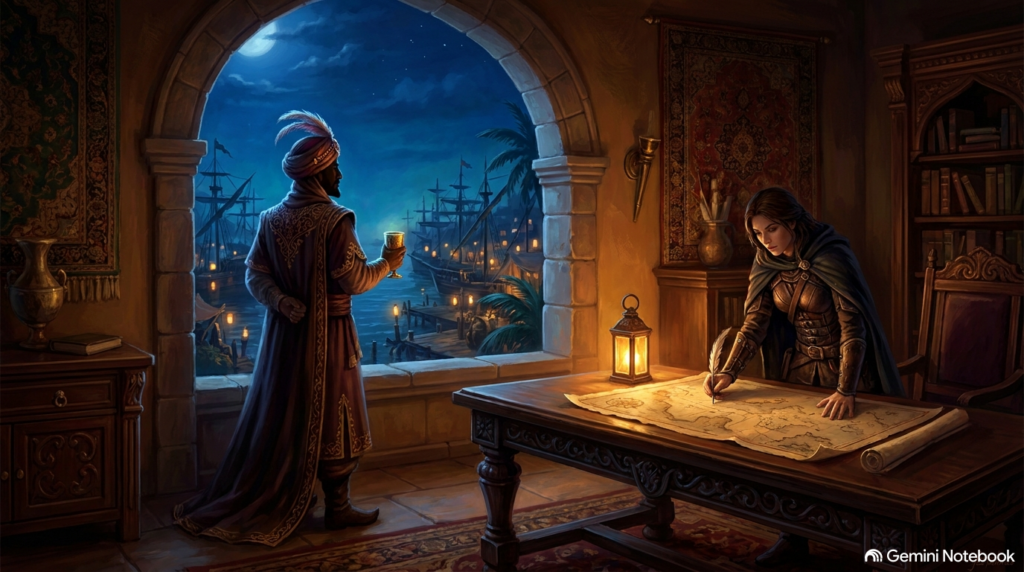
Tlisli joined him at the window, looking out at the forest of masts riding at anchor in the bay. “What kind of boat were you thinking? A heavy three-master can’t get close to shallow river mouths, and a riverboat like the one we came down on will get smashed in open coastal waves.”
“And a rowed cutter is too slow,” Aterin agreed, nodding. “While a Tlazil war canoe has no room for trade goods or heavy provisions. None of the standard hulls in the harbor will work for what we need.”
“Then what do we use?”
Aterin turned to her, a slight glint in his eye.
“Three months ago, a captain came into port with a vessel built in the far northern yards—something entirely custom that doesn’t fit Inraline navy doctrine or local river design. The crown navy turned their noses up at it because it didn’t have three square-rigged masts, so I bought it for a song. She’s sitting in my private covered slipway on the south side of the island right now.”
Tlisli looked at him. “How big is she? How many crew will we need?”
Aterin chuckled, reaching for his coat. “Enough to handle her, but small enough to slip past a Marahuatecan war canoe if the wind stays fair. As for what I’m investing in this… let’s just say if you wreck her on a reef, I’ll be recovering the cost from your guard pay for the next thirty years.”
He opened the study door and gestured down the staircase.
“Come on. Let me show you before dawn. It’s time you met your new ship.”