Category: Fantasy

  • The Definitive Guide

    The Definitive Guide

    This is a work of fiction. Any resemblance of any character to anyone past or present in the story to anyone in real life is purely coincidental. Copyright © 2025, Henry E. Neufeld

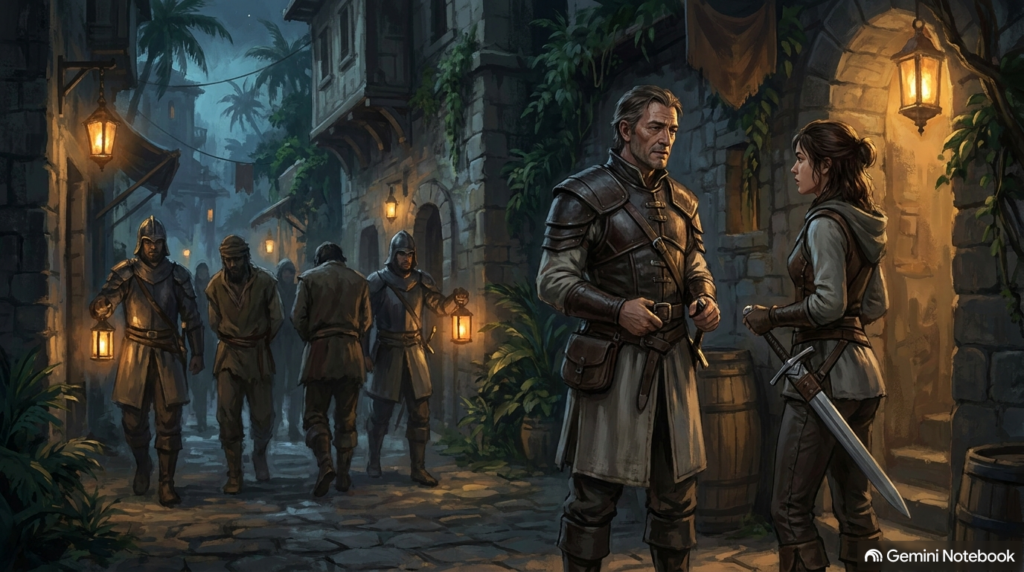
    “Are you planning to cross through the mountains with that gear?”

    Liranac, heir of a great Enzar family (in his own mind), and graduate of the University of Arkanal, with a Grand Master of Geography, turned to see who was addressing him in this manner.

    He saw a girl, perhaps in her late teens or early 20s (it was so hard to tell with these weather-worn peasants) dressed in worn, drab clothing, and not all that well groomed. “Are you speaking to me, peasant?” he asked.

    “Yes,” she said abruptly.

    “Who are you to question me?” he asked trying to get the right tone of haughtiness into his tone. While he claimed to be part of an ancient Enzar bloodline, he faced the problem that the Enzar weren’t really about bloodlines, and nobody really remembered what an Enzar was in these parts. As for the great University of Arkanal, it was but a shadow of its former glory, or at least of the glory its faculty and students imagined it had.

    “I’m someone who has traveled through the mountains many times. I rode through the mountains on my mother’s back before I could walk. I know the mountains.”

    “These are the Zalenthan Mountains, are they not?” asked Liranac. He clearly expected a “yes.”

    “We call them the Salens, if we need a name. Most of the time they are just the mountains.”

    “You don’t even know their name, and you’re trying to tell me how to pass through them?”

    “What good does knowing their name do? I’ve experienced their trails, their landslides, their avalanches. I’ve crossed their streams and climbed cliffs.”

    “Why don’t you use the royal road?” asked Liranac.

    “Royal road? There are a few ancient road markers, but no road that you can actually trave.”

    “No road? You have to be lying.”

    “It’s also very cold,” added the girl. “You don’t appear to have adequate cold weather gear.”

    “The land north of the Zalenthan mountains is warm and borders the sea. In summer, passage on the royal road is easy. I will stay at inns at the various stops along the road.”

    “There are no inns. There is no road. There are trails, rocks, occasional rope bridges, but often they are in such bad repair you can’t use them. You need warm clothing, camping gear, hunting gear, weapons to defend yourself from bandits.”

    Liranac reached into his pack and withdrew a carefully hand copied volume titled, “Southeast Enzar Geography.” The original of the book, back in the university library, was at least a millenium old.

    “This,” said Liranac, “is the definitive geography of this area. It shows a road through the mountains. It says there are civilized people to the north, though this area to the south is filled with ignorant peasants such as yourself. Now leave me. I am one who knows.”

    The girl, Arinithar, descendant of mountain rangers and expert hunter and climber, shrugged and walked out.

    Days later she recovered Liranac’s body from the bottom of a cliff. Well preserved in his backback was the definitive geography of the region. She could read it quite well. It showed a well-kept road running about where the cliff was. She remembered the earthquake that had rearranged the area.

    “Definitive,” she said to herself, “is an interesting word.”

  • The Wrong Story

    The Wrong Story

    Jared waited, somewhat impatiently.

    The old story-teller sat very still and seemed to be staring off into the distance.

    The longer the old man stared, the more nervous Jared became. He remembered the words. “The old story-teller has never given his blessing to anyone on their first try.” But Jared had listened carefully to every story. He’d talked to any listener who would tell him why they went to hear the old story-teller. He knew he had all the elements.

    After an interminable wait, the old man spoke. “What I am wondering,” he said quietly, “is where are you?”

    Jared just stood there. He couldn’t find any words. He couldn’t understand the question, and he thought he should. He wondered why he knew there was a meaning just beyond his grasp.

    Then suddenly it came to him. Such a common way of thinking it, but it simply came to him. He wasn’t overwhelmed. No light came from heaven. He doubted even that his face showed what had happened. He knew what was missing.

    “Master,” he said. He had never addressed this man as “master” before, but it just came out now. “I am the man who carelessly ran across the log that spanned the creek. I fell in, and I died. Yet I did not die.”

    “I am the man who wandered aimlessly, asking stupid questions, only to find out that he had wasted hours and hours, and his goal was beyond his reach.

    “I am the man who came to the test, and never even knew what the test was. I am a failure, yet here I am.”

    “You were a failure. Were. You are a story-teller.”

  • Traversing the Pass of Demons

    Traversing the Pass of Demons

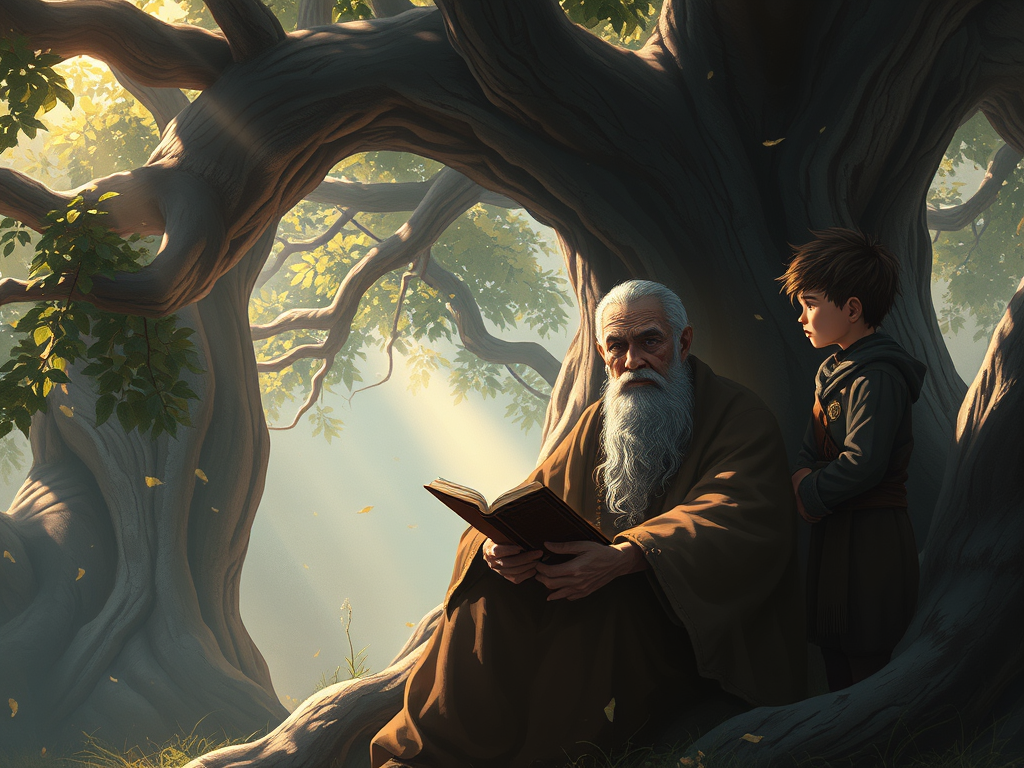
    The itinerant storyteller was old and gray, but while they showed the wear of travel, is clothes were of good quality, and he carried a sword and bow that were much above the average in the village. Such was expected of a successful storyteller.

    So there was a huge fire that night in the center of the village, along with a fine feast, and a certain amount of beer, one of the products of the town. With the certainty of a law of nature, the visiting storyteller was invited to tell a story.

    The children gathered near the old man, while the youth and adults crowded around, pretending they were less interested, but making sure they could hear.

    “It is well-established that nobody can go through Entehrenac, which you may know as the pass of demons, during the months of winter,” he began.

    He paused, waiting for a response. “Of course,” said an older boy. “Everybody knows that.”

    “It is possible,” said the storyteller, “for everybody to be wrong.” There was a gasp from the crowd. This sounded like a dangerous statement. But storytellers were given great latitude in their culture. Besides, if this man would break with custom, the evening would be far more interesting than normal, say, if the storyteller told a traditional tale demonstrating the importance of living according to tradition and the decrees of the town elders.

    “Long ago, so long ago that I had not even been born, a young woman lived with her family in a village just south of Entehrenac. Her name was Imeril. She was in her mid-teens and was a very unremarkable girl. She kept to herself mostly, other than helping her mother keep their house and care for younger brothers and sisters.

    “Her father was a rich man. Some said this was because he was blessed by the gods. Others said it was because he was just plain lucky. Some admitted he had a way of finding gems and gold nuggets in the streams around their town. But others said he was a violent man and a thief, and that his riches were the result of theft, but nobody had been able to prove anything for years.

    “Then one day an accuser arrived to claim that Imeril’s father had entered his house when he was not there, robbed him of gems he had stored there, and assaulted and killed his wife.

    “The people gathered around the town shrine — it was much too small of a town to have a temple to any particular god — and the town priest, was asked to consult the gods. Nobody actually recalled how the man had become a priest, nor anything miraculous he might have accomplished, but it was well established,” the storyteller paused here for a moment, “that he was a priest and could, at need, determine truth.

    “The priest required the sacrifice of a goat, which he examined carefully, and also rattled some bone dice around and read them with a knowing look on his face. Then he announced that the gods had spoken clearly in multiple ways, and they, the gods, declared Imeril’s father guilty as a murderer, thief, and also a rapist.

    “Some further augury was required, this time costing two chickens.”

    At this point some people noticed that the local town priest was looking frightened. Well, perhaps it was blasphemous to say the priest was frightened. Even in their thoughts, people changed that to “concerned.”

    As well he should be! This way of describing priestly rituals was likely to cause people to question the value of the village priest. If they did that, they might question his rulings. If the did that, they might question the gods themeselves!

    But the storyteller continued.

    “Once the entrails of the chickens had been duly examined, and the dice again rattled and rolled, the priest announced the sentence. ‘This man and his entire household must be burned alive in the town square so as to cleanse our village of this evil.’ Some of the people were disturbed, wondering how it could be that a man they had known all their lives, even if they hadn’t really liked him, could be so evil that his sin must be expiated in such a dramatic and nasty fashion.

    “But most of the villagers considered that the proper forms had been followed, and that the gods must have spoken, and almost immediately set about seizing the convicted man, his family, and even his slaves, of which he had two. The priest informed them that they were to create a huge bonfire just outside the town and burn the man and his household alive. This was, he told them, the will of the gods and what was required by tradition.

    “Now Imeril, as a girl child, was supposed to be waiting for the results at home. In fact, a guard had been left to make sure nobody could escape, or, more importantly, carry out any valuable items from the house. She was certainly not supposed to hear the ceremony.

    “But Imeril, though often quiet, was intelligent and observant. She thought this was not going to go well. She packed some things that might be needed in order to run, just in case, and then she took her six-year-old brother, a favorite of hers, climbed out a window in the back, and found a hiding place from which she could observe.

    “It is, I must add, a very bad comment on the guard that she could do this. It says something about how alert the village people were that she could observe and listen with nobody noticing. It says something about the trust of a little brother that said brother remained totally quiet.

    “When the verdict had been rendered by the priest, Imeril took her little brother, went to where she had hidden her supplies, and fled the village. It was winter, though spring was near. She decided the safest option was to go through Entehrenac, despite its reputation as the pass of demons, and the established fact that nobody could go through the pass in winter.

    “It was perhaps, though not certainly, unfortunate that she was not as good at hiding her tracks as she had been at the other parts of her plan. A girl was not expected to learn how to travel quietly through the mountains while not leaving a trail.

    “The people of the town gathered the household into the town square. Some of them were hesitant, but it only took a few mentions of the curse of the gods if they didn’t do precisely as those gods demanded to shut them up. The mob was getting quite stirred up enough to burn an entire household alive.

    “Then suddenly someone noticed that Imeril was missing. They must have the entire household! If anyone escaped, the town would be under a curse. Nobody was sure whether the priest started this story, but he certainly agreed to it when asked.

    “So a group of men from the village grabbed their hunting bows and hunting knives–swords were unknown in that village–and they proceeded to hunt for Imeril and the little boy. They almost missed some of the obvious clues that Imeril had left due to her complete lack of experience at traveling through the forest.

    “Soon they realized that she was headed for Entehrenac. There was some discussion. But in the end, they decided they had to continue. After all, it takes considerable anger–real or contrived–to decide to burn an entire household.

    “Imeril was well up into the pass by the time they caught up enough that she noticed them. While she was inexperienced, she was in good shape, and she moved fast. She was, I must add, very much motivated!

    “She could tell that her pursuers were gaining on her, even though she was pretty sure they hadn’t noticed her yet. She was also slowed by the burden of a six-year-old child. She never considered leaving him behind.

    “Then she saw her chance. There was a rock, the remnant of an earlier rock slide, that was near the edge of the path, which looked like it was about to fall in any case. Using a handy branch, she set about to send it over the edge to the trail behind her, which meant ‘below’ as well, to stop her pursuers. She was really thinking of blocking their path.

    “But rocks in mountain passes that are subject to avalanches may have unexpected effects–never forget that should you be in a mountain pass–and it was just at the start of spring. The rock went over the edge almost as soon as she touched it with her branch, and it bounced against several other rocks and trees. At the end, it hit a log that was the last thing holding back tons of snow, rocks, and dirt, and set off a spectacular avalanche.

    “The ground shook, and Imeril thought they would be carried away. In fact, the path a hundred feet behind her disappeared, but the path where she was and ahead of her remained in place. When the noise and shaking stopped, she could see nothing of her pursuers.

    “She nearly died from cold crossing the rest of the pass, but a teenage girl emerged, barely alive, to find refuge with a farmer. The people on the north side of the mountain, as you know, are generally farmers.”

    The storyteller paused, and let some of the children work themselves up to say, “Don’t stop there!”

    Some of the adults hoped he would. They wished he had never come to town. Good stories were supposed to reinforce obedience and good behavior. Sure, the sentence had been harsh, but if people started arguing with the gods, where would it end?

    But the storyteller was not finished.

    “A few weeks later, some of the regular summer merchants got together the first expedition to go south through the pass. There they would bargain with the mountain dwellers for gold, silver, and gems. The first passage was always difficult, often requiring making new sections of trail, especially if there had been particularly bad avalanches.

    “The merchants had heard of the girl who came out of the pass, but she had hired on with a merchant caravan weeks before, and besides, most of them didn’t believe she had come through the pass at all. It was an established fact that that was impossible.

    “So they traveled through the pass, and they came to a place where they could see signs that the a stream had been blocked by an avalanche and then the blockage had been removed when enough snow and ice had melted. It looked bigger than any such catastrophe they had seen before, but they didn’t really understand just how big.

    “Not until, that is, they got to where the village had been. That village was simply gone. They found just a few remains that might have been part of a village, but they might have missed them if they hadn’t been looking diligently.

    “When word of this got back to people who had heard Imeril’s whole story, there were quite a number of explanations.

    “Some people believed that Imeril’s father had been falsely accused, and thus the village had been cursed, and Imeril had miraculously survived.

    “Others thought the village had been cursed by their carelessness in allowing someone under the condemnation of the gods to escape punishment.

    “Others maintained that the entire story was made up.

    “There were a few oldtimers who said, ‘Why do we need to invoke the gods? That’s the way villagers, village priests, mountains, snow, avalanches, and floods work. It’s a tough universe.’

    “Imeril’s brother became rich and famous and is known as Galdor the Sailor.

    “Imeril always tried to reenforce the first option, that her father had been falsely accused. It was the one that had kept her alive.

    “But when I was old enough to understand my mother told me that was all nonsense. ‘Your grandfather was indeed a murderer, thief, and rapist. I escaped because I knew that, and assumed the gods would declare him guilty.”

    It was a good thing the storyteller had such a good sword and knew how to use it.

    This story is a work of fiction. Any resemblance to any persons in the real world is strictly coincidental. Copyright © 2024, Henry E. Neufeld. The featured image was generated with Jetpack AI.

  • What Harm Can She Possibly Do?

    What Harm Can She Possibly Do?

    This is a sequel to Have You Tried Going Around?. You might want to read that first.


    This is a work of fiction, as should be obvious. People, places, and events are all products of my overactive imagination.

    When a mysterious lady arrived on horseback from the north, there was quite a stir in the city.

    She was accompanied by a young maid, who radiated innocence. In some big cities, the maid might have created some suspicion. People might not have believed such innocence could exist. But in this city, they believed in the innocence of young girls, and so were simply pleased to see it clearly displayed—finally.

    She also had five guards. The guards looked quite competent, provided one assumed they were intended to stop pick-pockets and petty thievery. Besides, what more could a lady need? Nobody would assassinate her, since she was, after all, a lady. The duke’s guards who watched the gate were, in fact, comforted by the presence of guards. They indicated normality. They were so obviously suited to their function that one would never assume they were anything else.

    What was so mysterious?

    All sorts of things. The lady arrived from the north, after all. Only the bravest of merchants and travelers tried the pass through the mountains to the north of the city. It was, in fact, regarded as impossible for carriages or wagons. It seemed odd, at first, that a lady should show up out of the mountains on horseback. She was strangely dressed as well, with very colorful, but clearly well-worn clothing, a face that had probably been beautiful before she’d aged, and more than one bag that probably contained some of the makeup she used to overpaint her face.

    There was nothing definite, but people started to expect her to show up in the marketplace and begin telling fortunes. In the city, fortune tellers were generally rather ordinary looking and had a pack of cards, or some simple crystal ball. As long as they didn’t tell any fortunes that annoyed the duke (and nobody wanted to annoy the duke), they were regarded as harmless. It was, in fact, unlikely that people were right about the visitor from the north. Public opinion is so untrustworthy.

    But in this case the odds were quite wrong. Madame Peony showed up the very next day in the marketplace with a canopy and curtains. She paid the price of a market stall, which was unheard of for a fortune teller. Normally they occupied whatever space was unoccupied and didn’t cost them rent. Madame Peony broke the mold. This could have been dangerous, but she did it with such grace and style.

    Besides, her customers were women. Almost exclusively. It seemed that men were not anxious to spend time in a tent in the marketplace with someone named Madame Peony. It seemed like a way to be accused of unfaithfulness without the benefit of time with, shall we say, a paid companion. Not to mention they’d rather have spent that sort of time with her maid. Here maid, however, was distinctly unavailable. She’d listen, she’d flirt, but she never put out. Contact with her was so, well, innocent.

    And time she spent. Lots of it. With the ordinary fortune teller you paid a few coppers, then she (or he) dealt out some cards and provided a vague response. Madam Peony spent time with each person and listened. She was a bit steep at 20 coppers per session, but the sessions! She’d spend as much as an hour with a client, and they always left with a look of satisfaction.

    She quickly became a favored stop of the rich and famous. Women, that is. Now if it had been rich and famous men, someone might have gotten suspicious. If the Seneschal, the treasurer, the chief justice, the commander of the guard, the chief jailor, and dozens of other officials in the duke’s castle had all been going to see some woman—from the north, no less—there would have been more than suspicion. There would have been action. A summons from the duke would be likely, and such things were unlikely to go well.

    But who cared if the wives of all these men wanted to spend money on what was probably a fraud in any case? It wasn’t that people in the city weren’t superstitious or didn’t believe in magic. It was just that a fortune teller in the marketplace filled a known role, and that role was harmless entertainment. Nobody actually believed that sort of thing.

    What the men didn’t know, and wouldn’t have cared about if they had known, was that Madam Peony not only told fortunes; she gave advice. In fact, she gave good advice.

    Weeks went by, then months, and Madam Peony became a fixture. Her origins faded and became just a subconscious support for her mysterious and valuable capabilities. Nobody could remember precisely what she’d done. At least nobody who was talking.

    And then … Nobody ever really untangled what happened.

    The treasurer, who had once recommended that a northern merchant be arrested and his property seized, became quite certain that the Seneschal and the chief justice were plotting against him. Some rumors said he had heard this from his wife who had heard it from somebody, nobody was quite sure who. There was even a rumor that Madam Peony had seen the plot in her crystal ball, but everybody knew Madam Peony was just entertainment for women, and there was actually no evidence she possessed a crystal ball.

    Since the treasurer was quite unpopular, and generally believed to line his own pockets at the expense of other officials, it was not considered surprising. What was never rumored, though it was true, was that the wife of the chief justice had informed him that the treasurer was about to extort some more money from him in order to protect him from the duke, who had heard that the chief justice had actually arranged that someone the duke had wanted condemned be acquitted. The rumors became much more complex than this.

    In the middle of the night a prisoner was actually located in the bowels of the dungeon and led outside the city. Why this happened was very unclear. But it was rumored that, in exchange for this deed, the wife of the treasurer (or was it the chief of the guard?) had acquired some magical potion that would kill the chief justice and the seneschal when they had lunch together. Well, not kill them during lunch. Rather, it would kill them hours later when nobody would suspect their lunch. But these rumors only circulated among the upper class women, so nobody who mattered cared.

    There was no rumor, but the chief guard of the duke’s dungeons was having an affair with the wife of the city guard. There was a rumor, largely among the wives of high officials, that something scandalous would be revealed about the chief guard, probably by the chief justice, but also perhaps by the commander of the guard. The commander of the prison was not unhappy to hear that both were dead. Oh, and some months after the events here related, he married the bereaved widow.

    There was never a rumor that the prisoner had escaped. The chief guard was an old hand at this. The dungeon census, faithfully maintained and about as truthful as a romance novel, remained the same, and the extra supplies were sold, increasing the net worth of the chief guard.

    The Duke believed in the rule of law. Most particularly, he believed that when he ruled, it was law. In fact, since the duchy was so isolated, he had come largely to believe that what he ruled was reality as well.

    The problem, however, was that when one trains one’s staff to fake reality, they can actually become rather good at it.

    Madam Peony disappeared from the marketplace. She and the imprisoned merchant traveled north through the mountains. Nobody pursued, because there was nothing to pursue. At least nothing important. The upper class ladies were distressed, but they got over it.

    Oh, and Madam Peony replaced her colorful clothes with light armor, a dagger, a short bow, and a rapier with which she was regarded as without a peer. She was a troubleshooter for the merchant guild, and nobody better. As it turned out, she could do quite a bit of harm.

    (Copyright © 2018, Henry E. Neufeld. Image Credit: Openclipart.org)

  • Tlisli and Village Politics

    Tlisli and Village Politics

    Tlisli took a moment to thoroughly survey the people. She didn’t see any further weapons, but was extremely conscious of the fact that she had missed the fact that the man she had just defeated was carrying a knife. At the moment, she couldn’t recall whether she had seen the knife, and not categorized it as a weapon, or whether she had simply not seen it. She could hear Azzesh castigating her for either mistake!

    This is a work of fiction. All characters, places, and events are totally products of the author’s imagination (as should be obvious).
    Copyright © 2017,
    Henry E. Neufeld

    She looked sternly at the villagers. “What happened here? Where is Isteriss, your headman?”

    One of the men started to approach here, but jerked back as she gestured at him with her sword. Then he knelt on the ground where he was and started to speak in a whining tone. “Please, agent of the great merchant Aterin, do not blame us for what has happened. We were set upon by this man and his guards. They killed Isteriss and there was nothing we could do about it.” He nodded toward the man on the ground as he identified him.

    Tlisli was fairly certain that much was being left out, yet she wasn’t sure how she was to sort all this out. “Who is in charge of the village now?” she asked.

    The men started to look at one another. It seemed nobody wanted to claim to be in charge.

    “Speak up! Surely someone is in charge in your village when the headman dies.”

    “Yes, great mistress,” said the spokesman, as Tlisli tried hard not to laugh, “the Shaman leads a ceremony and the new leader is selected when he reads the entrails of a goat that has been sacrificed.”

    “And who is in charge in the meantime?”

    “I am,” said the Shaman, getting up from tending the wounded man.

    Tlisli sent the one guard who was on the pier to check that the man was still thoroughly bound. It appeared that he was.

    “So can you take the mail and exchange some of the other goods that we have?” asked Tlisli.

    “I can,” said the Shaman. He was easily the oldest person there.

    Tlisli watched him and his two companions closely. She kept expecting someone else to challenge her, but nobody seemed willing to take any action.

    Following the instructions she had learned from Tlorin, she delivered the mail and bargained for the supplies that she had. Despite having gone over the instructions thoroughly on the trip up there, she had never expected to be called upon to do the actual bargaining.

    When she was finished, she prepared to leave. She was interrupted by the Shaman’s voice.

    “Please great lady,” he said. Again, Tlisli had to fight the urge to laugh. Her? A great lady? But perhaps it seemed so in a village of a few dozen people at most.

    “Yes?” she asked.

    “You can’t just leave us. What will we do for protection?”

    “For protection? What have you done up to now?”

    “Nobody was trying very hard to kill us then. Perhaps a thief or two, a couple of bandits, but nobody organized.”

    “So tell me what happened?”

    “The man there,” he gestured toward the wounded man, “came with his guards, killed Isteriss and claimed he was the new headman.”

    “Why did nobody challenge him? There are many more of you.”

    “But they were armed with warriors’ spears. They are professional guards. We have only our bows and arrows and fishing spears.”

    Tlisli could understand the problem. Their bows and arrows were suitable for hunting small game and birds, and their spears were good for reasonable size fish, but they were not the weapons of warriors.

    “Did they say where they came from?”

    “From out that way,” said the man, gesturing generally toward the west.

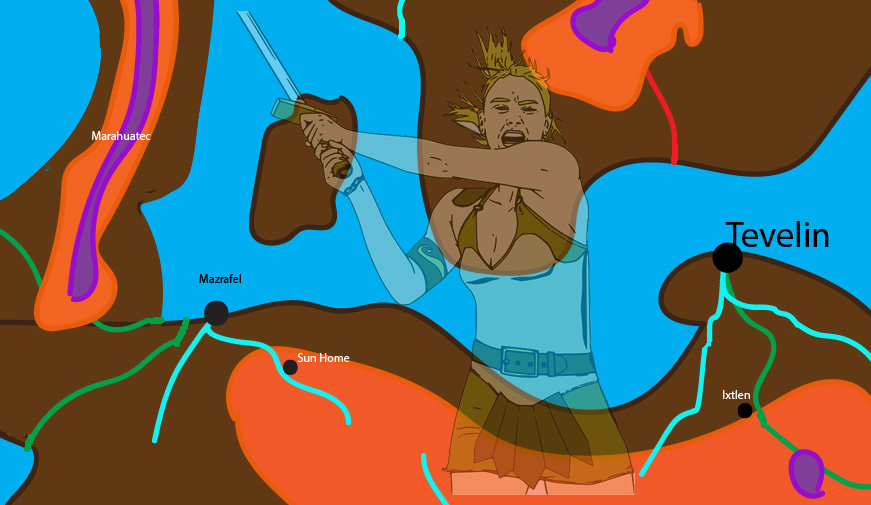
    Tlisli would have suspected the Grand Empire of the Sun, which was in that direction, though she knew that the nearest likely outpost was hundreds of kilometers away at the closest. She also knew the grand emperor’s soldiers would have been better equipped.

    “Did they way what they were doing?”

    “They said that we were to trade with them, inland, rather than down the river to the sea people.” Tlisli assumed he meant Tevelin and the Inraline.

    “And why do you think there will be more?”

    “Because he said so!”

    “And you have found him trustworthy and truthful?”

    “Why should I doubt him?”

    “Perhaps because he killed your headman and held all of you as hostages!”

    The man just looked at her. It didn’t seem that he could imagine why the killer would lie.

    She nodded to her guard who was with her on the shore. “Get him in the boat,” she said.

    The two guards moved him without much ceremony.

    “I’ll tell you what,” Tlisli said to the Shaman. “I’ll take word to the great merchant Aterin that you are having this trouble. He will decided whether to send you any help. In the meantime, I’d grab the spears and the knife that the men have left behind and I’d do my best to learn how to use them.”

    There as a sullen silence on the shore as Tlisli left.

    Once there were in the center of the creek and headed downstream, Tlisli addressed the man she had wounded.

    “I’m interested in what you were doing in the village,” she said casually.

    “I’m sure you are.” Before this encounter, Tlisli would have sworn one couldn’t croak and sneer at the same time, but she thought the man had succeeded.

    “So tell me,” she said.

    The man laughed. “I’ll tell you nothing!”

    Tlisli watched him for a couple of minutes, as though she hadn’t figured out quite what to do with the man’s statement.

    When the silence became too long the man continued, “Well?”

    “Well what?” asked Tlisli.

    “Well, what are you going to do about that?” Tlisli was fairly certain he thought the answer was “nothing.”

    “I was just thinking that if I get no information from you, all my efforts to keep you alive were for nothing, and right now you’re weighting down this boat and making me keep my eye on you.”

    He eyed her, not quite sure he followed. He still really couldn’t fathom a girl as a warrior, and certainly not as someone who would treat a captured man poorly.

    “As I meditate on all those facts,” continued Tlisli, “it becomes continually more clear that I’m wasting my time. I’m thinking that it might be better if you die of your injuries and we throw out the body.”

    She drew her sword and began to poke very gently at the bandages. “Perhaps it was a mistake to leave you alive. Perhaps I need practice. Come to think of it, who knows what that Shaman might have actually done to you.”

    The wounded man stared into her eyes, and what he saw there frightened him. He didn’t see the girl who had run from her home. He saw the girl who had survived near death and traveled for weeks through the jungle. That girl was dangerous.

    “I work for the headman of a village about a day’s journey toward the setting sun, he said.” And he spun for her a lovely tale.

    Was it the truth? Tlisli wasn’t certain she’d ever get to find out. But it would doubtless interest Aterin.

    [Previous episode] [Next episode]

  • Have You Tried Going Around?

    Have You Tried Going Around?

    It wasn’t the merchant’s fault that he approached the city from the north and entered the northern gate. Geological processes had decreed that the city was largely surrounded by mountains. These mountains were higher to the north and northwest, though there was a pass, open perhaps 5 or 6 months out of the year, that led north-northwest from the city. There was another pass, generally open all year, that led to the southeast. The merchant approached from west-southwest. And that created the problem.

    When he emerged from the southwestern pass with his train of mules and two wagons, he noted that the area ahead of him and to the right looked pretty much deserted. There wasn’t even that much agricultural land. The city was a bit to his left, meaning a bit north of east, and it looked like things got more civilized that way. To the merchant, that meant a place to sell his goods. He was, after all, exploring a potential trade route.

    So he turned to his left, and then as he came parallel with the city, he veered to his right a bit, and met the road that headed north-northwest from the city into the mountains. It was summer, and so there was occasional traffic, though not the sort of traffic the merchant expected from a road leading into a city. If his geography didn’t fail him—and he was pretty much a geographical genius—there were some quite populous places to the north and he would have expected more trade, assuming there was a road. As it was, there was no alternative to heading into the city to check things out, and this he did.

    Northern good were prized in the city, and here came a merchant, claiming to be from the north, driving two wagons and a bunch of mules down the northern road (one tended to ignore the westward lean), headed into the city to the marketplace.

    Perhaps I should explain. The reason this was so remarkable was that the northern route was well-known to be impassable to wagons. Mule trains yes. Wagons no. It. Could. Not. Be. Done. It was so remarkable that word of the merchant’s arrival got to the Duke. As a result, the Duke invited the merchant to bring his wares to the castle and discuss the situation.

    “How did you get your wagons to our city?” asked the Duke.

    The merchant assumed that the Duke wanted to know, so he said, “I came through the pass to the west-southwest.”

    “But you entered the city from the north.”

    “Well, there is no road coming from the southwest, so I circled the city until I came to a road.”

    “So you are not, in fact, from the north, are you?”

    “Actually I am. I traveled south through the western foothills of this range and then blazed a trail through the pass to your city. I offer you trade in abundance!”

    For years the Duke and his duchy had been quite isolated from the empire. As long as his tax trains made it to the southeast, nobody bothered this area. It had become quite well established that the only way through the mountains was the northern pass. This made for a scarcity of northern goods, which were well known to be superior to those from the south.

    “The northern pass is the only way through the mountains to the north,” said the Duke.

    “But why haven’t you gone around?” asked the merchant.

    It was the wrong question. The Duke dismissed the merchant from his presence and ordered his goods held while he considered the situation.

    After some discussion among his advisors, one of them offered a solution. The merchant, he explained, was actually from the south, but he wanted to sell his goods as northern goods. He was thus deceiving and defrauding the people of the city.

    The Duke looked doubtful.

    “In that case,” pointed out another advisor, “his goods should be seized and become your grace’s property.”

    The Duke found that a convincing argument. So he declared that indeed the northern road was the sole way through the mountains to the north and the west, that the merchant was a scam artist here to defraud the city. He threw the merchant into his dungeon and seized his goods.

    The Duke believed in the rule of law. Most particularly, he believed that when he ruled, it was law. In fact, since the duchy was so isolated, he had come largely to believe that what he ruled was reality as well.

    Since nobody could actually tell whether goods were from the north or the south, except by observing how they had arrived, the seized good were quite valuable and made a quite comforting addition to the ducal treasury. Oh, I don’t think I mentioned that the main reason northern goods were valued was that they were more rare. This had become, in some peoples’ minds, an indication of quality. Well, actually pretty much everyone accepted that. So the goods were laundered, so to speak, and became northern again, which they actually were.

    It would likely have been better for the merchant had he been executed rather than thrown in the dungeon. The idea of release from the Duke’s dungeons was so distant a memory that it had become a matter of legend. In fact, it had progressed beyond that to provide one of the reasons one could not believe any stories of the past. Why if someone could get the idea that someone had been released from the dungeons in the distant past, then one might believe anything! So ignore all those people who teach history. They don’t really know, after all!

    It took months for anyone to check for the merchant, but eventually the consortium of merchants who had sent him to blaze the trail began to wonder what had happened, so they sent an investigator to check. In due course the investigator and his guards arrived at the eastern end of the same pass through which the merchant had arrived. It had required no major effort to follow the merchant. He had, after all, been marking the path for future use.

    The investigator, really as part of his job description, was a suspicious sort. When he realized that he had arrived at the city without so much as encountering a bear or a mountain lion, and without seeing any evidence of battle or ambush, he decided the problem must lie in the city ahead. He was pretty sure the merchant had made it that far, based on the evidence of the trail marker on which he as resting his right hand.

    So he chose to enter the city from the southeast. He wasn’t entirely sure of the merchant’s path, considering the amount of time that had passed, but he guessed the merchant’s logic with some accuracy. So he used a different route.

    In the city, he began to ask questions. As he listened to the answers he began to be very suspicious. When the Duke sent some armed guards to “invite” him to the castle, he was quite convinced. He was well acquainted with the sort of rule of law and view of reality held by the Duke, based on the answers he had gotten.

    So being sneakier and tougher than anyone in the city imagined, he knocked out the Duke’s guards (an impossible task, according to the Duke), bound them, gagged them, and hid them where they might, if lucky, be found alive. Then he fled.

    The Duke considered the possibility that the investigator had come from the north, but he dismissed it. There simply was no passage in that direction, not to the north in any case.

    Why hadn’t they gone around? Because it was impossible. That was why.


    (This is a work of fiction. Any resemblance of any of the places, characters, or events to anyone in real life is strictly coincidental. Copyright © 2017, Henry E. Neufeld.)

    (Featured image credit: Openclipart.org.)

  • Tlisli Decides

    Tlisli Decides

    This is a work of fiction. All characters, places, and events are totally products of the author’s imagination (as should be obvious).
    Copyright © 2017,
    Henry E. Neufeld

    Tlisli was still scanning the area when one of the men still standing stepped forward. Tlisli thought this was either very brave or very stupid, considering he was unarmed. He started to open his mouth, apparently to speak.

    Tlisli ignored him, turning toward the boat. The two oarsmen were just beginning to react to the situation, and their reaction was clearly confusion. The current this close to shore was just beginning to catch and move Tlorin’s body. She didn’t want it to get too far away.

    “Get Tlorin’s body into the boat,” she said, not loudly, but quite firmly. Her voice was quiet enough that the sputtering of the man who had stepped forward, only to be ignored, partially drowned it out. The oarsmen were willing, but the shock of the situation still had them frozen. It wasn’t that they weren’t capable enough in their own way, and they had spears, but this sort of expedition was routine and safe. That’s why there was only one real guard. So they didn’t seem to have considered using their spears for anything.

    “Now!” shouted Tlisli. That finally got the men moving. Tlisli couldn’t recall ever having shouted in that tone before. She had copied it from her father, who frequently used it with employees and with slaves.

    The exchange had given the headman time to feel slighted. He was not used to being ignored. “Girl,” he said. “When a man of rank  speaks, you listen!”

    Tlisli looked back at him. A lifetime of obedience urged her to treat the man with respect, yet fear, anger, and the knowledge, practically bred into her, that letting anything slip in such a situation could mean death, took over.

    “When the person with the sword says ‘shut up,’” she replied, “you shut up.” She didn’t even turn totally toward him. Working with her brothers back in Ixtlen and later with Azzesh, she had learned the importance of being able to keep track of a wide arc of activity around her.

    She watched as one of the oarsmen drew Tlorin’s body to the side of the boat, using one of the neglected spears, and then brought the body on board. She pointed at one and said, “Guard the boat.” To the other she said, “Grab your spear and come with me.” He didn’t seem to have any problem with that.

    The headman, on the other hand, was still livid. He was keeping his mouth shut, yet he managed to look as though he wanted to kill.

    “Why have you attacked Aterin’s boat and killed his agent?” she asked, holding her sword loosely in front of her. To someone unacquainted with her, it might appear that she was unready, but with Azzesh she had practiced moving from this lazy looking stance to an attack quickly.

    “Are you not the agent of the great merchant prince Aterin?” asked the headman with some surprise.

    “No,” said Tlisli. “I’m the guard. Your men killed the agent.”

    “Not my men,” said the headman. “Those were bandits who were holding us hostage.” As he spoke even more people were gathering around. None of them were carrying obvious weapons. The headman had a knife in a scabbard at his waist, but other than that, Tlisli couldn’t see anything threatening.

    The problem was that she had talked to Tlorin about this village, and he had told her that the headman was elderly, and that he and Tlorin had been acquainted for years.

    “What happened to Isteriss?” she asked, naming the old headman.

    “He died. I am the new headman.” His hand was moving slowly and skillfully toward the knife. The move was skillful in that it was concealed as he gesticulated with his hands while talking. With each move, however, his right hand came closer to the knife.

    If he’s that good with concealed movement, thought Tlisli, I don’t want to give him time to get the knife!

    “Keep your hand away from the knife,” she said conversationally.

    It seemed that was the moment when the headman, if such he was, knew that the game was up. He grabbed for the knife. Tlisli moved in with her sword again, trying again to stab the man in the chest. This time she was not so lucky as in her previous two stabbing attacks. The headman dodged to her right, and she just managed to nick him in the side. Meanwhile he brought the knife up and in, intending to stab her in the abdomen.

    It would have worked, too, except that Tlisli had learned something else from Azzesh: If your natural momentum will take you out of the way, even if you got that momentum by tripping, go with it. Because Tlisli had learned that she really didn’t have the strength for mighty blows with her sword (or anything else), she had thrown her weight into it. When the man moved, she was quite agile enough to have kept her feet, but instead she let herself fall forward and rolled further away from the man. His knife still caught the edge of her tunic, and in fact nicked her in turn, but not enough to even distract her. Azzesh had caused much more damage than that in training!

    The man then made a critical mistake. In one way it was hard to blame him. Where he came from girls weren’t warriors. Because she was small, Tlisli looked like a child to him. He knew about women as warriors because he lived near enough to Tevelin, but deep down he just didn’t believe it possible. That’s why he had assumed she would be the agent and the man would be the guard in the boat. Now, despite what he’d seen of her capability with her sword, he still assumed it had to be luck. In his mind, he was cursing his guards for their failure to kill a mere girl. To him, her fall could be nothing less that the inevitable failure of her uncanny luck.

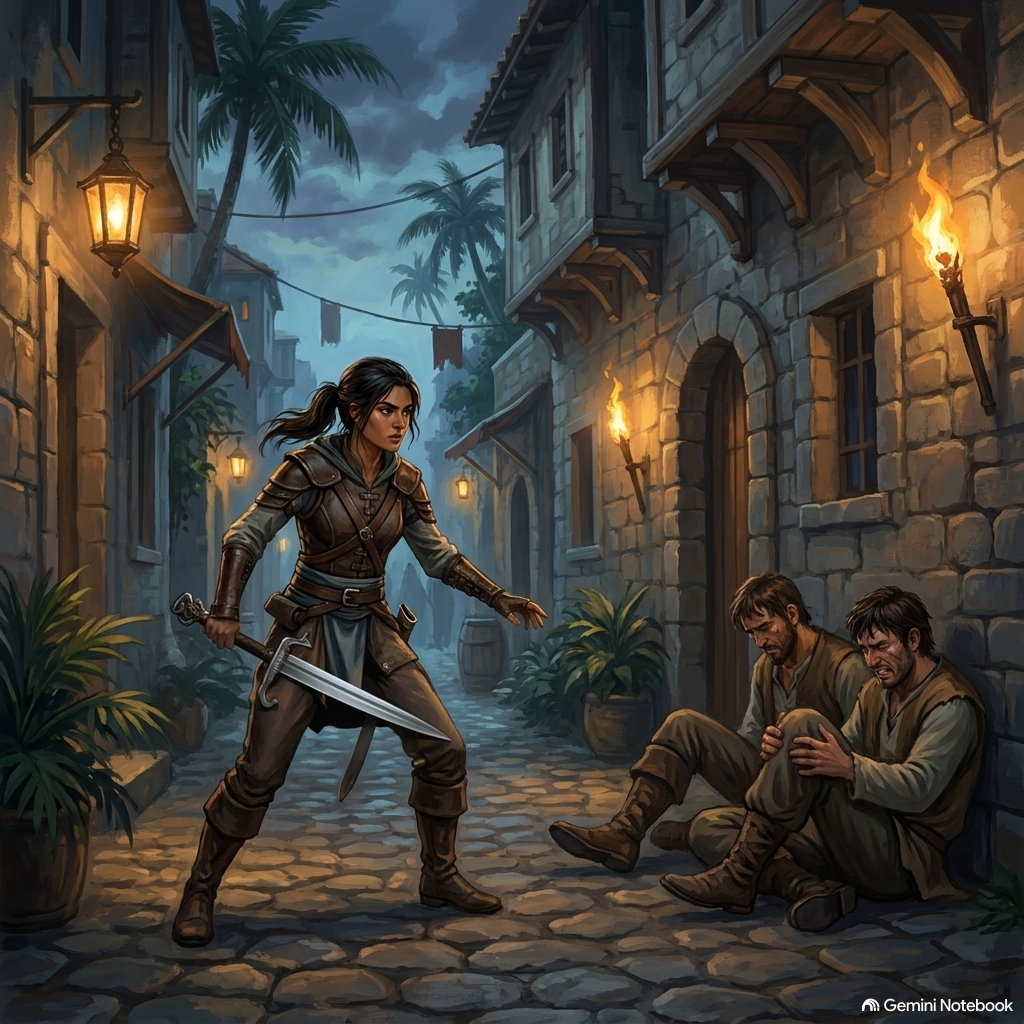
    He threw himself on her, intentionally dropping his knife. His whole purpose had been to capture the agent, and now he had his chance. Tlisli just pointed her sword upward and braced it, allowing the man to impale himself on it. Her move was to late to give him time to change his move. Tlisli pushed at the man and managed to move out from under his body, pulling her sword with her. He was still alive, but he wouldn’t be for long.

    “Bandage him,” Tlisli ordered nobody in particular.

    Three villagers, including one who appeared to be the village shaman, moved to obey. It appeared that everyone was willing to accept that Tlisli was in charge. Finally!

    [Previous episode] [Next episode]

  • The Dependable Assassin

    The Dependable Assassin

    In the history books he received just a brief mention. He was called Rutahgren (accented on the ah, though few people knew). If he was given any sort of title, it was “the Destroyer.” He was credited with assassinating Almar the Just around a century ago, following which there had been two or three decades of sheer chaos, known quite creatively as “the troubled times.” You decided how long the troubled times had lasted based on your tolerance for chaos.

    Again, according to the history books, Rutahgren (the Destroyer) had been caught by the palace guards, tortured, and eventually executed by impalement on the palace grounds. Since executions usually took place in the city square, some were surprised by this. Most, however, figured that since Rutahgren (the Destroyer) had killed the reigning king, the royal family had wanted to keep all the fun to themselves. Executions, even by impalement, were public events, parties even.

    It was said that this was the only time that an assassin had ever successfully killed the reigning monarch. If someone pointed out that several kings had died by violence in the centuries long history of the small kingdom, they would be told that those killings were accomplished by insiders. As an assassin, Rutahgren (the Destroyer) was, and would remain (never fear!), unique.

    There were two places where the story was told quite differently.

    The first of these was the Illustrious Guild of Critical Services, IGCS for short. IGCS had offices in a solid, upper class neighborhood in the royal city. Ordinary people wondered what “critical services” might be. Government officials and the police simply referred to the IGCS as the assassins’ and thieves’ guild. It was more accurate, though slightly less aesthetically pleasing.

    I suppose I must explain why IGCS was allowed to exist, right in the middle of the capital city of a (generally) law abiding country. There were two reasons for this. First, because no matter how many times the police searched the building, they were unable to find any evidence of illegal activity. It was hard to get judges to imprison or execute people because “everybody knew” that they were assassins or thieves. Even thoroughly bribed judges wanted some specific victim and target!

    Further, and as the second reason, too many government officials had made use of IGCS services at one time or another. These services rarely involved killing anyone. Usually, the goal was to produce filing errors. You know, the type that result in documents missing from well-marked folders, or perhaps showing up somewhere they had no business being. That sort of thing. It was hard to get the prosecutor to work very hard to put someone in jail, when that someone knew precisely what had happened to that contract he had wanted to get out of.

    Thus it was convenient for everyone that IGCS just sat there behind its sign.

    Now where was I? Oh, yes. Inside the guild building, when instructors talked to trainees, they told a rather different story about Rutahgren. In their stories he was dubbed “the Faithful.” Now some may have problems with an organization of thieves and assassins advocating faithfulness, but so they did. It was said that once they accepted a task, they carried it out. It was also said that they never, ever revealed who hired them.

    In their story, Rutahgren was indeed an assassin. He had been hired by a member of the government to get rid of Almar the Just, because, in the way of government officials, he felt that justice was much overrated, and that Almar was just too just! They never said the name of the official who had hired Rutahgren, because, of course, they never told such a thing. It amused the instructors to pretend that they actually had found out by sneaky stratagem, and were concealing this knowledge from their students. But the fact was that nobody knew, because Rutahgren, as a good guild member, had never told. Anybody.

    Over a period of years, the story went, Rutahgren had tried to get into range to assassinate Almar the Just, but had never succeeded. The royal guards were just too good. That they nonetheless never caught him during those failed attempts could be credited to the fact that Rutahgren was quite good as well. He always managed to withdraw. There were even a couple of innocent people, whose only crime was to be in the wrong place at the wrong time, who were executed for failed attempts.

    There were also many close calls. There were members of the guild who told Rutahgren (and any senior guild member who would listen), that this was a contract they should fail to keep. They could even return the money provided by the one who had hired them. But Rutahgren refused to quit. Finally, he determined that they only way to be absolutely certain he would kill the king was for him to plan it as a suicide mission. There was no way to accomplish it and get away alive.

    So he did that. He had a perfect plan to infiltrate the group of courtiers around the king. It was accomplished in a place where the royal guard was less concerned about assassins, precisely because the king was surround by courtiers and guards, and none of his other subjects. Rutahgren approached the king and killed him using a long thin dagger. He had taken the precaution of coating the dagger with poison, and having a wizard place a quiet but deadly death spell on it, and when he approached the king with a particularly flattering remark, and a particularly abject offer of obeisance and subjection, he also ran the dagger very precisely through the king’s heart. The king was dead before the poison could circulate. The spell of death ensured he stayed that way.

    Rutahgren knew he’d be tortured for information, and he didn’t want to reveal the one who had hired him, so he had made even more elaborate plans to insure that he would die as well and not be captured. His plans were unnecessary, however, as he died under a barrage of attacks from the startled guards. It was said, in the IGCS, that he died with a smile. He had accomplished his mission.

    In the IGCS, he was presented as the perfect example of a true assassin, carrying out his mission no matter what the circumstances and cost. Some instructors included a footnote about being very careful what you agreed to accomplish.

    In the second place, his story was remembered a bit differently. This was in the royal guard. The guard could forgive themselves when a prince or a government minister, granted free access to his majesty (or his or her highness, or whoever), turned traitor and killed someone they were guarding. How could the guard be expected to protect the king from someone the king invited to be there? They could search for weapons, but sometimes the king even forbade them that. They didn’t really condone missing any assassin, yet they felt differently about insiders.

    Rutahgren, however, had placed one single blemish on their record of keeping outsiders out, and they too told his story in training. They didn’t attempt to sugar-coat it. The guard had failed. The facts of the story sounded much like those told in the IGCS. But the lesson was different.

    They also called the assassin Rutahgren the Faithful. They’d conclude his story by telling their students, would-be guardsmen, that they needed to be just as faithful, just as determined, just as careful, and just as willing to sacrifice as the assassin. “Disapprove of his profession all you like,” they’d say, “but remember, and emulate, his faithfulness.”

    (Luke 16:1-8)


    (Featured image is based on Adobe Stock [#106106044] and I have licensed it for use here. It is not public domain.)

  • Tlisli as a Merchant’s Guard

    Tlisli as a Merchant’s Guard

    [Continued from Tlisli Gets a Job]

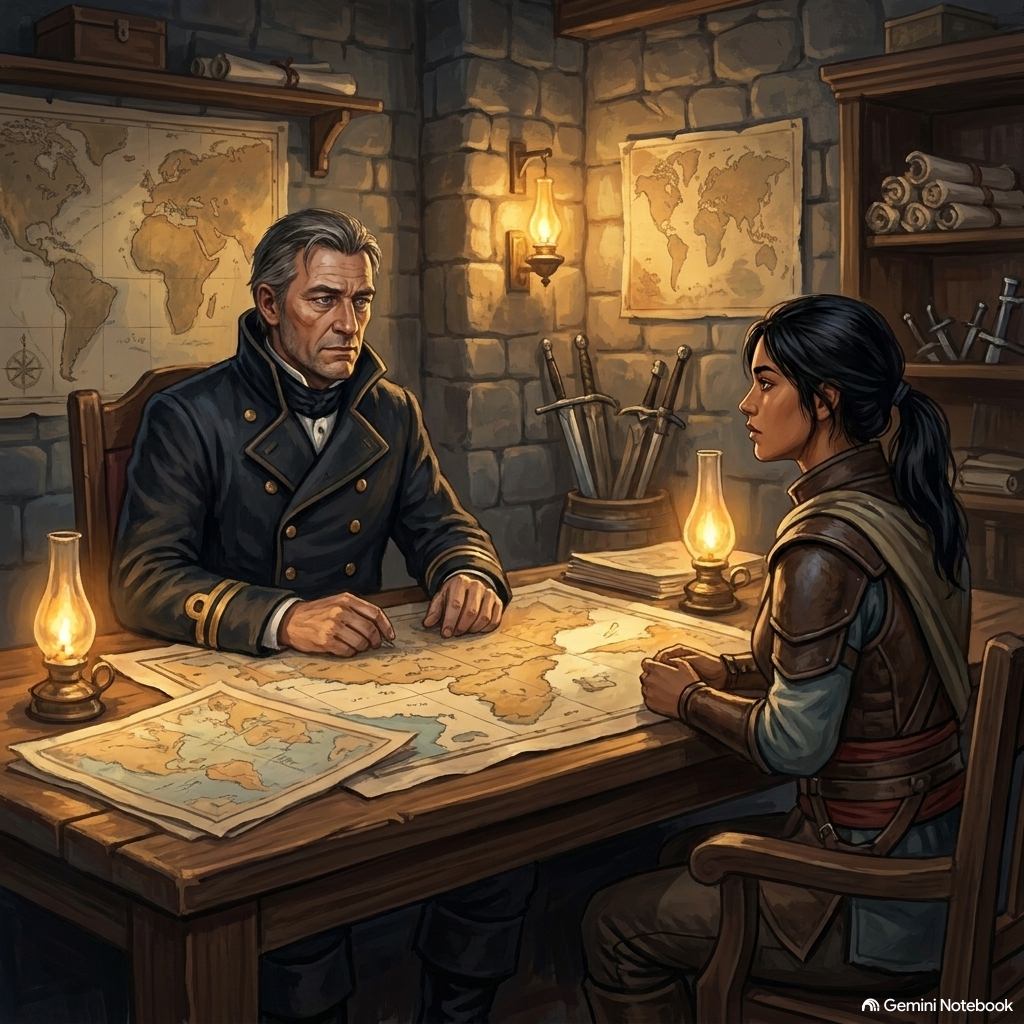
    Tlisli spent the rest of the day and a good part of the night being surprised. It started when she met Zerdanin, captain of the guard. Inraline used one name, and then the connective “ir” which meant “descendant of” and a parent’s name. Only in a formal introduction would the full name be used.

    The guard captain was Tlisli’s first surprise. She introducted herself as Zerdanin ir-Ketran, and informed Tlisli that Ketran was her mother. In Ixtlen, while a person was known as a descendant, there was “son of” and “daughter of” and it was always of the father. She learned that in Inralin one had a choice, though tradition held, in order, that one chose the higher ranking person, the parent whose profession was more similar to one’s own, or in the absence of such distinctions, a daugher  was descendant of her mother, and a son of his father.

    While she was being lectured on names, Tlisli was absorbing the shock of Zerdanin’s apparent age. She looked, well, old. She looked even older than old. Aterin was old, in late middle age. How could one be captain of the guard and be that old. Surely she would be slow!

    A couple of hours testing with weapons and then with hand-to-hand combat cured Tlisli of the thought that the captain was too old for her job. It turned out, however, that Zerdanin considered herself too old to be a front line fighter. That, she told Tlisli, was what she had lieutenants, sergeants, and yes, new recruits for.

    Zerdanin, it turned out, was a veteran of the Tevelin garrison, where she had risen to the rank of Evnor, which mean someone who commanded in the area of 900 troops. Why the number was stated as 900, when nearly everyone on this continent would have used multiples of 12 (a gift of the Tlazil Empire, Azzesh had told her), while she had heard that others would use multiples of 10, Tlisli could not understand. The Inraline used base 10 numbers, as she had heard were common elsewhere, yet they used companies of 300 and a sort of regiment of around 900. The structure was quite different. In general, however, she was pretty sure she had been told about the numbers so she would be impressed by Zerdanin’s command experience.

    The guard on their riverboat, however, was very different. Guards worked in teams of three with a lead guard in command. These were then divided into three shifts, and on this riverboat, each shift consisted of two teams. One of the lead guards would also be designated as the sergeant for each of the shifts. After her weapon skill was determined, Tlisli was assigned to work with the lieutenant. Lieutenant Uxinen was, in Tlisli’s opinion, an arrogant ass. She hadn’t had the opportunity to work out with him, but he just didn’t impress her at all.

    There was a certain amount of consternation among the guards, however, when Tlisli was assigned as a sort of junior lieutenant. That put her above the sergeants in rank, and they were none too sure this as a good idea. To be honest, Tlisli wasn’t that sure it was a good idea either!

    Before nightfall, Tlisli received another shock. All of the guards, including the officers, were required to know how to work one of the oars on the riverboat itself and to row one of the boats. Zerdanin assured Tlisli that she would be unlikely to row the riverboat other than to experience it, as she was too small, and would actually be a hindrance. But it was quite possible she’d wind up rowing one of the smaller rowboats. That skill could come in handy. Tlisli had no difficult with that task. Small boats on rivers were something she knew.

    That night they stopped in a small village by a tributary creek. The riverboat carried some letters and packages which they dropped off and picked up others. Tlisli learned that there was no official mail service outside of Tevelin and its official outposts, and so there was a considerable traffic in carrying mail between the various villages. It didn’t surprise Tlisli that there was no official mail service; what surprised her was that there was mail service at all.

    The next day was market day in the village. Tlisli wondered whether it was market day because the riverboat had arrived or whether Aterin had arranged to arrive on market day. She didn’t have time to ask. She was told that she would be going with one of Aterin’s commercial assistants up the creek for about two hours along with two of the oarsmen whose job it would be to row the boat. She would be the sole guard for the expedition. If she hadn’t seen the look on Uxinen’s face as he gave the order, she would have thought she was being honored, considering how little anyone knew of her. She was pretty sure, however, that this was considered grunt work. Uxinen told her to intimidate any bandits who might come along.

    On the way up the creek, Tlisli and the commercial assistant, a local named Tlorin, had plenty of time to chat. Tlisli took the opportunity to learn whatever she could. Basically, he said, they were delivering mail, and also watching for opportunities to buy certain fish—Tlisli was acquainted with most of those Tlorin described—and various herbs. They’d also be willing to pay for information that would lead to finding certain types of lumber that were highly desired for furniture making.

    “I saw that a great deal of our load was of rockwood,” said Tlisli. “Is that the sort of thing we’re looking for?”

    “Most of the stands of ironwood, which is what we call it,” said Tlorin, “have already been located, marked and are regularly harvested. The woods we’re interested in are used in making luxury, decorative furniture.”

    “Can we make enough money on an expedition like this to make it worth Aterin’s effort?”

    “Not on any regular basis, but the fact that we carry the mail makes us popular with the local people.”

    They pulled up to the wharf at the quiet village. Tlorin seemed to be quite delighted as he threw a rope to a man on the small wharf. Tlisli sensed something wrong. She saw at least three men holding spears. It was not unusual for a man to carry such a weapon in the jungle. But these looked like they were ready to move. There was a tension among the men waiting, those who didn’t have spears as well. She grabbed an arrow and her bow (which she had kept strung most of the way), still keeping both inside the boat. Then she tried to whisper a question to Tlorin, but she had hardly turned his direction when one of the men with the spears threw it and hit him squarely in the chest. Tlorin was standing, and fell into the river.

    Tlisli’s reaction was automatic. She raised her bow from a seated position (it was quite small enough for this), and loosed that arrow, not at the one who had thrown the spear, but at one of the others. He had started a move toward her, and he stumbled and plucked at the arrow that was in his belly. His companion was moving too quickly to stop and check, and stopping would have been a bad idea for him in any case, so he moved forward.

    Tlisli simply dodged his spear with the same movement as she picked up her sword from under her seat on the boat. He continued forward, apparently intent on fighting her bare-handed, and was completely unprepared as she brought her sword up. She had no time to really choose. She just rammed the point upward and let his momentum help impale him on it.

    The first man was now holding a spear. It had to be the one dropped by the one she had shot, but she hadn’t seen it happen. He was apparently not going to throw it, but instead try to fight her with it. She remembered Azzesh’s words, “When someone is about to do something remarkably stupid, be sure that you’re not missing something.”

    In this case, however, Tlisli couldn’t think of any wonderful thing the man might know that would make that crude spear adequate against her sword. Using a move with which she had often cut Azzesh’s sticks in half during practice, she sliced the spear in two at an angle. While the man was still trying to figure out his next move, she jumped to the wharf and stabbed the tip of her sword directly into his heart.

    She crouched and looked back and forth, trying to evaluate the situation. She didn’t know who belonged here and who didn’t. Was the battle over, or was someone waiting nearby to surprise her as she had the three men?

    [Previous episode] [Next episode]

  • The Parable of the Perfect Castle

    The Parable of the Perfect Castle

    On the borders of the empire there was a minor noble. Not that he thought of himself that way. In fact, he was lord of all he surveyed, little though that was. But what he surveyed, he liked to keep in perfect order.

    He had a perfect wife, not too fat and not too thin, and perfect children—well, almost perfect—but he knew that he’d have them straightened out in good time.

    His subjects, of course, were far from perfect. But what could one expect of commoners?

    He lived in a castle. It had stood for more than 200 years, and housed his noble forebears. It was guarded by troops who were, being commoners, also far from perfect. The situation, though sanctified by age, was, in a word, intolerable. The noble would begin to twitch every time he thought of his imperfect castle.

    So he summoned the best architect and builder he could find, and with them he called for the most experienced and capable guard commander he could find. It put a strain on the treasury, but the noble was willing to pay for perfection.

    He had studied many books on castle construction and on the weapons used to destroy castles. He had also studied the best armed forces in the known world. The world he knew was not all that large, but he found the specifications for the best.

    “Find the very best of my soldiers,” he told his new guard commander, “and send them out for the best training you can possibly find. I want my guard to be perfect. Spare no expense in their training and equipment.” Being the perfectionist he was, he had made a list based on what he had learned in his books so that the guard commander would know what equipment to buy and the standard to which the troops were to be trained.

    “Make the walls capable of standing any conceivable sort of siege,” he told the architect and builder. “Make sure the fields of fire for the crossbowmen are perfect. Create a park our of cleared land around the castle so that enemies cannot approach unseen.”

    The architect and builder found it difficult to imagine how to make the cleared area into a park and also eliminate all obstructions. But they knew the noble would hardly consider a completely undecorated area to be perfect, so they kept their silence.

    Many months went by as materials were assembled, workers were hired, land was cleared, and finally portions of the old castle wall were destroyed. The noble complained to the builder about the uneven, half-built look of his castle when a wall had been torn down in preparation for replacement, but the builder pointed out that he could hardly build the perfect wall without removing the imperfect one first. Because the builder used the word “perfect,” the noble understood completely.

    After another couple of months, the one new wall was nearing completion. For reasons of security, the wall was to be replaced one section at a time. (The architect pointed out that this was the perfect way to proceed. To the noble it became the only way.)

    One morning, however, disaster struck. A merchant arrived in town, and in his miscellaneous (far from perfect) inventory, he had a book on castle construction and defense. The noble bought it immediately. Of course.

    The book described siege engines that the noble had never even imagined, engines that would destroy his new wall in seconds. He had never even heard of the countries where such engines existed, if they existed outside of the author’s imagination. Nonetheless, how would it be possible to consider his castle perfect if he knew of siege engines that would destroy it, and even do so from a distance at which his crossbowmen would be unable to kill the crews?

    So he went to the architect, the builder, and his guard commander and explained the situation to them. He was willing to be tolerant, because they were commoners, and how could one expect perfection of them?

    “We will have to build these walls differently,” he said. “We need a stronger type of stone. We need better mortar. The wall must be thicker! And you, guard,” he continued, “you must have my guards trained to hit targets at greater ranges.”

    The architect proposed building another layer behind or in front of the present wall. His plan was rejected because it would look like they had changed their mind in the middle of the job. Hardly the perfect appearance for a castle. The builder pointed out that the blocks of rock he wanted were harder to quarry, came from a greater distance, and were also harder to transport, resulting in months of delay.

    But the noble was adamant. “And get rid of that abortion of a wall you’ve just built immediately,” he shouted, as he turned to the guard.

    The guard commander pointed out that if they were going to train guards to hit targets at greater distances, they would need more time, but they would also need better crossbows.

    “Find and buy me the perfect crossbow,” the noble said.

    So the builder ordered new stone blocks and tore down the wall, stacking the old stone blocks neatly, as befitted the noble’s desire for perfection. The mediocre troops who were guarding the castle while their betters trained, continued to guard the castle.

    In the 200 years the castle had been in place it had never even been threatened. That was because, while it was hardly perfect, it was really quite solid. Its fields of fire were blocked by new construction that had been tacked onto the old anywhere one could attach it. Nobody had cared, because the only people who ever considered attacking the castle were bandits, and they took one look at it and decided they could find their lunch money somewhere else. In the bargain, they’d get to live to buy the lunch! So they left the quite adequate castle (from their point of view) alone.

    With the best guards out of town, and one wall of the castle missing completely, a band of bandits came by. Pickings were slim and they wanted a big haul. They observed for a day or so. The mediocre (or perhaps not quite adequate) guards never noticed. The bandits saw that the castle was guarded by a fraction of the usual force, and that there was a missing wall.

    To them, it seemed the perfect situation. In the middle of the night (while the not-quite-adequate guards slept), the bandits stormed through the breach in the wall, entered the castle, killed the noble, and took all his stuff.

    The bandits were a bit disappointed in the state of his treasury, but it was a big haul nonetheless.

    Not being perfectionists, they were pretty happy with their night’s work.

    Matthew 5:48, Hebrews 6:1

    Perfection and Maturity in Hebrews 6:1 (Threads from Henry’s Web)