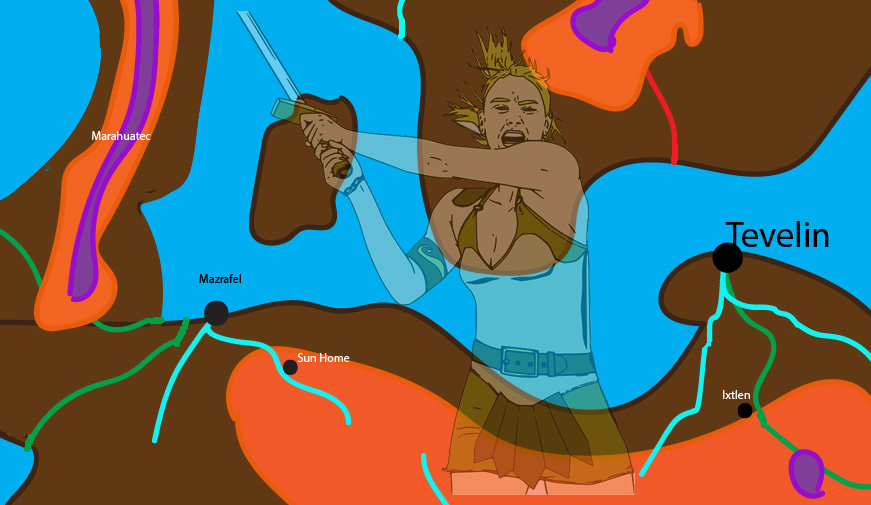

Category: Fantasy

  • Tlisli Gets a Job

    Tlisli Gets a Job

    [continued from Tlisli – A Lesson in Geography and Politics]

    After a few moments of silence, Tlisli worked up the courage to ask another question. “Why would taking the fort do the Grand Empire little good?”

    “Good question! For the same reason that it would be hard for them to actually take it. Clearing the town would be easy, but the fort is, as you have noted, not that far up the river, and the Inralin Navy is pretty much without peer, at least in these waters. So they would take the town itself back quickly. At the same time taking the fortress would place a relatively small number of troops out at the far end of a very tenuous supply line with logistics that can be cut easily by those same troops. How many troops did they have when they attacked Ixtlen?”

    “I heard it was a couple thousand. I don’t remember precisely.”

    “And how many do you suppose they left home with?”

    “I have no idea. Nobody discussed that.”

    “That is as I expected. Rulers of a city state are not used to dealing with the logistics of an extended campaign. Ixtlen is more than 1500 kilometers from the nearest Grand Empire outpost. So they have to deal with losses along the way, with setting up outposts, and establishing some sort of a supply and communications chain. My guess is that the overall expedition started with 10 times that many.”

    “So if the city had decided to resist, we might well have succeeded. There weren’t necessarily tens of thousands more troops just around the corner.”

    Azzesh laughed.

    “Hardly!” said Aterin. “I have no idea how your guard would have done against a couple thousand troops. Make no mistake, Grand Empire troops are well-trained. At the same time they are not extraordinarily well-equipped, and they are loyal as long as there are officers and enforcers in range.”

    “Of course, once they had established a route suitable for communications and resupply, they could have followed up with more troops. Travel time would only be a couple of months,” said Tlisli.

    “Very good!” said Aterin. “You know how to think about these things!”

    “It would take considerably less time to bring troops from Ixtlen to Tevelin or to the fort.”

    “True, but first they must be at Ixtlen. Which is the point of taking the city. Once they have built up their troops there, they will move south.”

    “But they’ll eventually do that, and they will threaten Tevelin.”

    “Again, true, and so we will warn the authorities, and they will prepare. One should note that sailing from Terinor to Tevelin takes less time that the fastest conceivable transit from Ixtlen to Tevelin.”

    “Wow!” said Tlisli.

    “You’ve lived inland all your life. You have never seen an Inraline sailing ship. Fortunately, the Grand Emperor doesn’t really understand sea power either.”

    “Oh, I’d say he understands it quite well,” said Azzesh, cutting in.

    “How’s that?” asked Aterin.

    “He shows that he understands it by what he’s obviously attempting here.”

    “What’s that?”

    “He means to take Tevelin and make it a Grand Empire base. It may look like an impossible task to you, and he’s certainly not going to move quickly as Tlisli here says.” She turned to Tlisli. “Besides being stringy and bland and not thinking enough you are filled with romantic ideas of single combat and decisive, swift strokes that decide an issue quickly. Your addled brain thinks in terms of heroes, villains, and glory. Yet perhaps Azzesh’s efforts are not totally wasted and you may come to understand reality enough so that you understand that war is a nasty, brutal, never-ending business.”

    “The current Grand Emperor’s grandfather started the expansion of the Grand Empire,” said Aterin. “At the time, Sun Home was little larger than Ixtlen is now.”

    “While his troops, and girls such as you think in terms of days and weeks, he doesn’t even think in terms of months,” said Azzesh. “He thinks in terms of years and decades.”

    “The process,” pronounced Aterin in a tone intended to end a topic, “is to make Tevelin unprofitable so that in the end Inralin will be happy to let it go. Then he will use Tevelin to cut off the Keretians at Mazrafel and to harass the Marahuatecan navy.”

    “And you just go on engaging in commerce?” asked Tlisli.

    “Why of course? Do you have a better idea?”

    “You must require a large number of guards.”

    “Absolutely. Which leads me to you.”

    Azzesh started to interrupt him, but Aterin waved her to silence. That he could do so was astonishing to Tlisli. “I will let her know how things are. I won’t try to cheat her because she’s naive.”

    He looked directly at Tlisli. “You’re going to need to decide what you do next. You’ll need a way to make a living. Did you have any plans?”

    “Not really,” said Tlisli. “I don’t really have any skills. Girls weren’t expected to have careers in Ixtlen. It wasn’t so brutally enforced as in the Grand Empire, but it was still true.”

    “Actually,” Aterin replied, “you do have one skill set. This conversation wasn’t entirely idle. I wanted to see if you could carry on a conversation about politics and commerce. Of course, we’ve only touched a few minor concepts. You’re not well informed, but you do have the ability to follow the conversation. But that isn’t the skill set I’m talking about. You traveled for weeks with Azzesh, and she hasn’t yet eaten you for lunch. That’s an indicator of skill. I’m hardly going to hire you at the wages of a veteran of the Governor’s Guard, but you are well above the skill level of the average new hire I get as a guard.”

    “I hadn’t thought …”

    “Just so,” said Azzesh.

    “How could you have?” said Aterin. “Here’s what I propose. You will serve with my guard during this trip and my stops while we go to Tevelin, and then I will make an offer. I would expect that I will offer more than you can make as, say, a barmaid, yet less that I would offer someone with actual military experience. I get someone with better skills because I trust Azzesh’s word. She recommends you, despite her insults. You get a bit more pay than you could get otherwise. Over time, you can get to the point where your value and your pay match more closely.”

    “So you’re paying me less than you think my skills would be worth because I don’t have formal proof.”

    “Yes, and because you don’t have the level of experience of others. On the other hand, because you grew up in a home involved in politics and commerce, you do have some acquaintance with how these things work.”

    “That makes sense to me,” said Tlisli. “I would have been suspicious had you offered me some sort of full wages.” She paused then laughed. “Well, I would have been suspicious after I found out what normal wages were.”

    “So do we have a deal?”

    “Yes,” said Tlisli.

    “Very well, let me introduce you to my ship’s guard commander, and she’ll put you to work.” He noticed her surprise. “Yes, the captain is a she,” he said.

    [Previous episode] [Next episode]

  • Tlisli – A Lesson in Geography and  Politics

    Tlisli – A Lesson in Geography and Politics

    The commercial riverboat looked a bit odd to Tlisli, who had grown up with canoes and small boats made of skins. This one was made of wood and looked heavy to her. Besides a bank of oars on either side, it had a single square sail, which was furled. While she could see men sitting on the benches, no oars were out. Since she had never been in a boat with a rudder, it felt odd and somewhat dangerous.

    Azzesh, it seemed, had friends here too, and she found that she was invited to lunch with the owner of the vessel, one named Aterin. She was surprised that he appeared racially to look more like her than the lighter skinned Inraline. She had quickly gotten the idea that the Inraline related to the natives here much as the Grand Emperor’s people did to the citizens of her home town, Ixtlen.

    “You look surprised,” said Aterin, again surprising Tlisli. She didn’t realize she had let her emotion show on her face.

    “Forgive me if this is rude,” she said, “but you appear to be as native as me, yet you’re owner of this boat. How is this possible?”

    “Well, actually, I’m owner of many boats,” said Aterin, as Azzesh chuckled. I run a trading company both up and down the river and and along the coast. I have several vessels that are sea-going ships for the coastal trade, and even one that makes the run from here to Terinor in Inralin itself.”

    “So a native can be a person of power and substance?” Tlisli ignored Azzesh’s laughing.

    “Well, yes, but that’s not the issue here. I’m a full citizen of Inralin by birth. Those born in the colony of Tevelin—and you should learn to distinguish the city from the colony—are full citizens of the kingdom. My parents were citizens as well. But a native, as you put it, can own a business here as well.”

    He paused a moment. “Azzesh here is as native as it gets, more so than you or I—by ancestry, of course—yet she is a citizen by virtue of residency and service to the governor and crown.”

    Tlisli tried, but failed, to conceal her shock. Tlazil as full citizens? How could that be? They were primitives. Well, except for Azzesh.

    The subject of her thoughts locked eyes with her as Tlisli came to that point. “Yes, small human, unsuitable even for a good lunch, Tlazil. Any Tlazil who will obey the laws (within reason), and become a part of society, can become a citizen. The Inralin government is very open.”

    “You were thinking of Azzesh here as some sort of exception,” said Aterin.

    “I wasn’t thinking, I guess,” said Tlisli.

    “Indeed, it is your great flaw, other than being too stringy and bland to make a good lunch,” said Azzesh.

    “Well,” continued Aterin, “Azzesh is indeed an exception to many rules. But those rules would apply to anyone. Azzesh is luckier than most, stronger than most, and really quite intelligent.” He paused. “Almost intelligent enough not to eat humans for lunch.”

    Azzesh just laughed.

    Tlisli was anxious to change the subject. “How long will it take to get to the city?” she asked.

    “Well,” said Aterin, “I would expect it to take a week, perhaps a little longer.”

    “Are we moving that slowly?” asked Tlisli. “I thought we were less than 200 kilometers from the city, and that it would take a couple of days just flowing with the current. I was a bit surprised that we were using neither sails nor oars.”

    Aterin looked at her for a moment. “I’m hoping,” he said slowly, “that you understand that the reason we’re not using this square sail is that the wind is blowing almost directly upstream, a truly wonderful situation if one is sailing upstream, but somewhat of an impediment if one is going downstream at the time.” He licked his finger and held it up into the wind, looking at it judiciously as though judging whether he could make use of the sail.

    “Yes, I know that,” said Tlisli. Azzesh snorted.  “What I don’t understand,” she continued, “is why we aren’t using oars either. I would have assumed we would normally use one or the other.”

    “What’s the hurry?” asked Aterin. “I prefer to keep my employees happy, and the oarsmen are happier when their work load is more reasonable. So I use them when I need the speed, and not so much when I don’t. They’re useful for loading and unloading cargo in any case. Right now, I will get to the next town well before my next appointment without the oars, so speeding up accomplishes nothing. And the reason we will take a week is that we will make several stops along the way, all while not hurrying.”

    “I know I’m going to sound stupid,” said Tlisli, “but I’m used to that. You mean the people who row your boat and load the cargo aren’t slaves?”

    Azzesh snorted again.

    “No,” said Aterin, “they aren’t. In fact, slavery is illegal in all Inraline possessions.”

    “It was not in my city,” said Tlisli. “It’s not in the Grand Empire. I hadn’t ever heard of a place where there are no slaves. What do you do with them? I mean, with the people who would be slaves? What do they do?”

    “Well, normally I employ them, pay them their wages, and get much more value from their work than any slave owner would,” said Aterin. He was looking at her without any sort of condemnation or condescension, very much unlike the way Azzesh would.

    “Inralin is a very different place,” she said after a moment.

    “Well, perhaps,” said Azzesh, “though I should point out that in the Keretian colonies and Marahuatec there is no slavery either. You humans here in Porana inherited some good things from the Tlazil Empire. Too bad you chose to keep the bad as well. Slavery is bad. I’m a realist, not a moralist. It’s not that I think slavery is wrong. I would, after all, go further, and eat you for lunch were you not bland and stringy. It’s that I think those countries that practice slavery eventually pay for it in efficiency. The Grand Empire has found itself blocked by smaller but more efficient societies on three sides so far.” Tlisli continued to note how much more sophisticate the Tlazil sounded now that she was in a more sophisticated society.

    “I thought the Grand Empire’s armies were essentially unstoppable. When they arrive you will eventually fall.”

    “You haven’t seen very many armies, small human. The armies of Marahuatec to the north and northwest stopped them cold. The Keretian colony of Mazrafel holds them to the north, and the alliance around Qenixtlan [See We Have Always Failed] holds them to the south and west. The sheer weight and size of the jungle holds them to the south. So now they are coming east.” Azzesh rattled off a list of countries and cities with ease.

    “So isn’t it critical that we move rapidly to reinforce the fort if they’re coming east?” asked Tlisli.

    “No,” said Aterin laughing. “Orlin may think the most important thing is to guard his fort, and since he’s the fort commander, that’s not such a bad attitude for him to have, but two points: 1) The Grand Emperor’s troops are nowhere near ready to attack the fort, and 2) It would do them little good if they did.”

    That left Tlisli to wonder just how a fort like the one she’d seen could be unimportant as a target.

    [Previous episode]  [Next episode]

    (To be continued. The “Next episode” link will be made live when the next episode is posted.)


    Note: For those who pay attention to languages in fiction, while I have stolen phonemes from some ancient Central American languages, the language spoken by Tlisli is not in any way related. If I manage to match a lexeme in those languages it is entirely unintentional and should not be considered relevant.

    Copyright © 2017, Henry E. Neufeld. All rights reserved.

  • Tlisli Argues Strategy

    This is a work of fiction. Any resemblance of any character, place, or event to anything in the real world is purely coincidental, not to mention ridiculous. This is part of the Tlisli Series.
    Copyright © Henry E. Neufeld, 2013

    The Inraline had a relaxed way of dealing with authority when in small groups, but became more formal as the group got larger and the rank of the official got higher. The fort commander, Orlin by name, stood in silence at the door while nobody moved or spoke. The idea of the commander walking in on the court was so shocking that many in the room scarcely breathed. Either someone was in serious trouble or there was an extreme emergency.

    “Adjourn your court, Super,” said the commander. Then he listed several names, including Azzesh and Tlisli, and ordered them to his bridge.
    Tlisli had no idea what the various ranks were or what a “bridge” might be. Later she would learn that the Inraline built their entire military around naval traditions. “Super” referred to their intermediate ranks, sort of like petty officers. Those in the regular ranks were called simply sailors, though they would be called soldiers when on duty based on land. Commanders came in junior, senior, and full rank, and served as officers junior to a captain. Then there was the rank of Captain-Commander, which was equivalent to a ship’s captain when not commanding a seagoing ship. Orlin was a Captain-Commander, but tradition denied him the title as his command included no seagoing ships. Riverboats did not count in Inraline minds.

    To Tlisli, however, it simply seemed that she was surrounded by people who had titles of rank and knew where they were going, while she did not.
    The reason a command center was called a bridge, even in a fort like this, was that Inraline officers tried to feel like they were on a ship. Orlin’s bridge was in the outer tower of his fort, overlooking the river. Azzesh thought the commander very foolish. The odds that an attack would come directly down the river were poor. Any reasonably competent foe would realize that the Inraline troops were much more prepared to defend from the water side. Indeed, those despised riverboats would be considered decent small ships by many navies. On the other hand, fighting in the jungle was not an Inraline strength. She had said as much to Orlin, but he didn’t quite get her point. Any real attack would come down the river, would it not? Thus obviously the best defenses must face the river.

    So as they sat down in the room called the bridge they could look out windows over the river and see the confluence. One couldn’t look far to the west, because the bulk of the fort was in that direction. Azzesh and Tlisli couldn’t see the palisade that formed the jungle side wall. That palisade was largely designed to keep the animal life out, and not as a major defensive barrier. Across the river one could see the towers on the eastern shore of the river, as well as the one on the tip of land  between the rivers. Again, Azzesh thought these were fairly foolish ideas. It was probably worthwhile to have forts there to watch river traffic, but these towers were not well equipped to defend themselves from land, and could easily be isolated.

    On the positive side, there were regular towers or high points around the area, and the Inraline maintained a good signaling system, using mirrors in sunlight, flags in appropriate conditions, and lanterns at night.

    Despite the seriousness of the way Orlin had summoned them all, when doubtless a messenger would have done, he seemed in no hurry to get them settled down and tell them what they were all here for. Azzesh was ready to resent being called in this fashion, unless Orlin got to the point quickly and offered her money or other advantages in exchange for her involvement. She didn’t work for him. Tlisli, on the other hand, was just bemused at being called. She had no idea what she was doing here. The very idea of being in a room filled with officials frightened her in a way nearly dying in the jungle had not. But Azzesh was busy greeting various people and generally ignoring Tlisli, as was everyone else.

    Finally Orlin called the meeting to order. “We got news yesterday courtesy of Azzesh that there was a patrol of the God-Emperor’s troops with a boat up the eastern branch. Now this morning we get word that Sun-troops are actually holding a village to the north. One young man escaped and brought word. We need to decide what to do about this. I have already dispatched messengers to Tevelin to inform my superiors of this threat. We had previously known that there were occasional GES agents in the jungle around here, which was not surprising considering their ambition. But to have them around the area with boats is a new variety of threat entirely.”

    Azzesh seemed rather taken aback by this speech, Tlisli thought. She was trying to understand the issue with the boats. If there were Grand Empire of the Sun troops around in the jungle, why would one be particularly concerned if they had boats. In fact, from what she could see, about the stupidest thing the GES troops could do would be to try to use boats to assault this outpost. On the other hand, from what she’d seen of the western side of the town, there was very little to prevent the GES troops from invading from that direction.

    The room had devolved in chaos, as various people argued about recalling patrol boats, reinforcing the waterfront, and making certain that nobody could approach unseen via the river. She would certainly not attack this city (as she thought of it) from the river. But it would take less troops than her home town had had available (before the GES came) to isolate this fortress. And with the fortress isolated, commerce would come to a halt. Using the cover provided by the fortress itself, it would be possible to besiege, and eventually to take the fortress unless it was resupplied by river very early.

    Azzesh looked at Tlisli, watching the girl’s expression change as the debate went on. Azzesh was of the opinion that these debates on his bridge provided the best explanation for why Orlin had been assigned to command this fortress. He simply was not at all decisive, and in his view, the river was the world. It wasn’t an ocean, to his great disappointment, but it was water, and water was the key.

    “So you think they are thinking poorly,” she said quietly to Tlisli.

    “I would not attack this town from the river.”

    “I thought your brains were more functional than you ever allowed me to see. Tell me how you would attack this town.”

    “I’d bring troops in from the western side, overrun the town quickly, and then besiege the fortress. A few simple siege engines could then take this fortress with relatively little problem.”

    “Don’t underestimate the fighting capability of the Inraline soldiers.”

    “No, I think they seem very skilled as fighters, but if the GES is nearby in any numbers, they’ll be outnumbered by as much as ten to one, and if there is any one thing that the GES is good at, it’s disciplined, coordinated attacks.”

    “So you listened as your father and brothers discussed the military situation around your town.”

    “Yes.”

    “And now things start coming together for you.”

    “I suppose.”

    They didn’t notice that things were getting quieter and quieter in the room.

    “Lady Azzesh,” said Commander Orlin suddenly. Azzesh grimaced. When Orlin, or any of the other Inraline she knew, called her “Lady Azzesh” it usually meant that they were trying to get her officially involved in something.

    “Yes?” she said.

    “Did you and Tlisli have something to share with us?”

    “Well, no, we were just discussing how we would conquer your outpost if we had the job of doing so.”

    “And how would that be?”

    Azzesh looked at Tlisli. “Tell him, why don’t you?”

    Tlisli paused to gather he thoughts. The idea of a mere girl getting involved in such a council bothered her, and that feeling made her realize how much of her upbringing was still with her. At the same time, she was losing some of her exaggerated respect for people with official positions.

    “Well, if I were your enemy, which I’m not, and I had anything more than a few hundred troops with me, I would simply attack your town from the west. It wouldn’t take any great master strategy. I think you’d be overrun in a matter of minutes. This fort would hold out, but with the town out of action, it’s days would be numbered. Even if the troops then withdrew, the basis of your commerce would be destroyed.”

    “But we’d still have the docks and the forts themselves!” said Orlin.

    I’m in it now, thought Tlisli. Aloud she said, “But the docks aren’t the basis of your commerce. I’m new here, but I’m guessing the reason people trade with you is that they have confidence in these fortresses and in your power to protect them. If you lose that sense of power and confidence–and the destruction of the town would accomplish that–then the basis of your commerce is gone.”

    “But where else will people sell their goods?” asked someone.

    “The GES will kill people who try to trade with you. They will then quit selling their goods to you because they are afraid. All this happened around my home city before they took over.”

    Azzesh was nodding agreement. She was delighted to hear Tlisli using some of her knowledge. The girl had been so passive. Of course, she would never let Tlisli know that she felt that way!

    An argument broke out again all over the room. It went on for another half an hour. When it was over, nothing new had been decided. It appeared that the staff of the fort and its commander couldn’t imagine anything except defending the fortress itself. They disagreed with Tlisli that the GES troops would attack from the land and continued to expect any substantial attack to come by river.

    As the meeting broke Tlisli turned to Azzesh. “So why did they invite us?” she asked.

    “Oh, that’s simple,” said Azzesh. “They want to make sure that friends of mine in the city know that I was at the meeting. Then if something goes wrong they can point out that I was at the meeting and hope nobody notices that I didn’t really approve of their plans.”

    As she said this, Azzesh was leading Tlisli out of the room. She briefly acknowledged Orlin, who tried to act cordial. He was clearly hoping that Azzesh’s contacts in the city would not get a bad report. He did not believe that there was any real threat to the fort, or any long term or significant threat to their commerce.

    [Previous episode]

  • We Have Always Failed

    “It’s very simple. We need to ask for surrender terms,” said the deputy commander of the city militia of Qenixtlan. His words fell clearly on the silence in the conference room. “The reason is also simple. The fact is that the Grand Empire’s army always succeeds. They win every battle. But we always fail. We have never won a single battle.

    Copyright © 2013 Henry E. Neufeld
    This is a work of fiction. Any resemblance to any person, place, thing, or event in the real world is purely coincidental.

    The commander looked around the room. He saw the failure on every face. Nobody believed that there was any reason to fight. No matter how horrible the stories were of how the Grand Empire of the Sun treated conquered peoples, there was not one person who was willing to take the risk resistance. However badly they might be treated if they surrendered, it would be much worse if they resisted and lost. And in their minds, they had already failed.

    And he knew that they were right, at least about the history of failure. Their city had been conquered four times in the previous century. Their militia had proven quite capable of arresting thieves and rounding up juvenile delinquents. Every time they met a foreign army in battle, however, they lost. The only reason they were independent right now was that their last conqueror had simply collapsed about a decade ago.

    He looked around the room, and he knew he couldn’t fight it. Not today, in any case. “Very well, then,” he said. “You are dismissed. The militia is disbanded.” He stood up and walked out the door without meeting anyone’s eyes.

    It took a several minutes for the shocked men to leave the room. They were stunned. Everyone would complain. It was expected. Nobody actually believed they would succeed. Why should they? It was true that they had never won a single battle against a foreign invader. They had a truly unbroken record of failure. But there was a tradition to uphold. The commander was supposed to lecture them. He was supposed to exhort them. He was supposed to raise their morale by telling them they could succeed. They wouldn’t believe it. Likely he wouldn’t believe it either, but they would all pretend. Then when the enemy attacked, they would stand for a few minutes for form’s sake before they dropped their weapons and raised their arms over their head.

    The word spread through the city. Some people started collecting a few possessions and loading them into carts so they could escape the city before the enemy arrived. The king wanted to call the commander in to ask him what he thought he was doing. What negotiating platform would he have if he didn’t even have a militia? There would be no reason for the invader to offer the city any kind of favorable treatment when they could simply march in. But the commander could not be found.

    The next morning people were shocked to see recruiting posters all over town. They were signed by the commander and they read: “All those who are willing to resist the invader should report to a point one kilometer north of the city at the old fortress at noon today. Only those prepared to fight should report. We will form the Regional Defense Militia.”

    It was signed by the missing commander.

    Men looked at one another. Everyone was hoping that his neighbor wasn’t going to go meet north of the city. Then some of the younger men grabbed whatever weapons they had and headed north. Soon some of the older men, shamed by the action of the younger men, headed north as well. By noon, there was quite a crowd at the fort. Almost all of the same men who had been in that comfortable conference room were there. Even the deputy commander had showed up.

    Somehow those who were used to being leaders found themselves inside the courtyard. It wasn’t comfortable like the conference room downtown. It wasn’t in all that good of repair. Since the fort was only intended to help resist invaders, nobody paid much attention to it. After all, nobody had successfully resisted an invader in living memory.

    The commander raised his hand. Amazingly, silence fell in the room, though there was still quite a bit of noise coming from outside where the crowd had gathered.

    “We are the Regional Defense Militia,” he said. “We just came into existence. We will send messengers to all the towns, villages, and farms within a week’s travel and invite them to join us in fighting the enemy. And fight we will. We will stand. We will not surrender. We are the Regional Defense Militia of Qenixtlan, and we will win, because we have never failed.”

    The entire group broke into cheers. They didn’t know why, but they even believed it.

    But the commander knew. He knew these men knew how to fight. He knew they were willing to die, if necessary. But they had known—not believed, but known—they were going to fail.

    And that is why the southern border of the Grand Empire of the Sun is located just to the north of Qenixtlan. Three times they have sent their armies to take the city, and three times they have lost.

    The commander will tell you this is because for the first time, they have encountered an army that has never failed, never lost a single battle.

    (See Ephesians 6:13, or perhaps 6:10-20.)

    (This story was written for and submitted to the One Word at a Time Blog Carnival – Failures.)

  • What Honor Demands

    When 16-year-old Winifred determined that she was pregnant, she knew she had to take action immediately. It would not be long until her mother would start asking questions. Her mother, in turn, would doubtless tell either Winifred’s father, or her maternal grandfather, depending on how angry she was. If she was really angry, she’d tell both. In any of these cases, the consequences did not bear contemplation.

    So Winifred packed a small bag and exited the house through her own bedroom window. Her mother was not the sort of person who could imagine exiting any building through a window, so Winifred was relatively certain this was safe.

    She made her way to the home of the Keretian commercial representative.

    This is a work of fiction. Any resemblance of characters, places, and events to those in the real world is coincidental.
    Copyright © 2013
    Henry E. Neufeld

    To understand her decision, one must have some understanding of her home town, the small seaport of Aroqra. Despite having a relatively good seaport near several major shipping lanes, Aroqra was a poor town. It was multicultural, not in the sense of having developed a diverse mix of thriving cultures, but in the sense of having collected the remnants of many cultures. Specifically, those who were unable to leave for some reason.

    Aroqra could, by the very optimistic, be called a city-state. At the moment it was ruled by someone who styled himself the sultan, though less than a decade earlier, it had been ruled by a king, and before that by a mayor. Few remembered any further back than that. It mattered very little to the inhabitants. The same man had been chief of police through all those changes of government, and he and his people enforced a sort of consensus law as best they could. The mayor, king, or sultan could decree, but the police enforced, and they enforced what they thought they could get by with enforcing. What they couldn’t manage to solve in this way, they let people solve for themselves.

    The Keretians were primarily a seagoing people, with widespread commercial interests. They preferred to establish commercial representatives, who served as their ambassadors, wherever they could. In general, they expected these to be treated as embassies, unless they could manage to arrange extraterritorial rights for their citizens. In the case of Aroqra, they had simply stacked silver coins in front of the sultan until he guaranteed them their extraterritorial rights.

    But to get back to the world as Winifred knew it, the Keretian ambassador had a son, also 16 years old, who had become quite popular in the community. His name was Malkish, and it was to him, not the building, that Winifred ran.

    Malkish hid Winifred in one of the unused rooms of his father’s rather large home. It should be noted that this home was also his father’s place of business, and that it was surrounded by a substantial wall and guarded by armed guards. None of these guards paid any attention to the activities of the teenagers, however.

    However long it might have taken Winifred’s mother, Marga, to discover that her daughter was pregnant had the girl stayed home, it took practically no time at all for her to come to that conclusion when she discovered the girl had run away. It took very little time after that for her to discover where Winifred had gone. Winifred was sneaky enough to climb out the window, but not sneaky enough to avoid the many witnesses who had seen her walk from her home to Malkish’s home.

    And thus began the trouble …

    “Our daughter is pregnant,” Marga said to her husband.

    “Pregnant?!” he yelled. “Impossible!”

    “Nonetheless it is so.”

    “You have failed in your duty as a mother! You should have prevented this.” He would have struck his wife, but he restrained himself. After all, she could enter any room while he slept and she cooked his food.

    “It is you,” she said, “who permits her to roam the town. What did you think would happen?” He was unhappy to be reminded of this, but it was true that he was very indulgent of his daughter.

    Winifred’s father thought throughout the afternoon. Finally he decided that he would have to take a little trip into the countryside to the west, a trip from which Winifred would not return.

    “Honor demands that this stain be erased,” he told his wife.

    She had expected precisely this result.

    “Bring her to me!” he demanded.

    When he found out that Winifred was not available, he was furious. He went out and told his relatives who told their relatives. By the next morning, there was a crowd gathered in front of the Keretian commercial representative’s building.

    Yarub, the representative, could not understand what the problem was. The crowd was demanding that he bring out a girl he’d never heard of. He asked his staff, but nobody knew. He asked his guards, and finally someone said that Malkish had brought a young woman into the compound the day before, but that wasn’t particularly unusual, was it?

    So Yarub called for Malkish, who admitted that he had hidden the girl in the compound.

    “She has sought refuge here,” said Malkish. “Doesn’t honor demand that we protect her?”

    Yarub couldn’t see any reason why honor would demand that he protect a random girl, but then he thought of one circumstance in which it would. If Malkish was the father of this pregnant girl’s child, then honor would demand that he protect them both. Keretians were very protective of their offspring, even if they had not been conceived after the wedding.

    Yarub allowed Winifred’s father to come into the compound to talk.

    “Honor demands that my daughter be given to me, so she can pay for the disgrace she has brought on our family,” said the angry father. He didn’t specify just how the girl would pay.

    “But she is carrying my son’s child,” said Yarub. “Honor demands that I protect her and my grandchild!”

    One of the guards whispered to Yarub. “What?” he asked. “This man would kill his daughter!”

    “I didn’t say that,” muttered Winifred’s father.

    “But you didn’t deny it either. That’s what you mean, ‘pay’. You mean to kill her, and my grandchild at the same time! I will not allow her to leave this compound! You will leave immediately!”

    “You are a dishonorable man! Who are you to stand between me and my daughter!”

    But the guards threw the angry father out of the gate. The crowd continued to yell and occasionally throw rocks, but there was little they could do other than block the entrance.

    Marga also told her father what had happened, and explained how her husband was going to kill her daughter if he could, because honor demanded it.

    But Marga’s clan did not have the same custom’s as her husband’s.

    “Honor demands that we kill the man who has defiled my grandaughter,” said Marga’s father.

    Soon there were two competing crowds in front of the Keretian commercial building, one demanding that Winifred be sent out to them, and the other than Malkish be sent out. From time to time, men from the competing groups would get into fights.

    Jeloran was a captain in the city police. In fact, his task was criminal investigation. And despite the fact that he had no tools or training, and was paid very little, he took his job seriously.

    For some time he observed the groups gathered in from of the Keretian commercial building. He heard the crowds yelling at each other about honor and what it demanded. Perhaps, he thought, honor demands that someone find out exactly what has happened here!

    So he started asking around. Very quickly he discovered that Winifred was not known to be regularly in Malkish’s company. Like most of the young people of the town, she hung around the group that hung around him. He was rich, he was flamboyant, he was exotic, and the young people did that. But Winifred was not especially closely connected to him.

    He kept asking, and finally he discovered that there was a young man, from the wrong side of town (there were lots of wrong sides in Aroqra). He contrived to corner the young man out of sight of any of the contenders. This was easy to do, as the contenders were all gathered at the gate to the Keretian compound.

    “Pregnant?” said the young man. “How could she be pregnant?”

    “The usual way,” snapped Jeloran. Surely the young man knew how babies were made.

    “We played around,” said the boy, “but we didn’t go all the way. I swear it! But if she is in trouble, she can come home with me.”

    Jeloran thought about that for a moment. It would never do! The people who were now outside the Keretians’ gate would burn this poor kid’s house down around him in a moment.

    “Don’t tell anybody what I’ve said. I’ll see to it she’s alright. But things will go very badly if you say anything. Understand?”

    The kid understood.

    Jeloran went and found a healer, and they both went back to the Keretian compound. They made it through the crowd because Jeloran listed so sympathetically to the demands of both sides that he bring Winifred and/or Malkish out with him. Instead, Jeloran went to Yarub’s office.

    “I would like to see Malkish and Winifred,” he said.

    “I am not going to let any of you barbarians kill my grandchild!” said Yarub. “Honor demands that I protect both the child and its mother!”

    “Are you sure there is a grandchild?” asked Jeloran.

    “What do you mean?”

    “Are you sure the girl Winifred is pregnant?”

    “My son said she was. Why would he say that if it wasn’t true?”

    “What if he just took her word for it? What if he even knew he couldn’t be the father?”

    Yarub sat there silently. “He always did have a soft heart,” he said finally. Then he called both of the young people to his office.

    When Winifred saw the healer she tried to run. The healer just said, “What do you think I’m going to do to you, girl?”

    “I don’t know!” said Winifred.

    “Are you actually pregnant?”

    “No. I thought I was. I was late. I now know I’m not.”

    “Could you have been the father?” Yarub asked Malkish.

    “No, father, but honor demanded …”

    “Yes, I know. Honor. Everyone is talking about honor.” He turned to Jeloran. “What can we do? Everyone wants to kill someone.”

    “Oh, I think this can all be solved, if you’re willing to spend what will be, for you, a small sum of money. The healer here will confirm that the girl is not pregnant. There’s no way he can really be sure at this early stage, but the people out there believe he can. He’ll want his bill paid, by the way. Then your son will swear that he did not have sex with the girl at any time. If the two men, the girls father and her maternal grandfather are satisfied, then the crowds will disperse. Then you offer her a job that requires that she go elsewhere for training.”

    “In my experience, men around here are not anxious for their daughters to get jobs,” said Yarub.

    “That is quite true, but in this case, they are going to have problems marrying this girl off to anyone after this. There will always be a taint. Her father will accept that she’s innocent, because he never really wanted to kill her in the first place. But everyone else will have doubts. But you’ll need to offer a bit of money to keep the father happy.”

    “It seems I’m paying a lot for a girl who is not my son’s girlfriend,” he said, looking pointedly at Malkish.

    “But,” said Jeloran before the boy could speak, “you’ll end the disturbance at your gates, and you’ll have several people in your debt.”

    “True,” said Yarub.

    And so it happened that Winifred was recruited for a job in a distant land, and her father gave her permission to accept.

    After all the negotiations were complete, Jeloran had one more task to complete. He called Yarub aside.

    “There’s a young man,” he said, “who is actually Winifred’s boyfriend. I’m wondering if you could do something for him.”

    “And why would I do that?”

    “Might I suggest that my honor demands that I do something for him, to reward him for honestly answering the question that led me to the solution to all of this.”

    “That’s your honor, not mine.”

    “But would it not, perhaps, be helpful for you to have the chief investigator of the city police in your debt as well, a debt of honor? I take my honor very seriously.”

    “Oh, I see,” said Yarub. And he did.

    (This post was written for and submitted to the One Word at a Time Blog Carnival – Honor.)


  • Due Honor to Those to Whom It Is Due When It Is Due

    “You have to pay your dues,” said the professor. “You must give due honor to the people to whom it is due when it is due. Honor comes only after due time spent in study as a leaner, and a duly humble one at that. Just as the dew falls on the ground, this is what the student must do.”

    The professor thought himself a rather clever man with words. In fact, he was a professor of military science, and wasn’t nearly as clever as he thought. But he was still the professor, and today he was lecturing a student, though one he expected to soon be an ex-student. Ex-student, he would point out, as though his students would miss it, is very different from graduate. An ex-student is just someone who pretended to learn, but failed to do so. A graduate is due honor and respect. Less honor and respect than his teacher, but nonetheless honor and respect.

    This is a work of fiction. Any resemblance of characters, places, and events to those in the real world is coincidental.
    Copyright © 2012
    Henry E. Neufeld

    “Now you, Schultweiss, you are not a good student. The only thing due you is a dismissal from this university. You will never amount to anything. You will never be a great tactician or strategist. You will never be cited by other scholars when they research military history or other topics.” To the professor, honor was measured in how often one’s works were cited by other scholars.

    Armand Schultweiss only half listened to this lecture. He’d tried to argue earlier when the professor told him that his ideas about maneuverability were really quite wrong, but the professor cut him off. Nobody had ever operated in that way before. It wouldn’t work. Where were his citations? He wrote entire pages of his thesis without any footnotes at all! Did he think one of his youth and lack of credentials was capable of having his own thoughts, thoughts not rooted in and nurtured by the authorities?

    And then, after making his final clever speech, he dismissed Armand. Four years of hard study wasted. No degree meant no recommendations. No recommendations meant nobody was going to hire him for their guard. He could try to enlist in the army, but his career potential as a commoner would be limited.

    ***** 25 years later *****

    General Armand Schultweiss watched as his opposite number and staff marched stiffly into his command tent. It was a reversal of historic proportions. He had come into this battle outnumbered  two to one, with troops that were considered less well-trained. (It should be noted that Schultweiss disagreed with this assessment of his troops.) He commanded the forces of the tiny new Republic of Zeeland, formerly the province of Zeeland, against the forces of the Ardenean Empire, at least those available in the local area.

    But then Schultweiss noticed one man in the opposing delegation. It was the professor, serving as an adviser to his opponent. The professor showed no sign of recognizing Schultweiss. In fact, he showed no sign throughout the surrender ceremony.

    But before closing the ceremony, he turned and asked, “Professor, what are you doing here?”

    The professor was startled. He was not surprised that he had been recognized as a professor. Every well-educated military officer should know his name and should have read his books and papers. What surprised him was the question. If his services were available, why would he not be employed on a general’s staff? He was the foremost expert!

    “Why would I not be here?” asked the professor.

    “After you expelled me from the university, I checked your record. You have never before served on a military staff, nor were you ever a soldier or an officer. Isn’t this the first time you’ve served on any officer’s staff?”

    “Well, yes. It seemed to me that since I’ve retired from teaching it was due time that I put some of my knowledge into practice.”

    “And would you say that your advice was appreciated?”

    “Oh yes! The general relied heavily on my knowledge, especially of military history.”

    “So you would say that the battle plan used by the imperial forces was yours?”

    “You could say that.” The professor seemed oblivious to the situation. He was proud of his plan and the fact that it had been adopted.

    “A long time ago you said to me: ‘You have to pay your dues. You must give due honor to the people to whom it is due when it is due.’ That was right before you expelled me. Do you remember that?”

    “I said that to many upstart students, students who failed to give their professor and their betters the respect they were due.”

    “I’m just wondering, professor, how much honor is due a battle plan, or the person who crafted it, when that battle plan fails as miserably as your plan has today.”

    The professor looked stunned. It was at least a full minute before he spoke. “I can see why I expelled you. You have no respect for your betters. My battle plan was perfection itself. It took into account all the established principles of strategy. It took account of all the historical factors.”

    “But you lost,” said the general.

    The look on the professor’s face was genuinely puzzled. “I’ll tell you what I think,” said General Schultweiss. When he saw that the professor was about to speak, he continued quickly. “I think that very little respect is due to a battle plan that fails. I think little honor is due to a professor whose first experience of battle came after he retired, in a battle which he lost. But I’m thankful to you, professor. If so many of the empire’s officers had not been trained under you, I would probably have lost this battle.”

    Then General Schultweiss laughed. The delegation that had just surrendered were first astonished, then furious at this treatment. Even a surrendering general and his staff were due respect. “Actually, professor,” the general concluded, “the Republic of Zeeland thanks you for its independence!”

    And he turned and left.

    (This story was written for and submitted to the One Word at a Time Blog Carnival – Due.)

  • Tlisli – An Inraline Court

    Tlisli had never felt so low in her life. Even when she was running from home and facing the forbidden ground or looking for the first time into the face of Azzesh the Tlazil who, she was sure, was going to eat her, she had not felt this low. But her only experience of the law was in her home town where being arrested was pretty much the same as being convicted. But what was worse was that she now knew that the two men she had fought had been town guards. She had protested that they had attacked her and hadn’t told her they were guards, but the soldiers just told her to save that for the hearing in the morning.

    When she heard about the “hearing” in the morning, she assumed that would be her trial. She’d never make it to meet Azzesh, and the Tlazil would abandon her, she was sure. Why go look for a girl who couldn’t keep a simple appointment? She slept very little. At least she was alone in her cell. She certainly didn’t want company, especially the sort that might be spending the night in jail. Of course, she was doing that too!

    But Tlisli was wrong about Azzesh. When Tlisli didn’t show up at the dock, Azzesh went to look for her. It really required no effort to track her to the hostelry, and from there to the main castle of the Inraline Army for the outpost, the same building, in fact, where they had met with the commander the previous afternoon. The soldiers had gone to the hostelry to pick up Tlisli’s possessions, and so everyone knew where the girl was.

    Azzesh asked the duty lieutenant what was going on with Tlisli, the foreign girl who had been arrested the night before. As with many folks around Tevelin, he knew of Azzesh the Tlazil, and was impressed that she should be taking an interest into the girl they had arrested the night before.

    Now Inraline court procedures require just a little explanation. Azzesh understood them quite well, but Tlisli had no idea whatever. In her home town (a city state), the police had the power to arrest and punish. Any trials were conducted by those police courts. Though people didn’t realize this, it was a procedure that went back to the Tlazil empire five centuries before when the humans had been slaves. In throwing off the Tlazil Empire’s authority, the humans had changed the players, but had kept the procedures alive. So Tlisli’s view that arrest was much the same as conviction was quite correct–back home.

    Inraline courts, however, derived their practice from naval procedures, even their civilian courts. The general practice when there was a fight was to arrest everyone involved, unless there was a very clear explanation and guilty party or parties. Then there would be a preliminary hearing which was military in style, though all participants might well be civilians. They would determine if there was to be a trial. If there was a trial, the decision would be made by a panel of three or five judges, led by one professional, with the remainder being chosen from among qualified people in the community.

    In this outpost, Tlisli would be taken before a panel of military officers who would determine what had happened and would vote whether or not to charge any participants with a crime. Rather than arrest being equivalent to conviction, quite frequently everyone would be released. There was even a provision for compensating someone for the inconvenience of arrest if it appeared they were completely innocent. “Completely innocent” in Inraline law meant that the person had contributed nothing to any crime being committed, i.e. had done everything possible to keep the peace, even if those efforts failed in the end.

    So when Azzesh heard the story of what had happened, even though she found out that one of the two attackers was now dead, she was not concerned. There was little chance that Tlisli would actually be charged with anything. She doubted she would be compensated for her night in jail, because one could argue that she behaved in a belligerent fashion and might reasonably have been expected to resolve the situation without anyone ending up dead.

    Unfortunately, Azzesh never thought that Tlisli might not realize that this was going to come out OK.

    It was mid-morning by the time Tlisli was led into the hearing room. Her first shock was seeing that one of the men who attacked her was also being led in. She had assumed, once she knew the men were police officers, that they would not be under arrest. It appeared she had been wrong. The second shock was when she saw Azzesh in the audience. The Tlazil hadn’t left her. Perhaps there was hope after all.

    Three officers entered the room, everyone was told to stand, and then told to be seated. It happened so fast that not everyone even made it to their feet. There were two cases that came up before Tlisli’s, and both were charged with various crimes and scheduled for trial. The officers seemed bored. Then Tlisli was called and also the guard at the same time. One of the soldiers who had conducted the arrest got up and told the story of what they had seen and done. The chief of the panel then asked the guard for his story.

    “My friend and I were off duty, just walking down the street. We tried to talk to this woman, just friendly-like, and before we knew what was happening she pulled her sword. She killed officer Abil before either of us had a chance to draw our weapons. If the soldiers hadn’t come along just in time, we’d both be dead and she’d be gone.” He was clearly trying to look sincere, but he kept looking around the room, and sweat was breaking out on his forehead.

    “Had you ever met this woman before?” asked one the the judges.

    “No, sir. We were in the bar earlier, and there were lots of people there, so she might have been there. But we didn’t meet.”

    “OK,” said the lead judge. “Tlisli? What is your story?”

    “Both of the men bought me drinks at the bar. They offered to buy more, but I didn’t want to get that drunk. They clearly wanted me to do more, but I wanted to get some sleep. I was supposed to leave for Tevelin by the river boat this morning with Azzesh.”

    “By Azzesh, you mean the Tlazil?” he waved toward Azzesh.

    “Yes, sir. That’s her.”

    “So what happened in the street?”

    “This man,” she said, pointing to the guard who survived, “tried to grab me in the street. The other one, the one I stabbed, came out of the alley.” Tlisli wished she had a convincing way to claim she hadn’t killed the guy, but she couldn’t figure out what story these judges would like to hear, so she stuck with the truth.

    “Right after I stabbed him,” she continued, “the soldiers came and arrested us.”

    “Has anyone checked what happened in the bar?”

    “Yes,” said one of the soldiers. “Tlisli was definitely in the bar, and this man was seen approaching her.”

    “So he’s been lying to us?”

    “Yes,” said the soldier.

    “Well,” said the chief judge, looking to either side, “I don’t see anything we need to take care of here. Tlisli is ordered released with no charges, and we recommend this police officer be fired.”

    There was no gavel. He just waved them away.

    Tlisli didn’t know what to do. She just stood there for half a minute. Then she felt Azzesh’s clawed hand on her arm as she was led away. As they approached the door, however, the entire room was called to attention. The outpost commander was standing in the door. The relaxed atmosphere disappeared.

    (To be continued …)

    [Previous episode]  [Next episode]


  • Tlisli – The Edge of Civilization

    (Continued from Tlisli – Ambushed part of the Tlisli Series)

    Azzesh made an almost instant decision to use the boat left by the God-Emperor’s troops. It would be faster, and now that she was certain these were scouts for the Grand Empire of the Sun, she felt it was urgent to get word to the authorities in Tevelin that scouts of the Grand empire were this close.

    This is a work of fiction. Any resemblance of characters, places, and events to those in the real world is coincidental.
    Copyright © 2012
    Henry E. Neufeld

    Tlisli was too small to be much use in rowing the boat, so Azzesh chose simply to drift with the current while guiding the boat from the rear. It was a rather well made boat in the style of the human tribes in the area. That meant a solid frame of wood with animal skins stretched over it, sealed with pitch taken from one of several species of trees. It was waterproof, easy to guide (if you knew how), and unlikely to break up, as some human boats were.

    Following the river, it was less than a day before they were approaching the confluence, as it was known. Two rather substantial rivers, both flowing northward, joined into one. What was extraordinary about it was how close to the coast this took place. Another day of drifting downstream and they would be in Tevelin itself. But Azzesh knew the commander of the Inralin garrison at the fort and trading post here, known uncreatively as Fort Confluence, though it sounded much better in the Inraline language: Vorenvir, “fort joining two flowing waters.”

    To be fair, one should consider that Azzesh had never told Tlisli that they would first arrive at an outpost of the city. It had never occurred to her to mention this because it was so obvious that there would be such. What would be more natural than to stop here and spend the night? There was both an excellent inn and a trader’s hostelry that provided more ordinary accommodations and a reasonable price. So perhaps her reaction can be justified.

    “Wow!” said Tlisli. “Look at those wharves! I had never imagined that Tevelin would be so large!”

    In fact, Tevelin was slightly smaller in population than Tlisli’s home town, but it was larger both in area and in the number of buildings to be found. In particular, few of the buildings in Tlisli’s home town were made of stone. A temple and the palace, yes, but even the guards lived in simpler buildings. The sight of stone piers extending into the river, capable of handling sea-going ships, of stone fortifications surrounding the outpost, and dozens of stone buildings suggested to Tlisli a city much larger than any she had known.

    “Don’t be stupid!” said Azzesh. “This is merely an outpost. Yes, it is the largest outpost of Tevelin, but an outpost nonetheless. Tevelin itself is many times this size.”

    At that Tlisli fell silent. She was strangely afraid, though she didn’t know what of. They tied up at the pier. Tlisli was silent and followed Azzesh. Even when one of the dock workers tried to talk to her, she just gestured. She wasn’t sure what to say. She knew she was dressed strangely, but that didn’t worry her so much. She was also surprised that all these humans–how long had it been since she’d seen another human other than the Grand Empire soldiers?–seemed to know and respect Azzesh.

    She continued to follow Azzesh when she was led to the garrison commander’s office. Inside the stone buildings was even more of a shock to her than seeing so many of them from the outside. They were clean and really quite beautiful, with works of art scattered about. Tlisli couldn’t imagine how a garrison commander could be rich enough to own so many works of art. She expected to wait while Azzesh conducted her business. She also expected that both of them would have some time to clean up before they were taken in to see such an important official. If that happened what would she wear? But both she and Azzesh were directed into the commnder’s quarters, and when Tlisli hesitated to enter, Azzesh pushed her forward so hard she almost fell.

    “Well if it isn’t the great Azzesh as I live and breathe!” said the commander, a human who looked like he might be just short of middle age. He was taller than any man Ttlisli had ever seen, and resembled the description of the gods. Tlisli thought she had never seen anyone so handsome.

    “I see that nothing has diminished your firm grasp of the obvious,” said Azzesh. Tlisli cringed at both the familiarity and the disrespect. She also noticed a shift in Azzesh’s speech. She seemed to be speaking more formally. Her grammar was, perhaps more educated. Tlisli wasn’t sure.

    “Indeed it hasn’t. I see you have acquired an assistant.” The way he said “assistant” seemed to imply something else, but Tlisli wasn’t sure what. There was just an edge of humor and perhaps contempt in the commander’s tone.

    “Partner, commander, partner.”

    “So you’re going to give her a full share of the proceeds?”

    “Junior partner,” said Azzesh.

    “Very well. That is, of course, up to you and her.”

    “Indeed it is. Up to me. Not to her.”

    Very junior partner,” the commander drawled.

    “Very senior parner,” replied Azzesh, tapping her own chest with a claw, which produced a audible click.

    “I stand corrected.” The commander snickered. “And what brings you to my office before you’ve even had time to clean up from the journey?”

    “Clean up?” asked Azzesh. “Who needs to clean up?” She paused. “I arrived here in a boat.”

    “That is surprising, considering your contempt for that mode of transportation, but hardly requires that I be informed.”

    Tlisli heard the words, which were light, but she also noticed that there was increased tension in the commander’s voice. He heard more in the term “boat” than his words suggested.

    “Indeed I have contempt for that mode of transportation. It prevents one from seeing and benefiting from large tracts of countryside. On the other hand, it is fast. This particular boat handles well in the river, though it rides high and requires attention to keep it headed in the right direction. Skins cover a framework of wood.”

    Tlislli noted the increase in tension with each step in the description. “And you found this abandoned?” asked the commander.

    “No, not precisely. It’s former owners ceased to have need of it. There were nine of them, and they wore symbols of their office and their emperor.”

    “Nine? You killed nine Grand Empire scouts?”

    “No, Tlisli here accounted for three, or perhaps four.”

    The commander looked at Tlisli with new respect. “And this occurred where?”

    “About a day’s drift up the eastern branch,” said Azzesh. “The boat is at the dock. I have no need of it. But if there should be a purchaser after you have examined it, a junior’s share, 2 of 5, should go to Tlisli here.”

    “Very well,” said the commander, “We will examine the boat and its contents. I trust you have removed anything that is yours.”

    “I have.”

    “I’ll be in touch if I need anything more.”

    “No doubt you will.”

    Azzesh started to leave, and as she saw Tlisli still rooted to the spot, she grabbed her arm and got her moving. They left the commander’s office, then the building, and headed to the market.

    In the market Azzesh sold a portion of the materials she had collected. When Tlisli asked her why she sold some, but not all, she laughed. “Think, small human,” she said. “What makes prices high?”

    “When things are rare,” said Tlisli.

    “So where will I get the best price for anything I carry?”

    “Where it is rare.”

    “Indeed. You have come a long way from the time I first considered cooking you for lunch, though you are still almost unimaginably stupid.”

    Tlisli chose not to respond.

    As they left the market, Azzesh handed Tlisli a small bag of coins. This is your share of what I have sold thus far. For the things collected after you joined me, you shall receive a share of the profits. For some, you must wait until I arrive in the city.”

    “Thank you,” said Tlisli.

    “Some ferocious warrior you are,” said Azzesh. But there was no sting in it this time.

    Tlisli agreed to meet Azzesh at the docks in the morning where there was a commercial riverboat they could take to the city. Azzesh seemed to think that Tlisli could take care of herself in town. It was just in the wilderness that she needed a keeper.

    Tlisli found that she really did have little trouble making her way around the outpost. Prices were somewhat higher than she was used to, at least measured by the weight of metal in the coins she used. She actually had a couple of gold coins. Gold was never used in ordinary commerce in her home town. She included a scabbard for her sword in her purchases and also bought a small knife.

    Evening found her cleaned up and clothed in something reasonably civilized, or so she thought. She’d found it hard to get clothes that would be regarded as modest by her home town standards, but she simply couldn’t make herself wear the rather more revealing garments that seemed to be favored here. There were two distinct groups of people. Local folks who spoke a dialect closely related to her own, and the Inraline who were lighter skinned, generally taller, and seemed to be in charge. She was informed that Tevelin was a trading colony and seaport of the Inraline. Their colony was just the city of Tevelin itself, which was, people thought, perhaps 20 or 30 times the size of this outpost.

    Tlisli was having a hard time comprehending that. With the money she had, she found that she could stay in the more comfortable inn, and its facilities were better than those at her father’s home. He had been one of the richest folks in town! But then she wondered how much it would cost to live for a period of time, so she found a place at the trader’s hostelry. She was surprised to find that nobody even questioned the idea of a woman traveling alone. The hostelry’s manager also told her, when she asked, that there was no restriction on carrying personal weapons within the outpost.

    The feeling of having money gave her the courage to head to the bar in the evening–the one at the larger, more expensive inn. And that was where the trouble started. At one time Tlisli had considered herself an extremely beautiful and sexy young woman. Weeks of travel through the jungle and of measuring herself against Azzesh’s standard of usefulness had made her forget that. It turned out, however, that other than the odd scratch on her face, arms, and hands that hadn’t healed yet–and her more modest than average clothing covered most of those–her experience in the wilderness had not decreased her charm. She wasn’t yet ready for male company, however, and so other than accepting a couple of free drinks and talking she pushed away the various men who approached her.

    It was no later than around 10 pm that she headed out to walk the few blocks to the hostelry. As she passed an alley just two blocks from the inn a man stepped out in front of her.

    “Just where do you think you’re going little girl?” he asked.

    “I’m going to the hostelry. Get out of my way,” she answered and tried to step forward.

    He reached out to grab her arm. Almost without thinking she dodged. At the same time she noticed another man in the entrance to the alleyway. He was coming at her with fists. Neither was paying much attention to the sword at her side. She leaned back, forcing the second man to miss, while the first barely kept his balance. It was too bad, she thought, that she hadn’t gotten him off balance the other way, so that he’d walk into his companion’s fist. Still, they were both off balance for a moment, and she drew her sword.

    One of the men apparently didn’t believe she knew how to use the sword, and stepped forward again, well into her reach. He seemed to be reaching for her sword arm. What he got for his pains was a nasty gash almost the length of his forearm. She recovered before he did and stabbed him squarely in the belly with her sword.

    As she drew out the sword there was the sound of a whistle and a voice shouting “freeze.” Then they were all surrounded by soldiers. These were the Inraline troops, not locals. Tlisli could still calculate her odds, and they didn’t look good. In fact, it looked like she had no odds again. Only hours after again finding herself in a civilized town, she found herself under arrest.

    (To be continued … for those who note that this episode was written two years after the previous one, let me note that the next episode, Tlisli – An Inraline Court, is already written and will appear on November 12, 2012.)

    [Previous episode]  [Next episode]

  • The New Ornate Cathedral

    “I want an ornate cathedral, one suitable to my rank,” said the Duke.

    Pierre Otzmann tried to keep his eyes from wandering around the room, surely a sign of disrespect since he should be listening to his duke, but the walls were covered with paintings of cathedrals, including the great cathedral from the imperial capital. They weren’t very good paintings. Rather, they were the sort of cheap art that one could buy from a tourist stand in the street. They weren’t displayed properly either. They were just sort of slapped up on the wall.

    This is a work of fiction. Any resemblance of persons, places, or events to anything in the real world is purely coincidental.
    Copyright © 2012
    Henry Neufeld

    Otzmann was an architect. He liked order.

    The duke cleared his throat ominously.

    “Yes, your grace. I understand.”

    “You’ll have 30,000 universals to accomplish this. You are the best architect in my duchy. You will not fail me in this commission.” Otzmann’s heart sank. A universal was a small silver coin, the standard for imperial exchange. Just the semi-skilled laborers for the project would cost him around 6,000, and that was if he could get the project done efficiently. With only 24,000 for the artists, materials, and skilled labor? Not a chance!

    Again the duke cleared his throat.

    “Yes, your grace,” said Otzmann. “I will prepare plans for your approval.” What else could he say?

    “You will not,” said the duke. This brought a look of surprise to Otzmann’s face. Very briefly. “What you will do is block off the site of the new cathedral with a high wall. Then you will build this cathedral within that wall. I will not see it until it is completed.” This was a long speech for the duke.

    After a long pause, he continued. “I cannot decide what my cathedral should look like. I have seen all the major cathedrals of the realm. I know they are all better than mine. Their appearance brings respect to the rulers who commissioned them. Mine brings me snickers. You will create for me a cathedral of which I can be proud, one that will bring me honor and glory. You are the most talented man I know. You will do this for me. Fail at your peril!” The duke’s look matched his final words.

    Otzmann went home to his workshop. He tinkered with paper and drafting tools. He looked at the ceiling and thought. Nothing came to him.

    He commissioned the wooden wall that would be high enough to keep the duke from seeing the cathedral as it was being built. He wondered how he would keep the workers from talking, but he decided there would be time enough to worry about that later. Right now they could only talk about an empty city block!

    About a week after he had received the commission, Otzmann decided to visit the town’s current cathedral, the one the duke thought was such a disgrace. He had intended to pray, but nothing came to mind, so he just sat in a pew. As he watched a woman came into the sanctuary. He couldn’t tell her age, but she was clearly poor. He knew it was not polite, but he kept watching her. She didn’t seem to notice. She dropped some coins in the offering box. She lit a candle. She knelt down on an old, worn kneeling rail to pray. He had to move a bit to see her face, but as she knelt, her face lit up and it looked like years fell off her. Finally, she got up and left, showing no sign that she had ever noticed Otzmann.

    “I don’t know about honor,” thought Otzmann, “but there’s glory for you. That woman’s face shows the real glory of a cathedral. Now if I can just catch that in stone …”

    It was still a couple of weeks before Otzmann went to the building site. He threatened all the workers with hanging if they told anyone what was going on. He did so on the authority of the duke. He was certain the duke would back him up. If he asked for another 100 universals, he would doubtless be denied. The neck of one of the workers? No problem!

    The workers believed him.

    The duke was happy to see work going on. He wondered why there was some work in the new cathedral when he went on one of his rare visits, but he didn’t argue. He had, after all, ordered his most creative subject to accomplish a mission, and people accomplished those missions given them by their duke. Well, or bad things happened to them, that is.

    The big day came. The new cathedral was finished. The duke was to be given a tour of the new building before the church took it over and consecrated it.

    Otzmann led the duke into the enclosure. The duke had been able to see the a couple of towers toward the front of the cathedral over the wall. They looked pretty plain to him, but he supposed that they would look ornate when connected with the remainder of the building.

    The duke had never suffered such a shock in his life as the one he felt when he saw his new, ornate cathedral. It was drab. It was ordinary. It looked like pieces of other buildings around his duchy. He walked into the nave. He looked around the inside. There was stained glass in the windows, yes, but the designs were simple, almost childish. The pews were made of local wood. They were well built, but very ordinary looking. The altar was carved and decorated, yes, but again it was very simple work.

    The kneeling rails looked like they must have come from the old cathedral. They were old, smooth, worn.

    The duke was coming out of his shock, and becoming enraged. Otzmann thought to himself how much easier it was to think that if he was going to disappoint the duke, he might as well do it thoroughly, when there was no disappointed duke right there working up a good rage.

    Then the duke appeared to physically take control of his temper. He turned to Otzmann. “You’re the best architect in my duchy,” he said. “Tell me. Is this the best my duchy can produce?”

    “May I have a few moments to tell you about this cathedral first?” asked Otzmann.

    Reluctantly the duke nodded.

    “You wanted a cathedral to bring you honor and glory, one you could be proud of. You had pictures of the great cathedrals of the empire, and I knew you wanted something like them. So if your anger falls on me once I have explained myself and this building, you know that I did understand.” It was a bold statement. The duke appreciated boldness. In measure. Rarely.

    So I asked myself what a cathedral is for, and how it might best be made truly ornate. I got my answer when a woman prayed in the old cathedral.”

    “Nonsense!” exclaimed the Duke. “Women pray every day in every cathedral and misbegotten chapel of my duchy. There’s nothing special in that!”

    “Perhaps, your grace, you need to look with the eyes of an artist. If I might show you …”

    Otzmann led the duke to the outside wall of the church. Do you see these stones? Every one, you can see, has a name inscribed on it.”

    “More like ‘scratched’ you mean.”

    “Well, some are better at inscribing than others. Each stone comes from a cathedral or a chapel somewhere in your duchy. The stones were chosen by the people and sent here. Each piece of glass was made by a separate glassblower. Well, there weren’t enough for each piece, but every known glassblower in your realm is represented here.

    “The designs were each made by the children of a different school in your realm. No artist outside of your duchy contributed anything. The altar was built here in the capital, but then travelled around the country as various people I chose added something to the carvings. The altar cloths and vestments were sewn in some of your smaller villages.”

    “How did you keep all this secret?” asked the duke.

    Otzmann refrained from noting that the duke could easily miss an earthquake provided it happened more than a block or so from his castle. “I threatened them with death, but in the end, I don’t think that mattered. I think they just wanted to surprise you.”

    The duke looked almost thoughtful, a look that nobody could recall  him having before.

    “Each piece was prayed over and consecrated in the town or village it came from. I just fitted them into the resulting church.”

    “And for this you spent my 30,000 universals?” asked the Duke.

    “No,” said Otzmann. “Nobody would accept payment. I haven’t touched your fund. Your people have given you your cathedral.” He wanted to add, “And God gave you such people,” but he didn’t think that would be as well received.

    “I don’t know what to think,” said the duke, in a rare moment of sincerity. “I think I will not have you hung. How could I? But I have no idea how to explain this cathedral to my peers.”

    I’d tell them they should be fortunate enough to have such an ornate cathedral, thought Otzmann. But he didn’t say it.

    ((This story was written for and submitted to the one day at a time blog carnival – ornate.)

  • Find the True Source

    In the southeastern portion of the Enzar continent there is a great river, known in Enzar as the Ygulanor, but to local people as the Ig, or perhaps the great Ig. It flows south, and it’s mouth is a major port. For around 4,000 kilometers from its mouth it is navigable. It has its source somewhere in the huge mountain range that splits this portion of the continent. That somewhere is not generally known. Wherein lies our tale.

    There was a very wise man who lived along the lower reaches of the Ig. We’ll use the shorter name. Those Enzar are so boring with their long, multi-syllable, unpronounceable names. One day three young men came to the wise man and asked him what they thought was a rather simple question. They all met with him at once, because the very wise man, being wise, only met with people at certain times. Otherwise he would have done nothing but answer questions, which would be no fun. Even wise men have to have fun.

    This is a work of fiction. Any resemblance of persons, places, or events to anything in the real world is strictly coincidental.
    Copyright © 2012
    Henry E. Neufeld

    So the three young men found themselves together, and found that they had one question. Surely there would be one answer.

    They asked the wise man this: “How should one go about acquiring wisdom?”

    The wise man looked at the three young men, and realized they were very different. He didn’t think the answer to the question would be the same for all three. In fact, he was pretty sure the one on his right was never going to attain wisdom at all, and the one in the center was at best a coin toss. But they were unlikely to accept that wisdom might be attained in different ways, and might even take to fighting over different answers.

    So after some thought he said, “He who would attain wisdom must first seek the true source of the Ig.” Then he fell silent. He refused to comment further. He made shooing motions with his hands to indicate they were to leave.

    The three young men did so.

    The first young man, who had been on the wise man’s right, went to the library in the great cosmopolitan city that graced the mouth of the Ig. He found there a book detailing the geography of the river, as far as it was known. In the book it said simply that it was rumored that one explorer had tracked the Ig to its source in the mountains to a point where water spurted out of a large whole in a cliff. This first young man looked at that statement, and decided that the person who wrote the book was very smart, and had written the book many years before, and thus doubtless was correct, or at least correct enough. He put down the book and went on his way. He didn’t feel much wiser, though he did congratulate himself on his wisdom in going no further, and thus saving himself much time, money, and effort.

    The second young man, who had been in the center, read the same book, but he wondered if the rumor was true. He wanted to be wise, and so he decided to pursue this question a bit further. He hired a boat, some guards, and a river guide and began to follow the river. Soon he passed the navigable portions but he was determined, and his expedition continued on foot. They had to fight bandits and tribesmen. But after many months of travel and of making what he hoped was the proper choice of various tributaries (and having been wrong a couple of times), he arrived at the great cliff. There was a veritable river of water flowing out of the cliff in what was clearly the source of the Ig.

    He was a bit disappointed that he had merely confirmed what he had found in the book, but he also realized that he had learned many skills, including fighting and how to lead people in hard circumstances. He had also found a number of ways in which he could make money from his knowledge of these regions. So he headed back to the big city to put his plans into action. He wasn’t sure he was wiser, but he most certainly was richer. He was fairly sure he was richer than he might ever have managed to become simply by doing business in the city, so he was satisfied.

    The third young man read the same book. Having read the book, he also wanted to know whether what the book said was true. So he followed the second young man up the river. He had taken a bit more time on his research, so he actually met the second young man when he was returning from the source.

    “You don’t need to go further,” said the second young man to the third. “The source is indeed water flowing from a cliff just as the book said.”

    “Thank you!” said the third young man. Then he and his guards and porters made camp for the night, along with the second young man and his guides and porters.

    During the night, he kept considering the situation. He couldn’t quite get comfortable.

    In the morning he told the second young man, “I think I’ll still go and look at this water coming from a cliff. The wise man said, ‘the true source of the Ig.’”

    “Suit yourself,” said the second young man. He had plenty of things to pursue during his own lifetime, however long he managed to live.

    So the third young man continued the trek. When he got to the cliff he saw the water coming out of the rock, and he asked himself, “Where does the water come from that is coming out of the cliff?”

    He set about climbing the cliff, which was close to 1000 meters high. He nearly fell to his death twice, and two of the guards who were brave enough to go with him actually did fall, at which point two more guards abandoned him as well.

    But finally he was at the top of the cliff. Above the cliff there was a dry plateau. Now he truly wondered where the water came from. He travelled for many days across the plateau. He was nearly out of water when he came to the foot of some mountains that were even higher. He found there a tiny stream that came out of the mountain. From it he refilled his water jugs. He tried to follow the stream, but it disappeared into the ground, but that was not nearly enough water to provide the source of the Ig. So he continued to travel along the base of these new mountains. Stream after stream came down to the plain and then disappeared underground.

    He followed some of the streams backwards into the mountains, but he soon realized they did not meet there either. Each of the streams had its source in a spring, flowed through the mountains, often having small tributaries of its own, and then the streams disappeared under the dry plateau. Then suddenly it struck him.

    There was no true source of the Ig. It was like an explosion of enlightenment in his mind.

    Of the three young men, only this third one ever returned to thank the very wise man. There came a day when the very wise man tired of answering questions, and he invited this third young man to take his place.

    “I want to be replaced by someone who knows the true source of the Ig,” he said.