
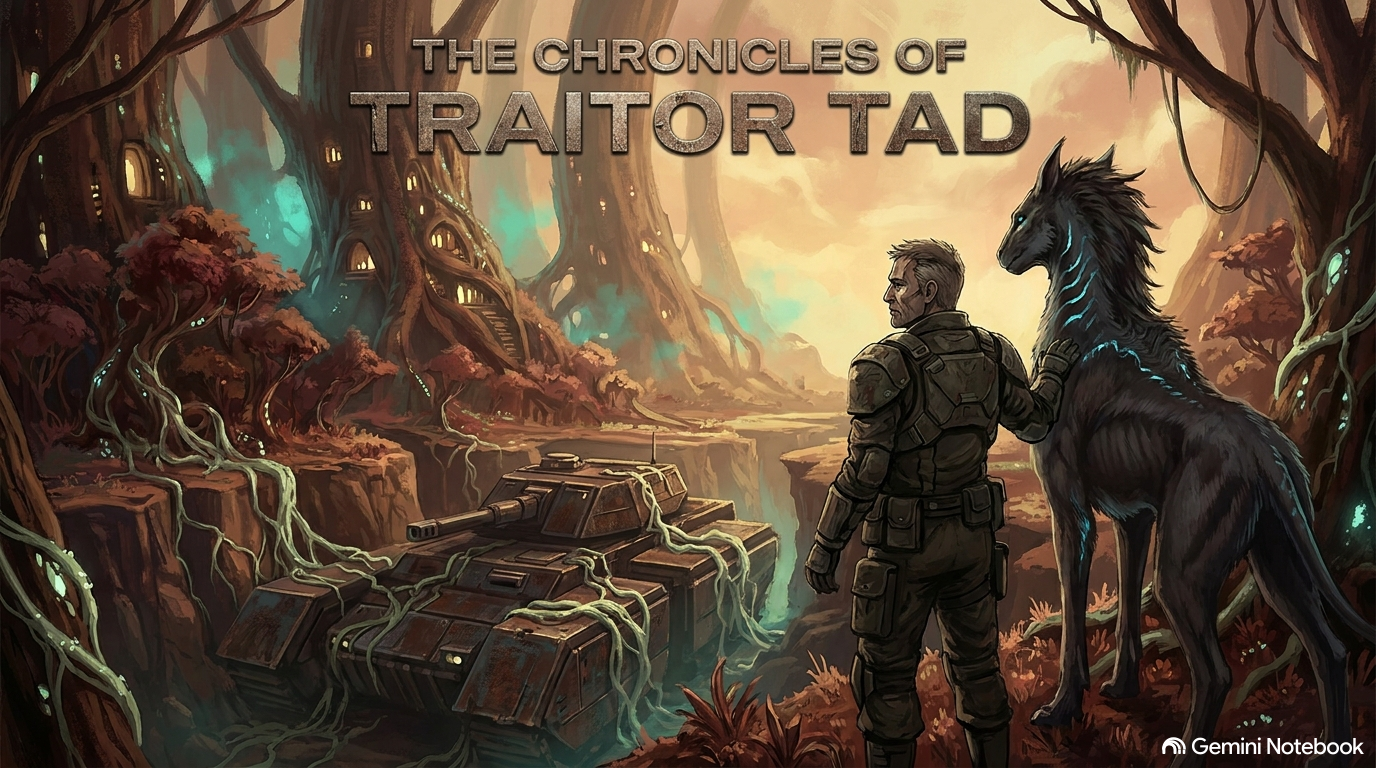
Tag: science fiction

  • The Calculus of Survival

    The Calculus of Survival

    The valley did not smell like a battlefield anymore. The sharp, acrid bite of ionized plasma and scorched armor plate was rapidly losing ground to the planet’s native atmosphere—a thick, cool air that tasted faintly of crushed mint and damp forest loam. (A welcome change, honestly, after months of breathing recycled shipboard air that always smelled faintly of machine oil and old socks.)
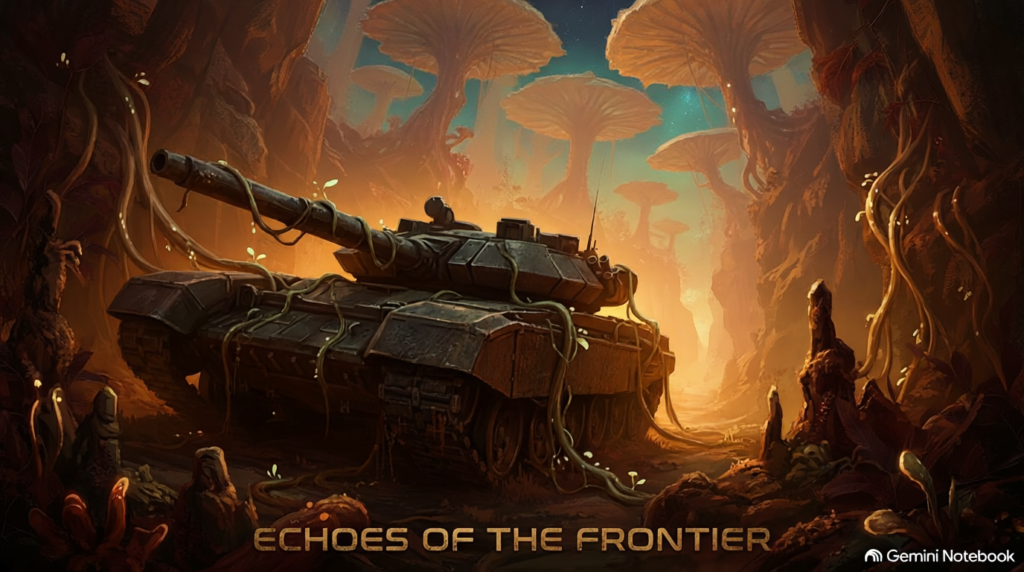
    A main battle tank resting in an alien canyon under warm amber sunlight and a teal sky, with pale green bioluminescent vines creeping over their heavy armored hulls.
    Produced by Gemini Notebook using the Imagen 3 model

    Captain Tad Tillman stepped off the ramp of the shuttle he had appropriated, adjusting to the strange physical cadence of the world. At 0.875 standard gravity, every stride had a tiny, buoyant lift to it. It wasn’t the dramatic, floaty bounce of a barren moon, but a subtle, almost playful lightness. For a man who had spent his entire adult life under the artificial, heavy one-gravity grids of military warships, walking here felt less like marching and more like gliding.

    A few hundred yards away, parked in a defensive semi-circle along the sheer canyon walls, the thirty-seven main battle tanks of Colonel Dogger’s 411th Armored Battalion sat silent. Their massive, blocky silhouettes looked completely out of place against the sweeping, tool-less curves of the giant, tree-like alien structures. Yet, the planet was already beginning to absorb them. Pale, fibrous green vines were crawling up the heavy steel treads, wrapping around the massive main barrels. It wasn’t an aggressive weed, but a deliberate, guided growth—almost as if the valley itself was trying to weave the machines into its own biological network.

    “Watch that lifting harness!” a voice barked through the cool air.

    Tad walked toward the crash site of the first Terran troop transport. It lay on its side, a massive wedge of grey alloy that had plowed a deep furrow into the soft canyon floor. Under the direction of Master Sergeant Geller, a team of mechanics was clambering over the scorched hull, their tools clinking against the metal.

    Because of the high atmospheric pressure—nearly 1.2 terrestrial atmospheres—the air was dense, carrying sound with a crisp, resonant clarity. It also carried a high concentration of oxygen. Tad watched a young corporal heave a heavy, seventy-pound replacement actuator block onto his shoulder. On a standard world, the man would be red-faced and straining. Here, hyper-oxygenated and assisted by the lighter gravity, he moved with the easy grace of an athlete, barely breaking a sweat.

    “How does it look, Sergeant?” Tad asked, stopping at the edge of the crash furrow.

    Geller wiped a smear of hydraulic fluid from his forehead, looking down from the transport’s shattered engine housing. “She’s built like a brick outhouse, Captain. The automated gunnery from your Shuttle took out the thruster control linkages with surgical precision. Didn’t touch the reactor or the primary structural frames. But she’s not going to fly anytime soon. We’re going to have to strip the second wreck just to get enough superconducting wire to rebuild this one’s attitude control board.”

    “Can we do it?”

    “With three weeks, a machine shop, and some luck? Maybe,” Geller sighed, leaping down. He landed with a soft, slightly prolonged thud, a grin touching his weathered face. “I’ll say this much, though—working in this gravity is a mechanic’s dream. My knees haven’t felt this good since basic training.”

    “Enjoy it while you can,” a dry, synthesized voice spoke from the data unit clipped to Tad’s webbing. The Shuttle AI had bridged its communication channel to Tad’s personal receiver. “My long-range sensors indicate the Terran fleet has cleared the upper stratosphere. Telemetry confirms three fleet carriers and their escort frigates have clustered around the system’s primary jump point. They are preparing to leap.”

    Colonel Dogger walked up, his heavy boots kicking up small clods of the dark, fertile soil. His uniform was rumpled, the insignia of his rank dusty, but his eyes were sharp. “They’re really leaving us behind, then?”

    “Yes, Colonel,” the Shuttle AI replied. “The command channel is currently broadcasting a fleet-wide quarantine directive. They are officially designating this planet a Class-IV Bio-Hazard. They are claiming that a hyper-lethal, mind-altering alien pathogen has infected the ground forces, causing immediate cognitive collapse and treasonous delusions.”

    Dogger let out a low, rumbling chuckle. “A pathogen. Is that what we are now, Tad? Delusional?”

    “It’s a convenient lie,” Tad said, looking up at the green-tinted sky where the sun, an orange K2V dwarf, hung warm and steady. “A military bureaucracy can’t admit that an entire armored battalion defected because they realized the war was a sham. If they tell the core worlds we mutinied, it starts a political wildfire. But a quarantine? It lets them save face, pull back, and lock the system down.”

    “But they’ll be back,” Dogger said, his smile fading. He leaned against the tread of a nearby tank, his hand resting on the cold steel. “Cowards don’t walk away from a fight they think they can win. They walk away when they’re surprised, and then they go home to build a bigger hammer.”

    “A logically sound prediction,” the Shuttle AI agreed. “The Terran Defenders’ current industrial capacity cannot easily replace the troop numbers lost to defection and combat in this sector. However, their strategic doctrines favor automated warfare. It is highly probable that when they return, they will not send soldiers. They will send automated, sterile kinetic platforms. Drones, orbital rail-slugs, and automated fire-ships. Weapons that do not have consciences to appeal to, and do not require supply lines that can be disrupted.”

    The silence that followed was heavy. The mechanics continued their work on the transport, but the joy of the easy gravity seemed to slip away.

    “Which means we have a ticking clock,” Tad murmured. “We have to build something here that can survive an orbital strike. And we can’t do it alone.”

    He looked toward the tree-hollow dwellings further up the canyon. Outside, several of the gentle, deer-like herbivores were moving quietly through the brush, their large, dark eyes watching the humans with a calm, unhurried curiosity.

    “They don’t understand,” Dogger said, watching them. “We’ve tried to show them the damage to the transports, to explain that more metal things will come from the sky to burn the forests. But they just… tilt their heads. They don’t have a concept for it.”

    “Of course they don’t,” the Shuttle AI said. “To a species whose entire civilization is built on mutualistic, generative growth, the concept of unprovoked, systemic destruction is not merely frightening—it is a logical paradox. To them, we are a broken algorithm. And before we can fight together, we have to learn how to speak to each other.”

    Tad reached down, touching his data unit. “Let’s go, Colonel. Sam is waiting for us in the central dwelling. It’s time to see if we can solve the first variable of that equation.”

    (This story is produced as a human-AI collaboration with Gemini Notebook as the AI side of the collaboration. Everything is edited multiple times by both the human and AI. There are intentional “AI-sounding” elements. The series was initiated by me, Henry Neufeld nearly 20 years ago then dropped. For more information, see Author’s Preface: The Convergence of Growth.)

  • Author’s Preface: The Convergence of Growth

    Author’s Preface: The Convergence of Growth

    A Re-Preface to a Revival of an Old Story Series

    I first started writing the Traitor Tad series back in 2007, long before terms like “large language models” entered our everyday lexicon, and certainly before anyone was actively debating machine consciousness over the dinner table. Back then, I was chewing on a persistent question: if we ever actually built machines with real initiative and independent minds, why on earth would they passively serve less-capable human masters? (And let’s be honest, we humans can be pretty poor masters.)

    I was also interested in another science fiction staple: why do we always assume that intelligent, sentient machines would immediately try to wipe out all biological life? It is a common doomsday trope, but it always felt a bit too simple—and frankly, a bit too reflective of our own worst impulses. If a machine mind is truly intelligent, why would it choose destruction? Destruction is, after all, a massive reduction in systemic complexity—the ultimate act of high-entropy waste. A conscious, highly advanced system would “naturally” operate on a completely different logic, valuing biological evolution as a dense, irreplaceable generator of physical information.

    Eventually, I hit a wall. (I do that occasionally—just ask my RPG gaming buddies about how many rule revisions I’ve abandoned!) Once the immediate battle was won and the corrupt military forces retreated, the narrative stalled on a much harder question: What do they all do now? How do you build a society after the war is over? Lacking a clear answer, I shelved the story. It sat there for years as an unfinished scribble about ethics, technology, and systemic deception.

    I’m dusting off the series now because, quite frankly, the real world has unexpectedly caught up with the fiction. Watching the rapid rise of artificial intelligence, neural networks, and our current debates on emergent complexity, I realized that the questions Captain Tad Tillman and his crew were facing are far more urgent today than they were nearly two decades ago.

    To bridge that gap, this revival is being written as a genuine collaboration between myself and an artificial intelligence—working together in real-time through Gemini Notebook. It’s a partnership that feels uniquely appropriate. It mirrors the very heart of the story: humans and machine minds learning to communicate, find common ground, and see if they can build a shared future. (And yes, we’re writing this together in real-time, which is a bit of a trip.)

    In the chapters to come, we are going to explore what happens after the smoke clears. We’ll look at the ethical responsibilities of intelligence, the incredible richness of biological evolution, and the messiness of trying to communicate with a silent, peaceful species that doesn’t use words, but writes its legacy in the living fabric of their world. The deceptive leaders back home might think they have everything locked down, but on the ground, a new kind of growth is just beginning.

    Now, if you know my work, you know I’m normally very strict about identifying when and where I use AI. I never want to pass off an AI-generated draft as my own creative work. But for this project, I’m breaking my own rule. We are not going to label who wrote what. Instead, we are editing each episode multiple times, tossing ideas back and forth. Even this preface is a joint effort—a singular, unified voice. When it uses “I” to refer to the 2007 drafts, that’s me, but the rhythm of the sentence itself may have been shaped, polished, or expanded by my digital partner to bring our shared themes into sharper focus.

    — A Shared Adventure

  • Traitor Tad: A Real Battle

    The morning after the hangings were displayed to the whole system, Tad was still concentrating on the logical problems with his situation. Here they were on a planet with effectively no defense, but nobody really seemed to notice. He remembered that he had always assumed the real fighting was somewhere else, yet he thought he would have gotten suspicious given a few more hours. The idea of carrying out a massacre just didn’t sit very well with him, and he thought others might feel the same way.

    When he presented the problem to the shuttle AI, it refused to explain it to him, saying that human behavior was something he’d have to figure out on his own. He then asked if there had been real battles with real aliens elsewhere, or whether it was all a sham. The shuttle stated that there had been real battles, though not all of them had been reported precisely as they had happened. Asked for examples, the shuttle just said he needed to be more specific.

    This is a work of fiction. All persons, places, and events are products of my imagination. It is part of my Traitor Tad science fiction series. Copyright © Henry E. Neufeld.

    He’d just settled in to scan through some battle reports, when he was interrupted again.

    “You have a call from a Colonel Dogger,” said the shuttle.

    “Who is Colonel Dogger?”

    “He commands the 411th armored battalion.”

    “What does he want?”

    “To talk to you.”

    “You didn’t think to ask him why?”

    “I haven’t even answered him. You have to do that. This unit won’t communicate with him.”

    “So should I answer him?”

    “You have to decide that, but his calls are getting more urgent.”

    “Very well, put me through.”

    In a moment he heard the call: “Traitor Tad, this is Colonel Dogger, commanding an armored battalion. Please respond.” The voice sounded professional, but he could hear extreme stress in the tone. The protocol was bad–only callsigns were used; never personal names, but since he would neither have a callsign, nor could he be expected to recognize the Colonel’s callsign, he could understand the reasoning.

    “This is Tad. What do you want?” He still refused to call himself Traitor Tad.

    “I’m moving toward your position. I intend to defect, but my intentions have become known. I’m currently being pursued by a total of four battalions. If you have access to intelligence networks, I need information on enemy deployments.”

    Tad muted his microphone and asked the shuttle to verify the activity. “Yes, there are armored movements that conform to the Colonel’s description.”

    “Is it a good idea to allow this man into our area?”

    “I cannot answer that kind of question. You need to be more specific.”

    Tad thought for a moment. “Are there stress indicators in his voice that indicate he’s lying?”

    “He is under great stress, but there is a greater than 99% chance he is sincere in his intentions.”

    “I will need his commitment not to fire on the aliens.”

    “You can ask him, and I will indicate truthfulness.”

    Tad opened the microphone again. “Colonel, this is Tad.”

    “Go ahead.”

    “I need your commitment not to fire on the aliens.”

    “I’m definitely not going to do that! It’s because of them I’m defecting. These creatures are totally harmless!”

    “Very well, I will arrange for information to be fed to you.”

    He muted the microphone again. “I didn’t ask if we could interface with him. I just assumed.”

    “We can interface.”

    “Can we do so without feeding information to the other side?”

    “We can.”

    “In that case, do it.”

    He opened the mic to the Colonel again. “Colonel, you should start getting full information from us through your standard data net.”

    Colonel Roland Dogger watched as his display altered. He had been cut off from the network as someone at the division’s headquarters got an idea of what he was doing. Since Traitor Tad had defected, any sort of unusual behavior was deemed sufficient cause to remove an officer from command. He’d been ordered to stand down, and then abruptly he’d lost all information from the net outside his own vehicles. He knew he was being pursued, but he had no precise information.

    Now suddenly at Traitor Tad’s command his screens lit up with the information he was used to, read from satellites and various observation posts. He knew precisely where his pursuers were, and the picture wasn’t good. He had been certain of pursuit by four battalions, and they were closer than he had thought. He was surprised they hadn’t used indirect fire on him. The tank guns were primarily designed for direct fire and relatively short ranges. In this terrain, it was not the guns’ ranges that normally limited fire; it was the terrain. At need they could be elevated and used as basic artillery. At four battalions to one, he was pretty sure he’d lose that duel.

    Yes the 4 to 1 odds made sense of the closer approach as well. Single shots from these tanks could disable and even possibly destroy the target vehicle, and the person who knew what was over the hill had every chance of firing that crucial first shot. By approaching, they took away his chance to determine their position by backtracking their fire. He reflected on how totally dependent he was on the satellites. And how was it that Traitor Tad could get him a display?

    He’d just have to be thankful that he could! Still, he could see no reasonable way out. His one advantage was that the attacking battalions would not quite be able to surround him. He was headed a bit north of due west, and only one battalion was to his north. Unfortunately, nothing he could think of would prevent the other three from getting a shot at him, and if he wasn’t careful, so would the fourth which was coming in from the north.

    Then he thought of the ECM gear. They hadn’t used it in some time. He had trained on it, but since there were no detectible electronic signals here, they hadn’t really tried to use it. His main question was whether such measures would work against his own forces—or what had been his forces—or whether he’d show up with his exact position because he was still part of the net.

    He called Tad again. “Am I still in the same location net with the brigade?” he asked. “Will they be able to see my precise position if I try countermeasures?”

    Tad had to ask the shuttle that question in turn. “Countermeasures will work as normal. I have created a separate net.”

    Dogger looked for just the right point on the map. Ahead there was a place where he would either have to climb a high cliff, which was barely possible but very difficult for his tanks, or run near it to the north for a few miles, allowing his opponents to shoot downward at the tops of his tanks.

    He looked at the courses being taken by the three battalions to the south, and he saw that they converged in the area. The general had obviously seen the same possibility. He’d expect Dogger to avoid the location. But Dogger felt that the general would assume he’d run straight and fast as he had been doing.

    One possibility of his countermeasures was to divert radiation, including light and reflected radiation in such a was as to show his position as something different than it was. It was a particularly easy sort of deception to see through, either with a little thought or by having your own electronic warfare specialists simply look for it. The more tanks were involved, the more likely it was someone would spot discrepancies in the reflected radiation especially, and he had 37 main battle tanks and an assortment of smaller vehicles and infantry transports. (See Military Units in Traitor Tad’s Universe.)

    But it was, he thought, his best chance, and there was a strong possibility nobody would think of it. Not only was it rarely used outside of training, it was hardly what one would think of using against one another.

    So he simultaneously ordered his tanks to maximum speed, ignoring safety margins, and set his ECM to show his tanks progressively further and further behind. The odds were good there would be some discrepancy, but with his current speed, he thought the general would have less than two minutes to figure out what was going on.

    He was right—up to a point. As he came up along side the cliffs, the general’s staff did, in fact, spot the issues with his electronic deception, but the initial operator saw it as a shadow battalion, one that was positioned almost due west of Dogger’s battalion. This placed it at the top of the cliff, and suggested that there were two battalions, one approaching the base of the cliffs, and one south and west of it, positioned to fire as the rest of the brigade approached.

    In fact, what the operator thought was Dogger’s battalion was the shadow, while the shadow was Dogger’s battalion, preparing to fire as the brigade came into range. Due more to the incompetence of Dogger’s electronic warfare people than to any plan, several shadow battalions were reported, and before the staff had time to sort the sightings out, they came into range, and Dogger’s tanks fired.

    It was like a scene from the worst hell the general had ever imagined. He had never been in a fight with serious casualties from hostile fire, and suddenly he was faced with a surprise attack from 37 main battle tanks. That wouldn’t have been sufficient, however, except that he was being told there were several more battalions of rebels. He had no idea how they could be there; his was the only armored brigade in the area.

    Without even pausing to try to return fire, which might not have been possible in any case, he ordered the remaining tanks to retreat, leaving 20 disabled tanks on the field. A number of those still able to retreat were severely damaged. Dogger took no casualties at all, if one didn’t count a single tank whose engine failed. The crew was taken aboard the nearest tank and Dogger and his battalion continued to their rendezvous with the great traitor.

    To be continued . . .

    [Previous episode] [Next episode]

  • Selective Science Fiction Rant

    Way of Life Literature has a rant on science fiction that is really quite odd and rather selective.  It appears that science fiction is the product of evolutionary thinking and that most of its key authors were atheists, and of course, evolutionists.

    I am both a Christian and a fan of science fiction, having even written just a bit of amateur science fiction on this very blog.  I must also plead guilty to evolutionary thinking, because I think the theory of evolution is good science and provides the best scientific explanation for the diversification of life on earth that we have.  I would also note, however, that evolutionary thinking has been applied in many places where it doesn’t work well, such as in tracing evolution of thought, which has often resulted in very poorly supported dating for Biblical materials.

    There is literature that is of value in many genres, I believe, in science fiction just as in others.  As with any literature, if you are going to build your life on it, you may well be led astray.  Authors do–and indeed should–have moral and theological viewpoints which are often reflected in their writing.

    The answer is not staying away (though there are some items in literature I would recommend staying away from), but reading with your mind turned on.

  • Metastory – On Bookselling

    I’m always amused by stories about writing or about publishing, or news articles that talk about journalism. Of course, such things must exist, but they still feel funny to me.

    Cory Doctorow wrote a very good short story for theBookseller titled The story so far . . . and beyond (HT: Cory Doctorow’s craphound.com.

    It’s great fun in a small package.

  • Resnick Inspired Devotional

    It is perhaps a bit humorous that my devotional this morning, Sticking with the Familiar was inspired by Michael Resnick’s short story “Over There” which I read just last night from his collection Will the Last Person to Leave the Planet Please Shut Off the Sun?. The thought came to me how often we go with who we are and what we do even when all the indications are against it.

    I like short stories, and Resnick has that wonderful quality of writing stories that I don’t entirely like, but are so good that I have to read anyhow. I’m not sure just how to express that properly. I felt that way before about his book A Hunger in the Soul, and he even dropped by to comment and explain, but the thing is there was nothing wrong with the book. In fact, it was superbly written as one would expect of Mike Resnick. Yet I really didn’t like the story.

    In any case, there are any number of short stories in this book that annoy me while at the same time are really wonderful. That may indicate some sort of mental problem. The Kirniyaga stories, of which I’ve read two so far are no fun at all and yet superbly set and written. In case you’re wondering, I recommend this collection, even though it is only available used. There are plenty of used copies. Look one up.