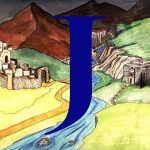
[Note: This story gives some idea of the imaginary Jevlir Caravansary, after which this blog was named.]
The Jevlir Caravansary is just across the river from the small, but well-fortified town of Jevlir. Immediately to the west, the great east-west caravan route enters the pass of the mountains, variously known as the East Enzar range, Malkuthim range, or God’s Backbone. The ancient road once led from sea to sea, and theoretically still does, though nobody can recall anyone making such a journey.
Theoretically also, Jevlir’s mayor and town council owe their allegiance to the baron (who has more variants to his title than the mountains have names), who in turn theoretically owes his allegiance to the Duke, resident in Aagerinar, far to the east. At the time of our story, the baron is only marginally aware of the name of the duke (Alexander II), and rather than giving allegiance to any hereditary noble, the various members of the town council are owned by different merchant houses, and it is rumored that some are owned by bandit chiefs. It is also rumored that some town council members are owned by more than one person.
Caravans come to the caravansary and generally spend just one night. If they are headed east, to Aagerinar, they will leave their extra guards here, and proceed with only reasonable security. Unreasonably tense security is the rule in the mountains. If they are headed west, they will hire some of the guards that others have released. There are guards who spend their entire careers guarding caravans along this route. The pay is good for any who survive. Occasionally someone even survives long enough to retire, and the Caravan Guards Guild pays a handsome pension to any who make it, though the total pension payments form only a small part of the guild’s budget.
Next to the caravansary, between it and the entry to the pass, there is the ruin of an Enzar temple. In this area that means the building is at least 3,000 years old, though from the outside it looks nearly whole. Those who claim to have seen the inside–a very small number–say that it is completely gutted, and it looks like the stone itself has been burned away in places. Very few bother to investigate Enzar temples unless extremely large treasure is to be expected, and none of the folks who claim to have seen the inside appear to be rich. Thus the temple is avoided by all.


Just now, Jared, Lieutenant in the Ducal army of Alexander II, is standing outside the temple on the western side, looking at the body of his captain. The cause of his death was altogether mundane and obvious, apparently having nothing to do with taboos about the temple. A heavy crossbow bolt was stuck in his neck. All of this took less time to see than it does to describe, and Jared, along with the four soldiers who were with him dropped to the ground, presenting less of a target. It looked, however, as though the captain had been dead for at least a couple of hours. It was unlikely anyone was about to shoot them now.
Jared got to his knees and scanned the cliffs to the west. The entrance to the mountain pass was quite rugged, and there were many places to hide–too many to allow certainty about where the shooter must have been. Sending one guard north and one south, Jared called on his sergeant and the remaining guard to look around for anything obvious. All of the captain’s equipment was still present. He had not been robbed. They found nothing else to indicate what had happened.
“Why was he in this location?” asked the sergeant quietly. It was a logical question. There seemed to be no good reason to expose oneself in what was probably the best position in the Jevlir area to make oneself a target for a crossbow bolt. With that thought they picked up the captain’s body between them and moved him around to the northern side of the temple. It was not precisely a safe position, but at least it was a position where nobody had yet been shot today. The two guards followed.
When they got there, Jared looked at his sergeant. “I’ll take two of the men and head downstream, staying on the northern side of the river. We’ll cross back at Peorlar and go to the camp. You go back to the village and tell Lt. Qerelir to make a show of moving out of town and heading east. And remember, I don’t want anyone who doesn’t already know to suspect the captain’s death.”
“One change, Lieutenant.” The sergeants voice was respectful, but also determined. “You go back to town and get the company out. I will take the captain’s body.”
Jared was silent for a moment. Was it time to assert his authority? The sergeant was right. He was the best man to go back into town, while the sergeant could easily get the body to the required place. People would hardly believe the company was leaving on routine business if the sergeant came back and then they hurried off.
“Very well, sergeant, but be careful. Leave the crossbow bolt where it is. I want Qerelir to look at it.”

In town Jared had to break the news to Qerelir, who was Kelaru, and thus regarded automatically as a much better woodsman. She was also older than he was and more experienced, but he still outranked her by days as a Lieutenant.
He needn’t have worried about her reaction. As soon as he told her his plan, she went into action. The innkeeper was informed that folks who were occupying his courtyard were about to leave, that the captain had already headed out of town and the troops were obliged to follow. Soldiers started discussing what they would do when they got back to the big city. Jared was pretty certain none of them believed they were actually on their way home, but they put on a good show. He remembered this same group less than six months ago as they left on this mission, each quite skilled as warriors, but lacking teamwork. The captain had taught them to read one another and cooperate. Now it was paying off.
In less than an hour they were on the road. Once they were out of site of Jevlir, Jared signaled Qerelir to join him. “The captain is dead,” he explained.
She showed now sign of shock. “I was certain of it, and I’ll bet half the troops know it too. But obviously you wanted to leave without people realizing that.”
“Yes. I need you to look at the body. We found it between the temple and the mountains with a crossbow bolt through the neck. I need some idea of how he died.”
“Did you say ‘through the neck’ as in the point sticking out?”
“Yes.”
“That’s odd. When you said he was north of the temple I immediately assumed sniper. A good heavy crossbow could just do it from the cliffs, but I doubt it would go all the way through. In fact, such a shot would risk failing to kill instantly, and the captain carried an excellent healing amulet, courtesy of the pretty priestess.”
“Well, my initial question was why he was back there. But how could anyone get near enough with a cocked crossbow? There’s no cover.”
“Are you sure he was actually shot there?”
“We found nothing at all, but the ground is hard. There’s no way to tell.”
“Probably not.” Was Jared just imagining that she was thinking she would have been able to tell?
“Do you know where the captain was going?”
“I think he was meeting his source at the caravansary. I have no idea whether he got there or not.”
“When we get back, I’m going to have to go there and do it alone.”
Qerelir looked at him for a few moments. He was afraid she was going to argue and suggest that he needed to take additional people along. It was essential that he do this all without getting noticed. But after staring at him a bit she just said, “OK.”
As expected, there was no difficulty meeting with the sergeant and his men, and then the troops prepared to return to Jevlir, this time on the southern side of the river. A little ways east of the town they settled into a hidden campsite. It was hard to be certain nobody would come across them, but they were fairly safe.
Yaran was not the sort of person you really wanted to know. For one thing, he smelled bad. His clothes were dirty, he was generally drunk, and his speech was slurred and not terribly interesting. When anyone could manage to understand him, he was generally asking for money to buy more beer.
Yaran lived at the Caravansary. He did not live in it, but sort of at it and around it. He regularly moved from place to place, sometimes because he was ordered to get out, and sometimes just because he didn’t want to stay in one place long enough to be noticed.
In the Caravansary Inn, designed to provide a bed, showers, and decent food for those merchants who could afford it, four men gathered around a table by the window. One of them looked out the window and saw Yaran there on the ground just outside.
“It’s OK,” he said to the others. “It’s just the old drunk.”
“Here’s the deal,” said the second man. “We have 6,000 silver valors to add to the pot if you will take care of him tonight. Remember, this is as important to you guys as it is to us. We just need the timing changed.”
“What about the commandos?” asked the third.
“Don’t worry about them,” said the second, “I’ve arranged for them to be otherwise occupied. In fact, I believe they’ve all left town, which will make even that unnecessary. Just in case, however, I haven’t canceled my little diversion. They won’t fail to go to the aid of the pretty priestess.” He chuckled.
“OK, go with it. He’ll be coming into town tonight to meet with the young militia officers. You can do it after he leaves town on the way home.”
“I prefer it during the dinner,” said the second man.
“Do it however you want,” said the first. “We can’t allow him to continue cooperating with Aagerinar. None of us can. If the Duke’s troops set up here permanently it will be bad for business.”
Jared set out for the caravansary. He was not a foolhardy man, and he was not happy to be following the course that had probably led to his captain’s death, but he needed the information that had gotten his captain killed. At least he expected that if the captain was contacting a source and then got killed, there was probably a connection.
It was after dark that he entered the caravansary grounds. It was impossible to approach the caravansary quietly and subtly, because one had to cross a long bridge across the river, and the bridge afforded no cover at all. Jared removed all insignia prior to crossing, and his normal clothing and armor did not distinguish him from the many caravan guards who were a common sight. Unless someone recognized him personally, he would be fine.
He handed his horse’s reins to one of the stable boys, and headed for the bar. He uttered the appropriate insult as he passed the form of the source, and knew that once he had taken time for a drink he would find the man in the stables. He needed that drink just now.
After a few minutes spent with some quite decent beer, Jared wandered slowly outside and sauntered over to the stable. He was still carrying his beer mug and looking rather casual. He stopped and checked on his own horse. Seeing that the fine animal was well cared for he continued down the line, finally finding an empty stall, and in the back, Yaran the drunk. Unknown to the regulars at the inn, this man was also Yaran the security agent, whose specialty was collecting information where others would be noticed. As he sniffed, Jared thought the agent played his part a bit too thoroughly
“What news?” he asked.
“You’re not Porivinar,” replied Yaran.
“Indeed I’m not. He was shot earlier today. That makes anything you know doubly important.”
“It’s a good thing I know you. If I didn’t I wouldn’t care how many passwords you claimed to have.” He ignored the fact that no password had been offered, nor were any used in this area. Personal recognition was the standard. Yaran was just trying to put him off balance, an almost instinctive activity for him.
“Your news?” insisted Jared.
“Who shot the captain?”
“We don’t know. Did you see him today?”
“No, and I was expecting to.”
“What did you have for him.”
“There is a plan tonight to assassinate the baron’s heir, Jerard. The folks I heard didn’t give a name, but he’s coming into town tonight, and they think he cannot be permitted to keep cooperating with Aagerinar. That eliminates the old baron himself, who doesn’t cooperate with anyone. So they’re going to kill Jerard. They’re planning a diversion at the Ecumenical Temple to distract you.”
“That makes sense. But why kill the captain?”
“You said he was west of the temple, toward the mountains?”
“Yes.”
“Did the crossbow bolt penetrate very far?”
“No. Qerelir already noted that. She thinks he was killed elsewhere, by somebody close.”
“Porivinar would have seen anyone that close, and would have defended himself—probably successfully.”
“Unless he met someone he knew and trusted.”
“Trusted? Hardly. Knew, possibly. Someone had only to offer him information and he’d make the meeting. On the other hand, he might have been surprised.”
“Surprised? That would be a trick with Porivinar.”
“But it could be done.” Jared looked thoughtful for a moment. “I can think of at least one thing that would work.” After another pause he said, “Keep listening, Yaran. I have some things to check out.”
As he left, Jared was thinking about Porivinar’s movements before his death. He couldn’t figure out why Porivinar would be carried behind the temple if that was not where he was killed. He thought back through the process that had led him behind the temple. A stable boy had told him he saw the captain headed that way, so there were a limited number of places he could have been killed. From the caravansary west and north there was nothing, not even farms.
He had immediately gone around the temple, but he had never thought to look inside. It was universally assumed that you didn’t go into old Enzar temples unless you had a specific reason to do so and a particular plan in mind. Despite the many stories of people getting killed in such places, it really wasn’t all that likely that a temple that had been sitting by the main road for 3,000 years was going to have active traps in it. It was just that the phrase “old Enzar temple” had come to be synonymous with “you’re going to die.”
So would Porivinar have checked inside? Jared was certain that he would have done so, and that he must have done so. Without thinking to go get some help, he set out for the temple.
There were few gaps in the wall, but one could enter from the east side in a couple of places. He kept low as he approached and carefully peeked around the corner. Inside he was shocked to see the light of a number of torches and numerous armed figures. It looked like a small army was camped inside.
So this was why the captain had died! He had obviously heard or seen something that made him suspect that there were enemies hiding there, and he had gone to check. Unfortunately, he’d done it in daylight and someone had been waiting for him. He didn’t stop to ask why someone who had a body quite well concealed in a building nobody wanted to enter would take it outside and leave it lying around to be found.
He heard something fly past his head, and suddenly he remembered how completely vulnerable he was. Not only could he be surprised in the darkness, he could be overwhelmed by numbers. He would die so quickly nobody at the caravansary would be likely to notice. He started to run and didn’t stop until he was almost inside the caravansary compound. Then he stopped and tried to compose himself so that he wouldn’t be so noticeable as he crossed it. He retrieved his horse and rode quickly back to the hidden encampment.
A company of Aagerinar elite scouts was a fluid organization, usually consisting of one or two platoons of 20 or so persons each and several teams that could be any size smaller than a platoon. Jared’s company had two platoons, his own and Qerelir’s, and five 5-man security teams.
He gathered Qerelir and the team leaders quickly and didn’t ask for discussion—he just gave out orders. Three teams were sent to add security to Jerald’s meeting, two to warn and help protect the Ecumenical Temple. If needed, they were to support the baronial heir’s security. The temple was important, being headed by a priestess loyal to the Duke, but it was not as critical as having a baron here who would truly acknowledge his duties to his lord.
Qerelir had questions, but she came from a long tradition of Kelaru scouts, and they knew how to take orders. They were full of advice when asked, but when ordered, they obeyed. Jared might have feared she would regard herself as his superior. In fact, his few days of seniority meant everything to her. She wished she was senior, but she wasn’t, and that settled it as far as she was concerned.
Jared elected to stay with the teams in town. Qerelir was an excellent tactician. If she couldn’t win the battle around the temple, he knew he probably wouldn’t make any difference.
Qerelir put one platoon in a loose line designed to cover as much ground as possible and kept the second ready to respond quickly wherever an attack might come. Jared had ordered her not to try to attack the force in the temple. The scouts had the superior firepower in the open. Inside the building they could be easily trapped and destroyed. She was happy to obey those orders. But there was something that bothered her about this situation, and after a few minutes of waiting she started to mentally list her concerns.
- Why hide troops in the temple? Besides superstition, which would make it hard to get most troops to stay inside, there were caravan guards all over the town and caravansary. Nobody worried about another few armed men running around Jevlir.
- How would they get to town without being spotted and stopped? Jared wanted her to meet them before they got to the caravansary so as to keep from involving the civilians there, but there was no way to get to town except over the bridge, and one person could notice them there and report them. Qerelir agreed that they did not want the fight to be at the caravansary itself.
- Why had they made it so obvious? It was almost as though they wanted someone to find the captain’s body.
With that thought she became certain. She could not abandon the watch here just because she was certain that she was guarding the town against nothing. She called her sergeant over and told him to take command. Then she slipped forward into the night and approached the temple herself. It was the work of a few minutes to get a look through the same break in the wall that Jared had used. Inside she saw the torches, but with more time to check she looked carefully at what was casting the shadows. She couldn’t get a very clear look. She took out a magical lens, a gift from her father, also a scout. It allowed her to look for the magical lines of force.
And there it was—the magical manipulation of the light, producing shadows on the walls and the appearance of torches set around the walls. Jared had no such device, and had had little time to look, but she was now certain.
She backed away from the wall and immediately whistled a command to her troops. They mounted quickly, and her sergeant brought her horse to her. Then they galloped for Jevlir. Qerelir hoped she wasn’t too late.
In the meantime Jared was thinking very similar thoughts. He could feel an attack coming. The hair on the back of his neck was standing up. It was not outside near the temple, but here in town that the attack would come. His security teams were inside the building could take care of anyone there. He was watching the street.
The team leader of the one team he’d kept outside approached him and asked him if he had noticed several armed men heading toward the Ecumenical Temple. He had. But he had to keep the teams here. The two teams at the temple would have to take care of themselves.
He wondered if he should send a messenger and call Qerelir back, but it seemed likely that if she hadn’t figured things out by the time a messenger got there, she’d be too late, so he kept all his men with him.
At the Ecumenical Temple dozens of followers had come to join in the defense of the temple. The gate was barred, and people were being admitted only on personal recognition. Alina, known as “the pretty priestess,” knew very well that a determined attack by as few as a couple dozen people could overrun her temple. She only had three truly trained guards along with her own magic. Her followers were brave and determined, but they had received less than two weeks of training in their spare time.
She and the security teams were quite certain they could see people moving into position, but they could not do anything until there was an attack. It was important to the temple and to the Duke’s forces as well that they be seen as totally obedient to the law.
It started with bottles of heating oil and flaming arrows. The temple building was quickly on fire, and there were patches of burning oil around the compound. The security teams were able to take an occasional shot, but it was hard to tell what was happening. It would not be long before they would have to abandon the compound. Clearly that was their attackers’ intent.
Alina wondered why they were making the attack so obvious when they could have won quietly without attracting attention. But however much she might question their approach, it was definitely working. Then she heard a cavalry horn giving a signal she didn’t recognize and she saw horsemen coming up all the approach streets from every direction.
The fight was remarkably quick, but the the cavalry didn’t stop to help them fight the fire. That turned out to be something that her local followers were good at.
As Qerelir and her troops arrived at the Ecumenical Temple the attack started at the dinner where Jerald, baronial heir, was the guest of honor. The outside security team spotted people approaching from the outside. The main attack, however, came from the audience. Every young officer in the city militia and the baronial guard was there with their weapons.
It was a quick draw of a sword, but one of the security team was watching closely and threw a dagger directly into the man’s sword arm. The delay and confusion allowed Jerald himself to draw his sword and step back from the table. Soon everyone was armed and had displayed their chosen sides. The attackers waited for the help that they thought would come from outside. This was to be a massacre, not just an assassination. The security teams didn’t want to kill the attackers. They wanted to question them and find out who had hired them.
Minutes went by with everyone looking for someone else to make a false move. It almost looked like the room was frozen in time. Then Jared stepped into the door and addressed the room.
“I don’t know if you’re aware of it,” he said, “But under Aagerinar law if you can prove that you were hired by someone for a job, such as the assassination of a nobleman, then you are not held guilty. The penalty for attempting such an assassination is death, and I have control of the area outside of this building. I’m wondering who would like to be hung tomorrow morning, and who would like to prove to me that you were hired for the job.”
There was a clatter of swords on the ground. “How do we prove we were hired?” asked one man.
“Well, you could have a certified hiring document.” Jared noticed their blank looks. “Or if you don’t have one of those, you could just identify the person who hired you.”
They couldn’t wait to give him names.
It was a sunny day two weeks later when Jared and Qerelir were both present as the flag of Aagerinar was raised over city hall in Jevlir. Also present was General Ezbah of the Aagerinar Elite Scouts. Several officers had come with her, and both Qerelir and Jared were wondering just who their new commanding officer would be.
In her own informal way Ezbah walked over to the two of them after the ceremony and tossed them new insignia of rank. Both were now captains—equal in rank.
“You’re probably wondering what your assignments are,” Ezbah said.
“You could say that,” said Qerelir smiling.
“We’re forming a new company to work the border here. Jared, you get the current one. Qerelir the new one. You’ll be working the northern side of the river,” she said, looking at Qerelir.
Then she looked at Jared. “You’re thinking I either didn’t read or ignored your report. You’re thinking you don’t deserve promotion, and your sense of fairness doesn’t let you feel happy about it if you don’t deserve it. Well, let me tell you something. I like officers who can learn. I like officers who can evaluate a situation, including their own weaknesses. I couldn’t have evaluated your actions any more cogently, nor could I have recommended any better corrective action.”
She started to leave, then looked over her shoulder. “Just make damn sure to take the corrective action you recommended!”