Author: jevlir

  • Book: Retief’s Peace

    I’m a big fan of Keith Laumer. In different moods I like Retief and the Bolo series. William H. Keith, Jr. has now been extending that series, and this little book is great fun.

    Especially with humor, I’m really leery of a new author taking something over. Will the charm and fun still be there? Keith has managed to accomplish the near impossible–a new Retief book that is just as much fun as the old ones. We find Retief again avoiding promotion by being excessively competent and willing to point out the errors of others.

    There’s a new species intent on conquest, the mysterious Krll, who are apparently intent on conquering peaceful planets and generally creating havoc throughout the cluster. The question is, what do peace protests, drug lords, and disguised five-eyed, sticky fingered Groaci diplomats have to do with it all?

    Enjoy!

  • Book: A Gathering of Widowmakers

    This is the first Mike Resnick book I’ve read, and I must admit that it struck me as simple, straightforward, and really quite a lot of fun to read. This is actually well into the series, and I’ll have to make up the older volumes over time, but it’s a fun story. The original widowmaker now cured of the illness that once required that he be frozen to await a cure. There is a new, young, recently trained clone on the job. He’s better than the old widowmaker, but is he wise enough?

    I’m rating this book a 4. I plan to look at more works by this author.

    Energion.com Author page for Mike Resnick
    Energion.com Series page for the Widowmaker series

  • Book: Imitation in Death

    What more can I say about J. D. Robb and the various books about Eve Dallas? I just enjoy the character interaction. They’re not too over the top in forcing me to think, thus being good reading after I’ve read all the serious stuff for the day, and did I mention the characters? They’re just fun.

    In Imitation in Death, J. D. Robb/Nora Roberts brings us the summer of 2059 and a serial killer who imitates serial killers, but not the same one twice. This one will lead us through a walk through history (and the series fictional history) and a look at some of the things that just might make a murderer.

    In the meantime, Peabody is distracted by preparation for her detective exam, and also the terror of actually taking it. How will the pair work their way out of this one? At least Roarke and Eve aren’t fighting.

  • Easter Morning Resurrection

    [Since this is contemporary fiction, and it may not be obvious, all persons and events in this story are fictional. Any resemblance to actual persons or events is purely accidental.]

    Dr. Philip McDermott was brutally awakened at 4:00 AM by the ringing of his phone. He was not on call for the emergency room that Sunday, but as the single trauma specialist in the county, he was always a backup. In this small town the number of cases that would require his attention was small, so he rarely worried about it.

    “Hello?”

    “Dr. McDermott?”

    “Yes.”

    “We’re going to need you this morning. There’s an accident victim, a young girl, being brought here with massive injuries.”

    “I’ll be there in five minutes.”

    And indeed he could be there. As he quickly dressed, then jogged the two blocks to the hospital, he wondered briefly why they had not taken her immediately to the nearest trauma center, but he immediately realized that the helicopter needed must already be out, and the EMTs on the spot must have thought she wouldn’t make it in the ambulance.

    As he entered the emergency room, the scene was chaos. This emergency room normally responded to things like serious colds, and the occasional accident victim who would be treated and released. The ambulance had just arrived, and the girl was being carried in. It seemed her parents had made as good of time as the ambulance, and her distraught father was interfering with the E. R. personnel as he tried to get answers and reassurance.

    He realized that his first step in treating the girl would begin with her father, so he took hold of his arm, looked him straight in the eye and said, “I’m Dr. McDermott, trauma specialist. We’re going to do everything possible.” He held the father’s eyes for a moment longer, and saw him settle, then he turned to the girl.

    She was 10 years old, what was left of her. Her mangled body lay in stark contrast to the white sheets. It’s amazing, he thought, that she is alive at all. How can I possibly manage to stabilize her enough to move? How has she survived the ambulance ride thus far?

    Irrelevantly, it seemed to him, his scripture reading for that morning’s Easter Sunrise service came to mind. That was where he had thought he would be this morning, but he now knew that no matter what happened he wouldn’t be reading it:

    (25) Jesus said to her, “I am the resurrection and the life. The one who believes in me will live, even though he dies, (26) and everyone who lives and believes in me shall never see death forever. Do you believe this? (27) She said to him, “Yes, Lord, I believe that you are the Christ, the son of God, who has come into the world.” — John 11:25-27

    Silently, he repeated part of the last verse to himself. Yes, Lord, I believe.

    He set to work. He was glad to see across from him Nurse Williams. Nobody ever called her anything else. It seemed that “nurse” was so much a part of her that you couldn’t imagine her as anything else. He always just called her “Nurse” and she called him “Doctor.” New people in the ER thought that they must not like each other very much, but those who hung around came to realize that each thought the other was precisely what their profession should be. To them there was one Nurse and one Doctor in this town.

    As he worked, he found prayers passing through his mind under his thoughts on what to do next. If they had really been part of his conscious thinking, he would have dismissed them. Though he was a believer, one of his core beliefs was that when one carried out medical procedures, one did so with total concentration, heart, mind, and soul. Applying the best medical care was not just the most important thing; it was the only thing that mattered.

    Thirty minutes later he was notified that the helicopter was heading their way. It would still be another 20 minutes getting to them. Would they be able to move the girl, or should they go on to something else? He looked at the vital signs, and at the work he had done already.

    “Tell them to come on. We’ll have her ready for them.”

    The next 20 minutes were nonetheless filled with activity for him. He remained totally calm and focused. One thing at a time. Push everything else out, and focus on one thing. Yet still he knew that as a background to each and every decision, each and every move he made there was a praying voice in his head.

    They passed the little girl to the trauma crew on the helicopter, still in critical condition, but with every chance of surviving the flight to the hospital. He had every reason to hope that with good care she would make it.

    He talked with the girl’s parents and sent them on to the city, then he settled in to make notes on the chart. He was amazed as he looked at the list of things that he and his team had done in less than an hour. He was more amazed that they had not declared the girl dead some time ago, and that his conversation with the parents had not been to pass on the bad news, but now to give a message of hope.

    Nurse Williams stopped him as he put down the chart. “Doctor?”

    “Yes?” She never stopped him unless she had something medical to talk about.

    “Were you praying as you worked on that girl?”

    “Was I?” He paused. Then he remembered. He must have said something aloud. “Yes, I suppose I was.”

    “Do you really think God might help that little girl?”

    “It seems to me that he has.”

    “There was nothing miraculous in there, Doctor. There was a hell of a lot of good medical care. If you hadn’t been here, that little girl would be dead. She needed you more than God!”

    “It seems to me that she needed both. It was God that arranged for me to be here. He provided me with parents who taught me to serve, so that I would choose to return to my small hometown.”

    “But your father is an atheist! Just this Christmas he sued the city to remove a nativity display from the grounds at city hall!”

    “Yes, and I arranged to have the display put in front of our church. He still taught me to serve. He arranged to have people donate the money for the equipment that we used. He arranged for that ambulance to be right near the scene to bring the little girl here. He arranged for me to be at home, just a two block jog to the E.R.”

    “But none of that is miraculous. It’s all natural!”

    “Yes, natural. And yet,” he said, looking out the window, “that little girl is alive.”

    As he walked out the door to the ER he saw the sun just peeking over the tops of the trees. About this moment, his pastor would be concluding the sunrise service. He hoped someone had volunteered to replace him reading the scripture!

    He would have said, “He is Risen!”

    Along with the congregation, Philip McDermott said, “He is risen indeed!”

  • Book: Beyond the Gap

    I actually thought I was reading a book by an author I’d never read before, and I still can’t remember what book I read by Harry Turtledove before, but I have a feeling that I have.

    Beyond the Gap is what I call good fantasy writing. It’s not action packed from start to finish. It has some characters that are larger than life, but they’re not ridiculous. It has magic, but the magic doesn’t take the story over. There are individuals involved in adventures, but those adventures relate to cultures and politics.

    For those who like constant action, as I noted above, this will not be a favorite, but for those who enjoy strong characters with a good helping of action, this should fit. Particularly interesting is the clash of cultures with the Bizogot Jarl Trasamund vs the civilized Count Hamnet Thyssen.

    There’s a gap in the great glacier. Who wants to go through it?

    Rating: 4

  • The Voice and the Green House

    [Since this is contemporary fiction, and it may not be obvious, all persons and events in this story are fictional. Any resemblance to actual persons or events is purely accidental.]

    Bob Smith was known as a boring, nuts and bolts, systematic, detail oriented, workaholic detective. He had gone through a period in his life when he wanted to change his name, perhaps to something slightly more exciting like “Smythe,” but he decided that “Smythe” was much too bold, and that he truly like being just plain Bob Smith.

    He worked as the chief Robbery/Homicide detective in a small city police force, which also suited him. He liked being in charge of his own cases and having the full responsibility for solving them. He enjoyed being ordinary and invisible in his lifestyle, but he didn’t mind taking the heat about his job. He was good at it.

    When angry city politicians or distraught citizens came to complain, and wondered who was responsibility for the state of an investigation, Bob would say, “I am.” There was something about the calm, matter of fact way he said it that made people believe that he truly was responsible, and that it was a good thing that he was. Probably that was because Bob Smith was so deeply convinced that justice was well served when he was on the job.

    Bob liked facts. One could almost say he adored them. He liked them when they were listed on his white board, or on little sticky notes all over his desk, but he especially like them when they lined up and he could put them together like a puzzle. “There’s nobody quite like Bob for putting an ornery fact in its place during an investigation,” said his colleagues.

    Bob attended church faithfully every Sunday morning. It wasn’t because he enjoyed church much, but he had promised his wife when he got married that they would go to church and take their children to Sunday School, and so he did it. He didn’t see this as some sort of heroic effort on his part, even though he really didn’t like it at all. If someone had asked him, which they never did, he would have been surprised that there was another option. It wasn’t the sort of thing he thought about.

    On Sunday morning, the pastor preached on the topic of the raising of the widow’s son in Nain. Bob asked him about it after church when they shook hands.

    “Do you really think that Jesus raised that boy from the dead?”

    “I do.”

    “But you’re an educated man. You know that people don’t come back to life just because someone touches their coffin.”

    “They did when Jesus touched them.”

    “How do you know that?”

    “I read it in the Bible, and I know Jesus. I know he could do it, so I don’t doubt the story.”

    “Just because something is in print doesn’t make it true.”

    “Yes, but just because you don’t understand it doesn’t make it false, either.”

    “True, though I’ve found that facts tend to make sense once we have them in the right place.”

    “Jesus makes sense, Bob, once you have him in the right place.”

    Bob said his goodbyes, and the pastor watched him go. There was no real point arguing with Bob. He wasn’t belligerent, but once he was done with a conversation, it was over. He’d go think about it.

    Sunday afternoon Bob was called in. There was a report of a girl missing. He wasn’t usually assigned to missing persons, but in the small department, it was occasionally necessary to cover for one another. Another detective was out sick, and Bob got the call. His captain was very happy that Bob would be on the case. He knew that if anyone could find the girl, Bob could. The captain had to confess that he was even more pleased that Bob would talk to the parents. Parents who talked to Bob believed that their child would be found, or that the criminals who hurt or killed someone they loved would be brought to justice.

    But in this case the facts were few and far between. Eight year old Alicia Allen had simply disappeared. She had been outside playing after church, in her own yard in a peaceful, quiet neighborhood, where people tended to notice strangers and report them. A thorough canvas of the neighborhood failed to turn up anything at all. The only missing neighbors had good explanations for where they were. The ones who were there had seen nothing. One moment Alicia Allen was in her yard; the next she was gone.

    It was well after dark when Bob was driving home. He was only planning to get a change of clothes and return. Other agencies were being notified, the Amber Alert was out, but there was almost nothing to work with. A number of folks in the department were suggesting that the parents must be involved, but Bob simply couldn’t see it. There were no facts pointing in that direction at all.

    Now he was not so fond of facts that he couldn’t use his imagination. So he had considered what the parents might have done and the facts that those actions would have produced. and he’d started looking for them, but there truly was no sign at all to suggest the parents had any involvement.

    As Bob was driving home, he suddenly heard a voice. It was so clear that he looked at the seat next to him before he realized that there was no one there and never had been. He was alone in the car. The voice said: “Stop at the green house on the right.” There was no green house on the right.

    He shook his head. I must be under more stress than I thought. This case is getting to me already!

    He drove around the next corner and there was a green house on the right. It startled him, because he had forgotten it. A slightly faded “For Sale” sign was in the front yard. I had just forgotten the house. My subconscious dredged it up. I’m imagining that it would be a good place for a kidnapper to take a child, but it’s not. It’s not possible for her to have been brought here without someone noticing. They’d have to go right through her whole neighborhood, then downtown, and through this one. Somebody would have noticed.

    So Bob kept driving. Almost immediately he heard a voice again. “Call for backup, and go to the green house.”

    Bob pulled off to the side of the road. This was impossible. He didn’t follow the orders of voices. Hell! He didn’t hear voices. He wouldn’t hear voices. Insane people heard voices. He reached out his hand to put the car back in drive.

    “Do you care more about a little girl’s life or about your sanity?” said the same voice.

    Bob was furious now. He was certain that he was going nuts, though why he should fixate on one green house, he didn’t know. It had to do with some television program. He’d probably watched one where a kidnapper took a child to an abandoned house. He liked to watch those shows and chuckle at their errors.

    Once again, he reached to put the car in drive. He was not going to follow a voice. He’d follow a hunch in a pinch, but even then he preferred a solid explanation for why he should take a particular action. He would never follow a voice.

    “Call for backup, and go to the green house. Now!”

    Bob was trembling now. I’ll have to call a psychiatrist. They’ll need to replace me. I’m no good if I’m going nuts. No! I’m not crazy! I’m going to go home and get my clothes and get back to work!

    He reached for the lever again to put the car in drive, but the voice interrupted him.

    “It’s too late to wait for backup now. If you want to save the girl’s life, you will go to the green house with your gun out. She’s in the left rear room.”

    Bob immediately could picture the house. I must have been there before. That’s how I can see just how to get to the room in my head.

    He was sweating and trembling. He thought he might die. He jumped out of the car and ran back to the house, straight up to the front door and kicked it open. It gave as though it was not even latched. He ran across the living room and down the hallway. The last door on the left was open. Forgetting all procedure he simply barreled into it, practically flying into the room.

    A man he knew in a police uniform he knew was looking up from the prostrate form of Alicia Allen. He was reaching for a gun lying on the floor and Bob saw a knife falling to the ground that he must have just dropped. Bob fired two shots and the man fell to the floor.

    The investigation of the site was completed quickly and Bob set about writing his reports. The man was a former police officer Bob knew who had been asked to resign because he was unreliable. In the garage they found one of their own departmental vehicles. Those responsible for security in the motor pool had grown lax. None of the girl’s neighbors had thought to report a police car passing through the neighborhood. They assumed the police knew that. Nobody near the green house that was for sale remembered seeing the police car, though it was in the garage.

    Bob was hardly a part of it. When asked how he had known the girl was there, Bob simply kept repeating, “It was the only option. It was just the only option.” The captain assumed he meant that somehow that one green house was the only possible option for where the girl could be, given the time and evidence available. Bob, however, meant he couldn’t ignore the voice.
    The next Sunday at church the pastor was preaching about John the Baptist, but when they shook hands after the service, Bob didn’t ask him about his sermon.

    “Pastor,” he asked, “Do you think God would take time to solve a crime?”

    “I imagine he might,” said the pastor, concerned about what might come next. “Would you like to talk about it?”

    “Not now,” said Bob, “But soon. I think God might be very good at it.”

    Copyright © 2007, Henry E. Neufeld

  • Guarding Books

    Guarding Books

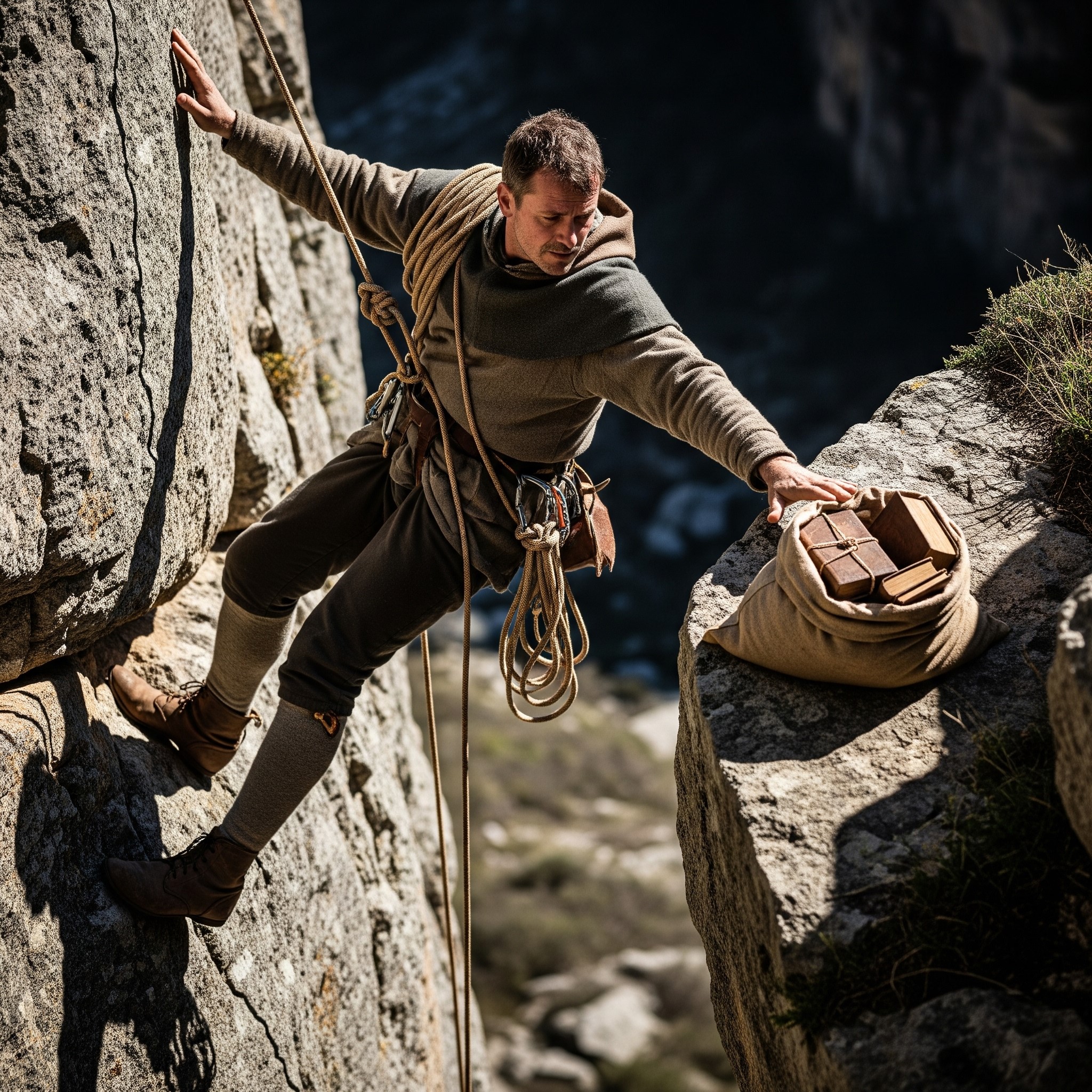
    “Books!” muttered Bryan. “I’m hanging from this rope to get books.”

    Bryan was a professional caravan guard, used to crossing these mountains with expensive cargoes. Generally, he expected substantial bonuses for ensuring the safe passage of his employer’s goods. The bonuses were guaranteed by the sale of the expensive cargo.

    But times were hard, and fewer and fewer caravans crossed the mountains, and bonuses were smaller and smaller. If it weren’t for that, he would never have taken employment with a woman. She’d said her cargo was valuable, and she’d offered good rates—exceptionally good in these poor economic times. As a result, Bryan was leading a team of half a dozen guards guarding a train of mules loaded with bags and boxes.

    Then in the worst part of the pass a mule’s load had slipped, and one of the bags came loose. It was incompetent cargo handling, or perhaps even an attempt to sabotage the train and allow a robbery. But he couldn’t convince Lady Ilra of the danger. He couldn’t convince her that her life and the rest of her possessions were more valuable than a single sack of goods.

    He had even asked her what she would have done if the bag had fallen all the way into the canyon. “Use a longer rope,” had been her quick answer.

    So here he was, most of a rope length down the cliff, desperately trying to manage the rope and grab the sack that was lying on the ledge. Then through the partially loose mouth of the sack he identified the contents. Books! Each carefully wrapped in what looked like water resistant, oiled paper.

    His first impulse was to shove the sack off the cliff and let it fall the rest of the way. But then he looked up to the point where his rope ended on the path, and she was looking down at him. She was a small woman, easy for him to defeat, he assumed, but she was up there, and he was down here, and she was holding a dagger. The message was clear. Send the sack up on the second rope, or I’ll cut the one you’re hanging from. He could only hope she meant that he’d be forced to take an additional length of rope and recover the books from the canyon floor.

    So he carefully arranged himself so that he could hang from the rope and secure the sack, then tied it to the second rope. To add insult, she pulled the sack of books all the way up first, and only then allowed his men to bring him to the top of the cliff. It was humiliating to do this at a woman’s command, but it was insufferable to do it for books.

    As they reloaded the mule, watching the cargo-master secure the load correctly, two of his men whispered in his ear.

    “We’ve figured out that we are guarding books,” they said. “We’re agreed that we shouldn’t have to risk our lives for that.”

    “We need the money,” he pointed out.

    “Well, we can kill her, dump the books, and keep the money she has already paid. We only have her word that there is any more money awaiting us at the end of this journey.”
    “Very well, I’ll demand double our pay, and when she refuses, we’ll dump her. That will provide a good story for any future caravan.”

    Ilra had watched the men very carefully, but subtly, and she fully expected what was about to happen.

    “The men are not happy to be guarding books,” said Bryan.

    :”What difference does it make to you, so long as you are paid?”

    “That’s just it. How do we know we will be paid? We assumed you had a valuable cargo, and that would assure our payment when sold at the end of the journey.”

    “I have the money ready for you at journey’s end.”

    “That’s not enough.”

    “Oh? You demand double your pay, and half of the extra now.”

    Bryan tried to hide his surprise at her accurate guess. Why hadn’t he thought of demanding half of the extra pay now?

    “For double the pay, we’ll guard your books, humiliating as it is.”

    She didn’t so much stand, as spring into a standing position, with a rapier in her hand. “You really should have thought of asking for half your extra pay immediately,” she said. “You really aren’t very bright.”

    He reached for his sword, stung by the insult, angered at the way she intimidated him. How stupid could she be thinking that a woman 5′ 2” with a rapier could fight someone 6′ 1” and more than double her weight—all of his muscle!

    There was movement, so quick he wasn’t certain what had happened. His hand stung, and in surprise he lost hold of his sword. It clattered to the ground and came to a stop, precariously perched on the edge of the path. He was disarmed. By the time he realized that, her rapier was at his throat.

    The men behind maneuvered for position, but it was simply not possible to edge by the two leaders in order to join the fight. It was between Bryan and Ilra.

    “For what I paid you,” said Ilra, “you will guard my books across the mountains. For your stupidity, you forfeit the second half of your pay, but I may, just may restore it if you do an exceptional job the rest of the way.”

    “But lady, why take all thjs risk for books?”

    “You think my books are useless, do you?”

    “You can’t eat them, you can’t sell them. I’m a practical man. I like things that work.”

    “Interesting, then, that you are standing there unarmed, while I, a woman and a bookworm have you at my mercy. One might almost think I was the more practical person!”

    “Let’s see,” she continued. “I knew what you were going to propose because I know how to read lips, a technique I learned from a book. It’s loaded on the left hand side of the fourth mule. I know where it is by a memory technique I learned in another book, this one on the right hand side of the fifth mule.”

    “You are disarmed using a technique I learned from another useless book, designed to teach people who are smaller than average techniques that give them the advantage over large boneheads such as yourself. You believe that I will be unable to sell any of my books, and most of them I don’t actually want to sell, but some of them I do. I know who will pay for them, and how much, because of information I found in another one of those useless books. One of those bags of books toward the rear is worth about 5,000 silver crowns at our destination.”

    “But I also have an arrangement with a banker there so that I have much more at my disposal than the miserable pittance I’m paying you for this passage even without selling any books.”

    “Most importantly to you right now, however, is the fact that another book back there teaches one techniques with the rapier. I could, of course, simply drive the rapier into your throat and you would fall dead. You think your men would then kill me, but because I’ve spent my time reading stupid, worthless books, I know better. Instead, I could do this—she removed a button from his shirt right over his heart with a flick of the rapier—and with a slight modification you would be bleeding to death. That weapon belt, which bears the throwing daggers you’re hoping to reach for is easily dealt with as well.” With a another flick the belt was cut through and fell to the ground.”

    “My question is this,” she said. “Would you rather die here and now, or would you rather guard this train the rest of its way to its destination and recover your pay?”

    Fighting fury and terror in equal measures Bryan grated out, “I’ll see to it that you make it.”

    “I know what you’re thinking. You’re thinking you’ll catch me asleep and kill me later. But another book back there has taught me about traps and alarms—deadly traps. Do you know that I know how to make at least 15 different poisons with materials we have with us, each of which could kill you and all your men?” It was her first lie, but it was a necessary one.

    “We’ll serve you well, lady,” said a defeated Bryan.

    And the caravan of useless books moved on through the mountains.

    Copyright © 2007 Henry E. Neufeld

  • Book: Maelstrom

    I begin to realize that this blog has been around for some time and isn’t just my little idea from a couple of days ago when I prepare to write a note on the second book in a series for which I blogged about the first book.

    I like Anne McCaffrey, and to a lesser, but still quite great extent Elizabeth Ann Scarborough. Their second book in The Twins of Petaybee series is available, and is titled Maelstrom (The Twins of Petaybee, Book 2).

    I look at this book very much like the first. It is lighter than the Dragonrider series, and I don’t find the cultural background anywhere near as interesting, but the characters are engaging, and the story is fun. That’s a lot to recommend a book, especially since I look for books to read when my mind wants to rest rather than be challenged. I’m glad there are books that fit the bill.

    As long as you don’t demand sophisticated politics or advanced military strategy, and also as long as you can enjoy a story where the key players are children, you’ll likely enjoy this. I would warn the unwary that this second book takes the tranditional trilogy view and leaves you in a tough place. I knew it was going to happen as I read and saw the number of pages remaining–they didn’t resolve a number of conflicts. That, of course, is promising for next time, but annoying for those who don’t really like unfinished series all that well.

  • Book: Innocent in Death

    OK, it’s another book. I’ll get around to writing another story or something soon. That’s what you were waiting for, right? No? I’m so disappointed!

    Anyhow, my wife brought home another J. D. Robb, and I had to read it. It’s pretty good. In this most recent book, Eve gets to feel her dislike of schools as she deals with murders that occur in a school. At the same time she’s dealing with jealousy over Roarke, but is it justified? Everything seems so confusing until she follows an unlikely track and fights her way through to the conclusion. Oh, and is it possible she’s making a truce with Summerset?

    This continues the interesting future world, and all the very interesting characters with which Roberts/Robb chooses to populate it. It’s honestly not my usual fair, because I find near future science fiction a bit troubling. Even Star Trek has been made somewhat obsolete by the advancement of actual science, but that’s part of the game. Near future seems to get me comparing the technology then and now more carefully, so even though it should be easier to be accurate, I’m more likely to quibble. Of course, I’m just as likely to be wrong.

    In any case, I find the cultural background of this series believable and enjoyable. I’ll continuing borrowing the copies my wife gets from the library on a pretty regular basis.

  • Book Series: Starwolves

    I was looking over a few of the older paperbacks in my library, and I enjoyed a bit of time with this series, so I thought I’d mention it here. Thorarinn Gunnarsson is one of the authors I enjoy as light reading, and Starwolves is one of her series that I enjoyed. Those who enjoy serious military fiction will not be overly excited by the battles and history in this series (I’m not), but the personalities are interesting and the stories are fun.

    You can still find copies around on Amazon.com, though in many cases only used. It is quick reading for when you want to rest your mind. I also have found her other Magic Words series interesting on the same basis. It’s not deep and serious, but light, fun, and humorous. I enjoy that type of reading for a certain percentage of the time.

    I think many readers would enjoy a detour into Gunnarsson’s fun writing.