
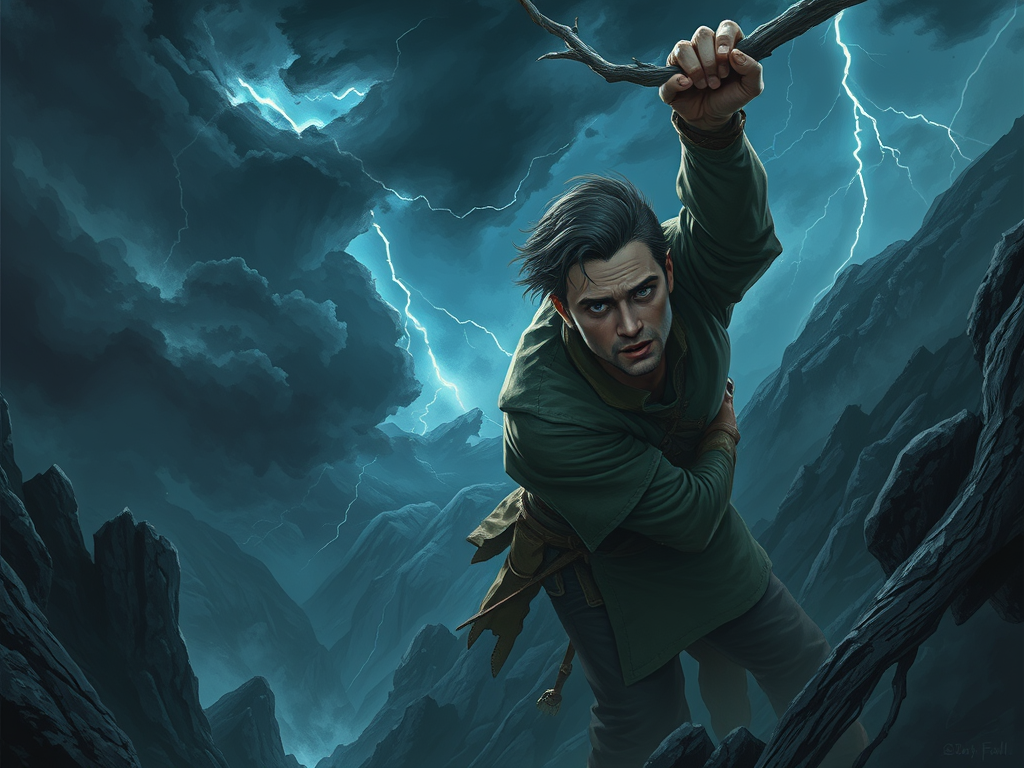
Clinging to the branch he’d grabbed, fighting for breath and focus, and looking at the blackness below him, Jack realized he really should have been afraid to walk through the mountain pass at night, with a storm brewing, after a night of drinking at the bar.
Category: Short Stories
-
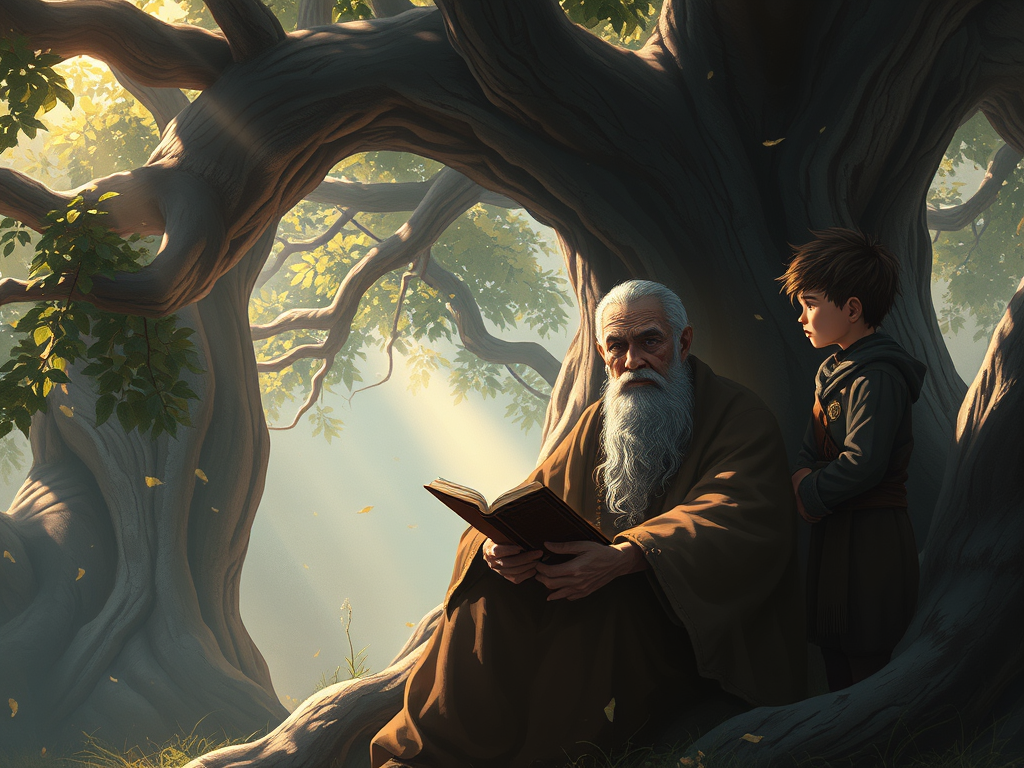
The Wrong Story
Jared waited, somewhat impatiently.
The old story-teller sat very still and seemed to be staring off into the distance.
The longer the old man stared, the more nervous Jared became. He remembered the words. “The old story-teller has never given his blessing to anyone on their first try.” But Jared had listened carefully to every story. He’d talked to any listener who would tell him why they went to hear the old story-teller. He knew he had all the elements.
After an interminable wait, the old man spoke. “What I am wondering,” he said quietly, “is where are you?”
Jared just stood there. He couldn’t find any words. He couldn’t understand the question, and he thought he should. He wondered why he knew there was a meaning just beyond his grasp.
Then suddenly it came to him. Such a common way of thinking it, but it simply came to him. He wasn’t overwhelmed. No light came from heaven. He doubted even that his face showed what had happened. He knew what was missing.
“Master,” he said. He had never addressed this man as “master” before, but it just came out now. “I am the man who carelessly ran across the log that spanned the creek. I fell in, and I died. Yet I did not die.”
“I am the man who wandered aimlessly, asking stupid questions, only to find out that he had wasted hours and hours, and his goal was beyond his reach.
“I am the man who came to the test, and never even knew what the test was. I am a failure, yet here I am.”
“You were a failure. Were. You are a story-teller.”
-

Two Christmas Stories
I’m making two earlier Christmas stories from this blog sticky and linking them here. I may manage to write a new Christmas story, but these two have been on my mind today.
There are at least two ways of going off the rails with charity. One is becoming a scrooge–a stick in the mud, miserable person who can’t celebrate. The other is to become so charitable that you miss important things at home.
How Scrooge Got It All Wrong tells a different story of Scrooge than you’re used to, but one that leads more logically to the way Christmas is celebrated today.
Not a Christmas Carol tells the story of a woman who is so charitable she doesn’t have time for her daughter’s needs.
-

In One Sentence: Nothing to Be Thankful For
“I don’t see where I have anything to be thankful for,” said the 95 year old man grumpily as he trimmed roses in the garden of his suburban home, and looked across the yard at his wife.
(Featured image generated by Jetpack AI.)
-

But I Didn’t Order It
“We’re here to install your new Complete Health Solution,” announced the cheerful voice.
“But I didn’t order any such thing,” said the old man.

“You didn’t have to! This is all paid for by the Department of Health. There will be no cost to you, and you can pretty much forget doctor visits and taking medications.”
“But I didn’t order it,” said the old man, again.
“You didn’t have to!” Less cheerful now. “The Department of Health orders it for you. They pay for it. We install it. It makes your life better.”
“But I didn’t order it.”
“Please listen to me! You don’t have to order it. It’s provided to you free of charge. You don’t have to pay a thing or do anything. I install it. It makes your life better.”
“I am listening to you, but I didn’t order that thing.” The voice was very steady for an angry man past 100 years old.
“Listen, please! Ordering doesn’t matter. It’s yours, courtesy of the Department of Health. It monitors your vital signs, looks for medical problems before they happen. It puts any required medications into your food and water for you. It does everything! It’s a wonderful machine. Now just sit down over there in your recliner while I install it for you.”
“But. I. Didn’t. Order. It. Since you’re obviously mentally impaired, that means I. Don’t. Want. It.”
There was silence for a few moments.
“But it’s good for you! It’s a wonderful gift the Department of Health is just giving to you. Companies that make pills and pharmacies that dispense them will soon be a thing of the past. All your medication will come through one of these machines. You won’t have to worry about taking pills ever again.”
“I don’t take any pills. I didn’t order it.”
“Well, we’re providing it to you in any case. Please, just sign right here acknowledging acceptance of this wonderful gift.”
The old man looked at the text on the tablet screen. He read it carefully. He wondered if the cheerful installer had ever actually read the text, of if he just handed it out expecting a signature.
“I didn’t order it. Therefore, I won’t sign for it.” He handed the tablet and stylus back.
“But you can’t do that!”
“Actually, I can. Read it yourself. I didn’t order it. I won’t sign for it. I don’t want it.”
“If you die, it’s all your fault!” Not cheery any more.
“So true, young man, so true.” And the old man grinned.
(Featured image generated by Jetpack AI, in an ironic twist, considering the topic.)
-

Traversing the Pass of Demons
The itinerant storyteller was old and gray, but while they showed the wear of travel, is clothes were of good quality, and he carried a sword and bow that were much above the average in the village. Such was expected of a successful storyteller.
So there was a huge fire that night in the center of the village, along with a fine feast, and a certain amount of beer, one of the products of the town. With the certainty of a law of nature, the visiting storyteller was invited to tell a story.
The children gathered near the old man, while the youth and adults crowded around, pretending they were less interested, but making sure they could hear.
“It is well-established that nobody can go through Entehrenac, which you may know as the pass of demons, during the months of winter,” he began.
He paused, waiting for a response. “Of course,” said an older boy. “Everybody knows that.”
“It is possible,” said the storyteller, “for everybody to be wrong.” There was a gasp from the crowd. This sounded like a dangerous statement. But storytellers were given great latitude in their culture. Besides, if this man would break with custom, the evening would be far more interesting than normal, say, if the storyteller told a traditional tale demonstrating the importance of living according to tradition and the decrees of the town elders.
“Long ago, so long ago that I had not even been born, a young woman lived with her family in a village just south of Entehrenac. Her name was Imeril. She was in her mid-teens and was a very unremarkable girl. She kept to herself mostly, other than helping her mother keep their house and care for younger brothers and sisters.
“Her father was a rich man. Some said this was because he was blessed by the gods. Others said it was because he was just plain lucky. Some admitted he had a way of finding gems and gold nuggets in the streams around their town. But others said he was a violent man and a thief, and that his riches were the result of theft, but nobody had been able to prove anything for years.
“Then one day an accuser arrived to claim that Imeril’s father had entered his house when he was not there, robbed him of gems he had stored there, and assaulted and killed his wife.
“The people gathered around the town shrine — it was much too small of a town to have a temple to any particular god — and the town priest, was asked to consult the gods. Nobody actually recalled how the man had become a priest, nor anything miraculous he might have accomplished, but it was well established,” the storyteller paused here for a moment, “that he was a priest and could, at need, determine truth.
“The priest required the sacrifice of a goat, which he examined carefully, and also rattled some bone dice around and read them with a knowing look on his face. Then he announced that the gods had spoken clearly in multiple ways, and they, the gods, declared Imeril’s father guilty as a murderer, thief, and also a rapist.
“Some further augury was required, this time costing two chickens.”
At this point some people noticed that the local town priest was looking frightened. Well, perhaps it was blasphemous to say the priest was frightened. Even in their thoughts, people changed that to “concerned.”
As well he should be! This way of describing priestly rituals was likely to cause people to question the value of the village priest. If they did that, they might question his rulings. If the did that, they might question the gods themeselves!
But the storyteller continued.
“Once the entrails of the chickens had been duly examined, and the dice again rattled and rolled, the priest announced the sentence. ‘This man and his entire household must be burned alive in the town square so as to cleanse our village of this evil.’ Some of the people were disturbed, wondering how it could be that a man they had known all their lives, even if they hadn’t really liked him, could be so evil that his sin must be expiated in such a dramatic and nasty fashion.
“But most of the villagers considered that the proper forms had been followed, and that the gods must have spoken, and almost immediately set about seizing the convicted man, his family, and even his slaves, of which he had two. The priest informed them that they were to create a huge bonfire just outside the town and burn the man and his household alive. This was, he told them, the will of the gods and what was required by tradition.
“Now Imeril, as a girl child, was supposed to be waiting for the results at home. In fact, a guard had been left to make sure nobody could escape, or, more importantly, carry out any valuable items from the house. She was certainly not supposed to hear the ceremony.
“But Imeril, though often quiet, was intelligent and observant. She thought this was not going to go well. She packed some things that might be needed in order to run, just in case, and then she took her six-year-old brother, a favorite of hers, climbed out a window in the back, and found a hiding place from which she could observe.
“It is, I must add, a very bad comment on the guard that she could do this. It says something about how alert the village people were that she could observe and listen with nobody noticing. It says something about the trust of a little brother that said brother remained totally quiet.
“When the verdict had been rendered by the priest, Imeril took her little brother, went to where she had hidden her supplies, and fled the village. It was winter, though spring was near. She decided the safest option was to go through Entehrenac, despite its reputation as the pass of demons, and the established fact that nobody could go through the pass in winter.
“It was perhaps, though not certainly, unfortunate that she was not as good at hiding her tracks as she had been at the other parts of her plan. A girl was not expected to learn how to travel quietly through the mountains while not leaving a trail.
“The people of the town gathered the household into the town square. Some of them were hesitant, but it only took a few mentions of the curse of the gods if they didn’t do precisely as those gods demanded to shut them up. The mob was getting quite stirred up enough to burn an entire household alive.
“Then suddenly someone noticed that Imeril was missing. They must have the entire household! If anyone escaped, the town would be under a curse. Nobody was sure whether the priest started this story, but he certainly agreed to it when asked.
“So a group of men from the village grabbed their hunting bows and hunting knives–swords were unknown in that village–and they proceeded to hunt for Imeril and the little boy. They almost missed some of the obvious clues that Imeril had left due to her complete lack of experience at traveling through the forest.
“Soon they realized that she was headed for Entehrenac. There was some discussion. But in the end, they decided they had to continue. After all, it takes considerable anger–real or contrived–to decide to burn an entire household.
“Imeril was well up into the pass by the time they caught up enough that she noticed them. While she was inexperienced, she was in good shape, and she moved fast. She was, I must add, very much motivated!
“She could tell that her pursuers were gaining on her, even though she was pretty sure they hadn’t noticed her yet. She was also slowed by the burden of a six-year-old child. She never considered leaving him behind.
“Then she saw her chance. There was a rock, the remnant of an earlier rock slide, that was near the edge of the path, which looked like it was about to fall in any case. Using a handy branch, she set about to send it over the edge to the trail behind her, which meant ‘below’ as well, to stop her pursuers. She was really thinking of blocking their path.
“But rocks in mountain passes that are subject to avalanches may have unexpected effects–never forget that should you be in a mountain pass–and it was just at the start of spring. The rock went over the edge almost as soon as she touched it with her branch, and it bounced against several other rocks and trees. At the end, it hit a log that was the last thing holding back tons of snow, rocks, and dirt, and set off a spectacular avalanche.
“The ground shook, and Imeril thought they would be carried away. In fact, the path a hundred feet behind her disappeared, but the path where she was and ahead of her remained in place. When the noise and shaking stopped, she could see nothing of her pursuers.
“She nearly died from cold crossing the rest of the pass, but a teenage girl emerged, barely alive, to find refuge with a farmer. The people on the north side of the mountain, as you know, are generally farmers.”
The storyteller paused, and let some of the children work themselves up to say, “Don’t stop there!”
Some of the adults hoped he would. They wished he had never come to town. Good stories were supposed to reinforce obedience and good behavior. Sure, the sentence had been harsh, but if people started arguing with the gods, where would it end?
But the storyteller was not finished.
“A few weeks later, some of the regular summer merchants got together the first expedition to go south through the pass. There they would bargain with the mountain dwellers for gold, silver, and gems. The first passage was always difficult, often requiring making new sections of trail, especially if there had been particularly bad avalanches.
“The merchants had heard of the girl who came out of the pass, but she had hired on with a merchant caravan weeks before, and besides, most of them didn’t believe she had come through the pass at all. It was an established fact that that was impossible.
“So they traveled through the pass, and they came to a place where they could see signs that the a stream had been blocked by an avalanche and then the blockage had been removed when enough snow and ice had melted. It looked bigger than any such catastrophe they had seen before, but they didn’t really understand just how big.
“Not until, that is, they got to where the village had been. That village was simply gone. They found just a few remains that might have been part of a village, but they might have missed them if they hadn’t been looking diligently.
“When word of this got back to people who had heard Imeril’s whole story, there were quite a number of explanations.
“Some people believed that Imeril’s father had been falsely accused, and thus the village had been cursed, and Imeril had miraculously survived.
“Others thought the village had been cursed by their carelessness in allowing someone under the condemnation of the gods to escape punishment.
“Others maintained that the entire story was made up.
“There were a few oldtimers who said, ‘Why do we need to invoke the gods? That’s the way villagers, village priests, mountains, snow, avalanches, and floods work. It’s a tough universe.’
“Imeril’s brother became rich and famous and is known as Galdor the Sailor.
“Imeril always tried to reenforce the first option, that her father had been falsely accused. It was the one that had kept her alive.
“But when I was old enough to understand my mother told me that was all nonsense. ‘Your grandfather was indeed a murderer, thief, and rapist. I escaped because I knew that, and assumed the gods would declare him guilty.”
It was a good thing the storyteller had such a good sword and knew how to use it.
This story is a work of fiction. Any resemblance to any persons in the real world is strictly coincidental. Copyright © 2024, Henry E. Neufeld. The featured image was generated with Jetpack AI.
-

In One Sentence: In Your Nanotech
“Your body maintenance nanotech package has been infected by a virus,” said the laughing voice via my virtual reality streaming implant, as I gasped for breath and felt my consciousness slip away.
(In a possibly ironic twist, the featured image was generated with AI.)
-

In One Sentence: Meeting in Heaven
The moment Andrew laid eyes on Jake’s smiling face he knew that life in heaven would be hell for him, knowing that depraved sinner was there as well.
-

In One Sentence: An Improbable Asteroid
As Ferdinand looked at the calculated path of the approaching asteroid, he suddenly was convinced that “improbable” and “impossible” were truly not the same thing.
(Featured image by Alexander Antropov from Pixabay, with help from clipart by (monsterbraingames on openclipart.org.)
-

So Dark, So Cold
I run my fingers over the incised lettering on the sign.
At least I think it’s incised lettering.
I think it’s a sign.
It’s hard to tell if I really have fingers.
It’s dark and it’s cold. At the last sign, I thought the number was a nine. If it was, I missed one mile marker.
Or maybe it wasn’t there. How can I be sure? It’s so hard to remember. I’m so cold.
Around the eighth mile marker you should see a light, below you, down the mountain.
I thought I saw the light, but I never found the marker. Then the trail turned off to the right, and I lost sight of it. Right now, it’s hard to remember what light is.
The goal is mile maker five, where there’s a farm house, a telephone, access to emergency services. Someone to go back and help my companion more than ten miles back in these mountains.
He’s the one who said there was a path, who told me about the mile markers, who said I’d see a light.
I reach out my fingers to the mile marker, but I can’t really see it. I reach out my fingers. Or I think I’m reaching them out. It’s hard to tell. I can’t tell if it’s a sign or a tree.
What should I do?
Go until you see the light. Keep going until the light is directly to your left. You’ll find the driveway.
The light is just a promise. A promise from someone who has been this way before.
Just a promise.
But it’s a promise from someone who knows the way.
I turn back to the trail, or at least where I think there’s a trail. I put out one foot and take a step.
No matter how dark, or how cold, keep looking toward the light.
There it is, just above that ridge.
There is a light.
Featured Image Credit: Adobe Stock #296811018 Licensed, not public domain.
This is a work of fiction. Any resemblance of any event or character to those in the real world is coincidental. Copyright © 2020, Henry E. Neufeld